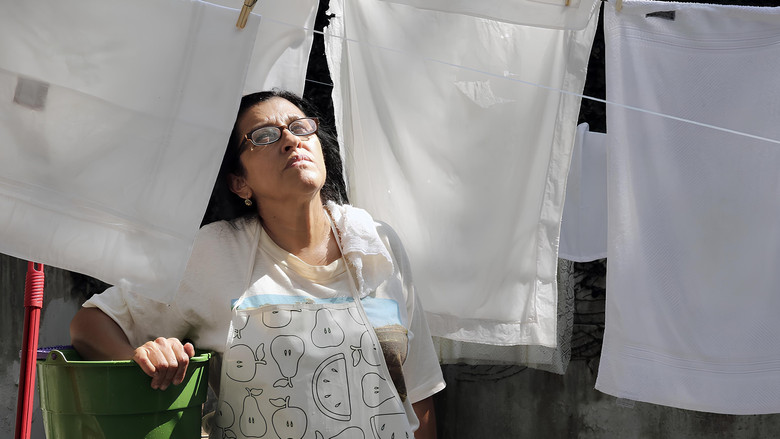

The Second Mother
A poignant social drama that simmers with quiet rebellion, visually framed by the invisible lines of class that divide a Brazilian home.
The Second Mother

The Second Mother

Que Horas Ela Volta?

04 June 2015 Brazil 112 min ⭐ 8.0 (756)
Director: Anna Muylaert
Cast: Regina Casé, Camila Márdila, Karine Teles, Lourenço Mutarelli, Michel Joelsas
Drama
Social Class and Inequality Motherhood and Family Generational Conflict and Social Change

Overview

"The Second Mother" tells the story of Val (Regina Casé), a live-in housekeeper who has spent 13 years raising her wealthy employers' son, Fabinho (Michel Joelsas), in São Paulo. She has left her own daughter, Jéssica (Camila Márdila), to be raised by relatives in her hometown. The carefully maintained, unspoken social barriers of the household are thrown into disarray when Jéssica arrives to take her university entrance exams.

Jéssica's confident and unapologetic refusal to accept the subservient role her mother has always occupied creates tension and discomfort, challenging the family's liberal self-image and forcing Val to re-evaluate her own life and choices. The film delicately explores themes of class, motherhood, and the changing social landscape of modern Brazil through the microcosm of this one household.


Core Meaning

The central message of "The Second Mother" is a critique of Brazil's deeply ingrained class structure and the invisible walls it creates. Director Anna Muylaert wanted to explore the undervalued and often invisible work of domestic helpers and nannies, who sacrifice relationships with their own children to care for the children of the wealthy. The film questions the notion of family, contrasting the biological ties of a distant mother-daughter relationship with the affectionate, yet transactional, bond between a nanny and her charge. Ultimately, it is a story about the awakening of self-worth and the possibility of social mobility in a new generation that refuses to accept the old hierarchies.

Thematic DNA

Social Class and Inequality 40%
Motherhood and Family 35%
Generational Conflict and Social Change 25%

Social Class and Inequality

This is the film's most prominent theme, illustrated by the physical and psychological spaces within the house. Val is confined to the kitchen and her small room, while the employers occupy the rest of the luxurious home. Jéssica's arrival shatters these unspoken rules; she eats at the main table, stays in the guest room, and uses the swimming pool, causing palpable tension. The film scrutinizes the hypocrisy of the employers who call Val "family" but are horrified when the boundaries of servitude are crossed.

Motherhood and Family

The film presents a complex portrait of motherhood. Val is a loving, present mother figure to Fabinho, whose own mother, Bárbara, is emotionally distant. Conversely, Val is an absent mother to Jéssica, a source of deep resentment for her daughter. The title itself, "Que Horas Ela Volta?" ("What Time Is She Coming Home?"), is a question both children could ask about their respective mothers. The film forces both Val and Bárbara to confront their maternal shortcomings.

Generational Conflict and Social Change

The clash between Val and Jéssica represents the collision of two different Brazils. Val has internalized the rules of deference and subservience required for her survival. Jéssica, representing a younger, more educated generation, believes in equality and refuses to be a "second-class citizen." Her ambition to attend a prestigious university symbolizes the potential for upward mobility and a disruption of the old social order.

Character Analysis

Val

Regina Casé

Archetype: The Caregiver
Key Trait: Loyal

Motivation

Her primary motivation for decades has been to provide a better life for her daughter, even at the cost of their relationship. She is also motivated by a deep-seated affection for Fabinho and a sense of loyalty and duty to her employers.

Character Arc

Val begins the film completely subservient to the family she serves, having accepted her role as a "second-class citizen." The arrival of her daughter forces her to confront the sacrifices she has made and the quiet indignities she suffers. Through Jéssica's provocations, Val undergoes a gradual awakening, culminating in her decision to quit her job and prioritize her own family, reclaiming her self-respect.

Jéssica

Camila Márdila

Archetype: The Catalyst / The Rebel
Key Trait: Confident

Motivation

Jéssica is motivated by ambition and a strong sense of equality. She wants to succeed in her university entrance exams to become an architect and refuses to be defined or limited by her mother's social position. She also desires a real relationship with her mother, but not one based on the existing master-servant dynamic.

Character Arc

Jéssica arrives as a confident, intelligent, and somewhat resentful young woman, determined to pursue her education. She doesn't change fundamentally, but her presence acts as a catalyst for change in everyone around her. She forces the family to confront their own prejudices and awakens her mother's dormant sense of self-worth. Her arc is one of asserting her identity and, by the end, beginning to mend her relationship with her mother on new, more equal terms.

Bárbara

Karine Teles

Archetype: The Gatekeeper
Key Trait: Controlling

Motivation

Bárbara is motivated by a need to maintain control over her household and her social status. She is protective of the privileges her family enjoys and feels threatened by Jéssica's intelligence and refusal to be subservient. She also feels a sense of maternal inadequacy and jealousy.

Character Arc

Bárbara is the matriarch and a successful professional who maintains the household's strict social order. Initially, she presents a veneer of liberal kindness. However, Jéssica's presence exposes her deep-seated class prejudice and jealousy over Val's bond with her son. She becomes increasingly hostile as her authority is challenged, revealing the fragility of her progressive self-image. Her arc is one of regression, as she clings tighter to the social hierarchies when they are threatened.

Fabinho

Michel Joelsas

Archetype: The Innocent
Key Trait: Affectionate

Motivation

Fabinho is primarily motivated by a need for comfort and affection, which he receives from Val rather than his own parents. He seeks an easy, comfortable life and is not particularly driven academically.

Character Arc

Fabinho starts as a somewhat spoiled but sweet-natured teenager who is emotionally dependent on Val. He exists in a bubble of privilege, largely oblivious to the class dynamics his mother enforces. Jéssica's arrival introduces a new dynamic, and his failure in the university exam, contrasted with her success, serves as a wake-up call, forcing him to confront a reality where effort matters more than status. He decides to travel, suggesting a step towards independence and maturity.

Symbols & Motifs

The Swimming Pool

Meaning:

The pool is the most potent symbol of social apartheid and privilege in the household. It represents a space of leisure and ownership that is strictly off-limits to the domestic staff.

Context:

Val has never set foot in the pool, despite caring for Fabinho in and around it for years. When Jéssica nonchalantly uses it, it is a major transgression that leads Bárbara to have the pool drained, citing a fictitious rat sighting. Val's own cathartic moment comes at the end when she finally steps into the partially filled pool, symbolizing her liberation.

The Guest Room

Meaning:

The guest room symbolizes status and belonging within the family. Val is expected to house her daughter on a mattress in her own tiny servant's quarters.

Context:

When the patriarch, Carlos, offers Jéssica the guest room, it is the first major disruption of the house's social hierarchy. Jéssica's acceptance of the offer signifies her refusal to be relegated to the status of a servant's daughter.

Fabinho's Favorite Ice Cream

Meaning:

The special, expensive ice cream that Val serves only to Fabinho represents the subtle ways in which class distinctions are maintained through material goods and acts of service.

Context:

When Jéssica innocently helps herself to the ice cream, Val is horrified, explaining that it is reserved for Fabinho. Jéssica questions this logic, highlighting the absurdity of the invisible rules that govern her mother's life. The sharing, or not sharing, of food becomes a constant, subtle battleground of class.

The Coffee Set

Meaning:

The coffee set Val gives Bárbara for her birthday symbolizes Val's attempt to bridge the class divide through a gesture of generosity, and Bárbara's rejection of it reinforces that divide.

Context:

Bárbara's lukewarm reception and her refusal to use the "common" gift at her party is a moment of quiet humiliation for Val. At the end of the film, as Val leaves her job, she takes the unused coffee set with her, an act of reclaiming her dignity and the value of her own taste.

Memorable Quotes

Eu não me acho melhor que ninguém, Val. Mas eu também não me acho pior.

— Jéssica

Context:

This is said during a heated argument between Jéssica and Val. Val accuses her daughter of acting superior and not knowing her place, and Jéssica's response calmly refutes this, framing her actions not as arrogance, but as a simple assertion of her own equal worth.

Meaning:

Translated as, "I don't think I'm better than anyone, Val. But I don't think I'm worse either." This line is the cornerstone of Jéssica's philosophy and the film's central conflict. It perfectly encapsulates the generational shift from acceptance of social hierarchy to a demand for basic equality and self-respect.

Parece que tem gente que já nasce sabendo o que pode e o que não pode fazer.

— Val

Context:

Val says this to Jéssica as she tries to explain the unspoken rules of the house. She is frustrated and bewildered by her daughter's inability to simply understand and accept the invisible lines that Val has navigated her entire adult life.

Meaning:

Translated as, "It seems some people are born knowing what they can and cannot do." This quote reveals Val's deeply internalized sense of social hierarchy. She believes that class boundaries are a natural, innate part of life's order.

Philosophical Questions

What defines a family: biological ties or the labor of love and care?

The film constantly juxtaposes Val's deep, maternal bond with Fabinho against her estranged relationship with her own daughter, Jéssica. It also contrasts this with Bárbara's biological but emotionally distant relationship with her son. It forces the viewer to question whether the daily acts of nurturing, comforting, and raising a child are more formative of a parent-child bond than blood relations alone.

Are social hierarchies a natural order or an artificial construct that can be dismantled?

The film explores this question through the opposing worldviews of Val and Jéssica. Val believes class divisions are an innate reality one is born into, a set of unspoken rules that must be followed for social harmony. Jéssica challenges this notion at every turn, acting as if these rules do not exist. Her success in the end suggests that these constructs are indeed artificial and can be overcome through ambition, education, and a refusal to accept a subservient position.

Can affection and care be commodified without consequence?

Val is paid to be a housekeeper and nanny, but the emotional labor she provides for Fabinho goes far beyond her job description. The family gets the benefit of her genuine love and affection, which they cannot seem to provide themselves. The film examines the emotional cost of this transaction, both for Val, who sacrifices a relationship with her own daughter, and for Fabinho, who is closer to the paid help than his own mother.

Alternative Interpretations

While the film is largely seen as a triumphant story of empowerment, some critics have offered alternative readings of the ending. The final scene reveals that Jéssica now has a young son of her own, and Val steps in to care for him while Jéssica works. Some interpretations view this as a somewhat pessimistic cycle, suggesting that despite her education, Jéssica may be repeating her mother's pattern of relying on a "second mother" to raise her child.

Another perspective focuses on the character of Carlos, the patriarch. While he appears more sympathetic to Jéssica than his wife, his interest can also be interpreted as predatory and a subtle exercise of patriarchal power. His offer of help and his eventual marriage proposal are seen by some not as kindness, but as an attempt to possess and control the intelligent young woman who has entered his domain.

Cultural Impact

"The Second Mother" was released at a time of significant social and political change in Brazil. The country had seen over a decade of policies under the Workers' Party that expanded access to higher education and improved the economic standing of the working class. The film perfectly captured the anxieties and tensions of the established middle and upper classes as these changes began to blur traditional social lines. It resonated deeply with Brazilian audiences, sparking widespread debate about class, servitude, and the legacy of slavery in modern society.

Internationally, the film was a critical success, winning awards at Sundance and the Berlin Film Festival. Critics praised it for telling a culturally specific story with universal themes of family, ambition, and inequality. The film was selected as the Brazilian entry for the Best Foreign Language Film at the 88th Academy Awards, though it was not nominated. It has been hailed as a landmark of contemporary Brazilian cinema, offering a nuanced, character-driven critique of societal structures.

Audience Reception

Audience reception for "The Second Mother" was overwhelmingly positive, both in Brazil and internationally. Viewers praised the film for its powerful and nuanced storytelling, which managed to be both a poignant social critique and a heartwarming human drama. The performances, particularly by Regina Casé as Val, were singled out for their authenticity and emotional depth. Many viewers found the film's exploration of class dynamics to be both eye-opening and deeply moving. The humor woven throughout the narrative was also appreciated, as it made the serious themes more accessible.

A minor point of criticism for some viewers revolved around the ending. A few felt that the resolution, where Val ends up helping to care for her own grandson, was a bit too neat and potentially undermined the theme of breaking generational cycles by suggesting a repetition of the past.

Interesting Facts

  • The film's original title was "A Porta da Cozinha" ("The Kitchen Door"), which emphasizes the physical and symbolic barrier between the family and the staff.
  • Director Anna Muylaert was inspired by her own experience of hiring a nanny to care for her son, who had left her own child behind. The project was in development for nearly 20 years as she felt she needed more maturity to direct it.
  • Lead actress Regina Casé is a major television personality in Brazil, akin to Oprah Winfrey. Casting her as a subservient housekeeper was a deliberate choice to play with public perception and add another layer to the film's commentary.
  • To create a sense of authentic estrangement, director Anna Muylaert had Regina Casé (Val) and Camila Márdila (Jéssica) rehearse their scenes over the phone and separated by a black screen, never meeting in person until they shot their first scene together.
  • The screenplay was rewritten four times. Initially, the character of Jéssica was more of a cliché who wanted to be a hairdresser, but a consultant suggested that to truly break the cycle, she needed a more ambitious goal, which led to her wanting to be an architect.
  • Much of the crew, including the cinematographer Bárbara Alvarez and editor Karen Harley, were women. The director stated this wasn't intentional, but she simply hired the best people for the job.

⚠️ Spoiler Analysis

Click to reveal detailed analysis with spoilers

Frequently Asked Questions

Explore More About This Movie

Dive deeper into specific aspects of the movie with our detailed analysis pages

Comments (0)

Leave a comment

No comments yet. Be the first to share your thoughts!