
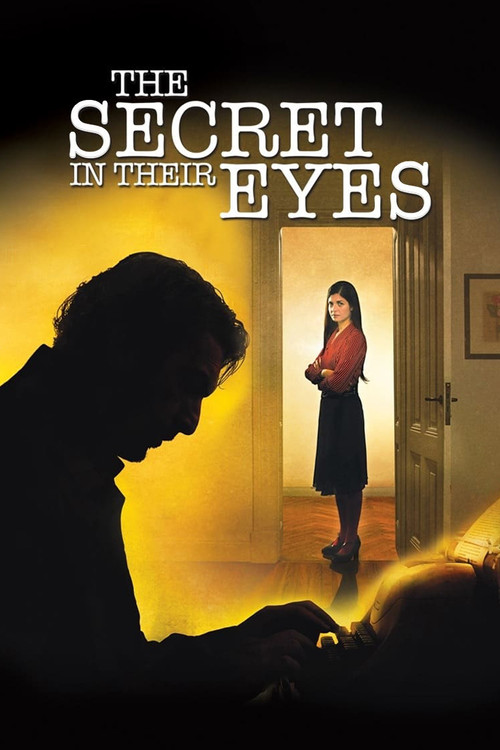
The Secret in Their Eyes
A haunting neo-noir thriller where the ghost of a past crime bleeds into the present, revealing that memory is a relentless detective and justice, a life sentence.
The Secret in Their Eyes

El secreto de sus ojos

"An unsolved crime. A love story. An unwritten ending."

13 August 2009 Argentina 130 min ⭐ 8.0 (2,702)
Director: Juan José Campanella
Cast: Ricardo Darín, Soledad Villamil, Pablo Rago, Javier Godino, Guillermo Francella
Drama Thriller Mystery Romance
Memory and the Past Justice vs. Revenge Unrequited Love and Regret Passion
Budget: $2,000,000
Box Office: $33,965,843

The Secret in Their Eyes - Ending Explained

⚠️ Spoiler Analysis

The central twist of "The Secret in Their Eyes" fundamentally redefines the film's exploration of justice and revenge. For 25 years, Benjamín Espósito and Irene Menéndez-Hastings believed that the murderer, Isidoro Gómez, had gotten away with his crime after being released from prison by corrupt officials. The audience is led to believe that the grieving husband, Ricardo Morales, has been living a quiet, empty life of sorrow in the countryside.

In the film's climax, Espósito visits Morales, who claims he tracked down and killed Gómez years ago. However, something feels amiss. Espósito returns to Morales's isolated property and makes a horrifying discovery: Morales did not kill Gómez. Instead, he has kept him imprisoned in a makeshift cell in a shed for a quarter of a century. The once-arrogant killer is now an aged, broken man who begs Espósito to have Morales at least speak to him. Morales's simple justification is that he promised Espósito he would ensure Gómez got a life sentence. Having lost faith in the state, he took it upon himself to be the judge, jury, and jailer.

This revelation makes it clear that Morales's obsession was not just with grief, but with a meticulously executed, lifelong act of vengeance. He has sacrificed his own freedom and life to administer what he considers true justice: not death, which he views as too quick an escape, but a life of complete nothingness. This ending elevates the film from a simple crime story to a profound moral tragedy. Espósito's decision to walk away without reporting Morales signifies his final break with the flawed legal system he served, and an implicit understanding—or even endorsement—of Morales's devastating private justice. It also provides Espósito with the closure he needs to finally confront his own past and profess his love to Irene, his own 'life sentence' of unspoken feelings finally coming to an end.

Alternative Interpretations

While the ending is narratively straightforward, its moral implications are open to interpretation. One perspective is that Morales's actions represent a form of ultimate justice in a world where the official system failed. He delivers the "life sentence" that the court was supposed to, creating a private, self-contained system of punishment. This reading sees his actions as a justified, if horrifying, response to unbearable loss and systemic corruption.

An alternative interpretation views Morales not as a dispenser of justice, but as a man who has become a monster himself, sacrificing his own life to tend to his hatred. In this view, he is as much a prisoner as Gómez. His action is not justice but an all-consuming revenge that has rendered his life empty, as Espósito's question—"How do you live a life full of nothing?"—implies. He hasn't found closure, but has instead locked himself in a perpetual state of torment, endlessly reliving his trauma by keeping its source alive.

A third reading focuses on Espósito's final reaction. By walking away and not reporting Morales, Espósito implicitly condones the act. This can be interpreted as his final disillusionment with the official law he once served, accepting that true justice sometimes operates outside of it. Alternatively, it could be seen as an act of pity and understanding for a man whose life was irrevocably destroyed, a recognition that Morales's fate is a tragic sentence of its own.