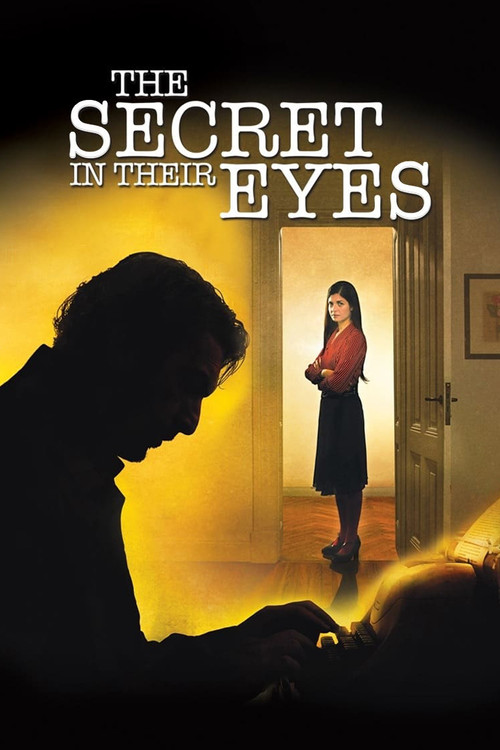
The Secret in Their Eyes
El secreto de sus ojos
"An unsolved crime. A love story. An unwritten ending."
Overview
"The Secret in Their Eyes" (El secreto de sus ojos) is an Argentine crime thriller that unfolds through a dual timeline. In 1999, retired federal justice agent Benjamín Espósito decides to write a novel about a brutal rape and murder case from 1974 that has haunted him for 25 years. This endeavor forces him to reconnect with his former colleague and unrequited love, Irene Menéndez-Hastings, now a judge, stirring up long-suppressed feelings and unresolved questions about the case.
As Espósito delves into his memories, the film flashes back to the 1970s, a time of political turmoil in Argentina. We follow the original investigation conducted by a younger Espósito and his brilliant but alcoholic partner, Pablo Sandoval. They relentlessly pursue the prime suspect, Isidoro Gómez, despite facing corruption and indifference within the justice system. The narrative masterfully weaves together the past and present, exploring the profound impact of the crime on everyone involved: Espósito, Irene, and most poignantly, the victim's devoted husband, Ricardo Morales.

Core Meaning
At its heart, "The Secret in Their Eyes" is a profound meditation on memory, justice, and the consuming nature of passion. Director Juan José Campanella explores the idea that the past is never truly gone and that unresolved trauma continues to shape the present. The film questions the official channels of justice, especially within a corrupt political system, and examines the lengths to which individuals will go to find their own form of closure. It posits that a person can change everything about their life except their passion—be it for another person, for a cause, or for revenge. This central idea drives the narrative, suggesting that these inescapable passions dictate our ultimate fates and define our lives, for better or for worse.
Thematic DNA
Memory and the Past
The film's non-linear structure emphasizes how memory shapes identity and the present. Espósito's attempt to write a novel is an act of confronting his past, not just the murder case but his unspoken love for Irene. The film illustrates how memories can be both a burden and a source of life, as seen in Ricardo Morales' daily ritual of remembering his wife to keep her alive in his mind. It suggests that one cannot move forward without reconciling with the past.
Justice vs. Revenge
"The Secret in Their Eyes" draws a stark contrast between the failures of the formal justice system and the pursuit of personal retribution. When the corrupt state releases a confessed murderer, the film forces the audience to question what justice truly means. The shocking final act reveals one character's decades-long act of private vengeance, blurring the lines between justice and a self-imposed life sentence, and asking whether such an act provides closure or merely perpetuates the trauma.
Unrequited Love and Regret
The simmering, unspoken love between Benjamín and Irene serves as the emotional core of the film. Their relationship is defined by missed opportunities and the regret of what could have been. The murder investigation becomes a proxy for their own unresolved story. The title itself, "The Secret in Their Eyes," refers not only to the clues that solve the crime but also to the silent communication of love and longing between them that is never fully articulated until the very end.
Passion
Sandoval's memorable line, "A guy can change anything... But there's one thing he can't change. He can't change his passion," serves as the film's thesis. This applies to every major character: Gómez's obsessive and violent passion for Liliana, Morales's passionate love for his wife that turns into a passion for vengeance, and Espósito's dual passions for Irene and for solving the case. The film argues that this core, unchangeable part of a person is the ultimate engine of their actions.
Character Analysis
Benjamín Espósito
Ricardo Darín
Motivation
His primary motivation is to find closure—for the unresolved murder case that represents a failure in his career and for the unspoken love for Irene that represents a failure in his personal life.
Character Arc
Espósito begins as a man haunted by the past, professionally and personally. His decision to write the novel forces him to confront his regrets, his cowardice, and his deep-seated love for Irene. By solving the final piece of the mystery, he finds the courage to close the door on his past fears and open a new one with Irene, transforming from a man living in memories to one ready for a future.
Irene Menéndez-Hastings
Soledad Villamil
Motivation
Her motivation evolves from upholding the law and maintaining professional decorum to a desire for true justice and, finally, a personal happiness that she had long suppressed.
Character Arc
Initially, Irene is a by-the-book, upper-class professional who keeps Espósito at a distance. Through the investigation, she reveals her own strength, conviction, and a hidden vulnerability. In the present, she is a successful but seemingly unfulfilled judge. Her arc is one of thawing; she moves from upholding the rigid structures of law and her personal life to finally acknowledging her feelings for Espósito and being willing to step into an uncertain future with him.
Pablo Sandoval
Guillermo Francella
Motivation
Driven by a deep-seated loyalty to Espósito and an intuitive, almost poetic, understanding of human nature, particularly the concept of 'passion'.
Character Arc
Sandoval is presented as a brilliant legal mind crippled by alcoholism. He appears to be a source of chaos but repeatedly provides the crucial insights that move the case forward. His arc is tragic; he achieves redemption not by overcoming his addiction but through a final act of loyalty, sacrificing his life to save his friend Espósito. His death is the catalyst for Espósito's decade-long exile.
Ricardo Morales
Pablo Rago
Motivation
His sole motivation is to ensure the man who destroyed his life suffers a punishment he deems fitting: not a quick death, but a life sentence of utter nothingness, mirroring the emptiness he feels himself.
Character Arc
Morales begins as a grief-stricken widower whose profound love for his wife is palpable. His initial faith in the justice system is shattered, leading him to disappear. His arc is the most shocking, as he transforms from a passive victim of a failed system into the active, long-term dispenser of his own brutal form of justice, dedicating his entire life to the punishment of his wife's killer.
Symbols & Motifs
The Typewriter / The Novel
Symbolizes the attempt to make sense of the past and impose a narrative order on chaotic, painful events. For Espósito, the act of writing is an act of confronting his own ghosts, both professional and personal.
The film opens with Espósito struggling to write the first line of his novel. The recurring image of the blank page and the clacking keys of the typewriter frame the entire narrative as an exercise in memory and confession.
The Train Station
Represents moments of departure, separation, and unspoken farewells. It is a potent symbol of missed opportunities and the irreversible passage of time, particularly in Benjamín and Irene's relationship.
The most pivotal scene at the train station is when Benjamín leaves for a decade of self-imposed exile. He and Irene share a longing, silent goodbye through the train window, a moment that haunts him for 25 years.
The Eyes
The eyes are the central motif, representing unspoken truths, hidden emotions, and the key to solving the mystery. They reveal secrets of love, guilt, and obsession that words cannot express.
Espósito first identifies Gómez by the obsessive way he stares at Liliana in old photographs. Irene is convinced of Gómez's guilt when he looks at her during the interrogation. The title itself underscores that the most profound truths are seen, not said.
The Letter 'A'
The broken 'A' key on Espósito's typewriter symbolizes his fear and paralysis. His inability to write the word "temo" (I fear) is a metaphor for his inability to confront his feelings for Irene and the dangers of the case.
In the present, Espósito tells Irene his novel will be about a man who is afraid. At the end of the film, having found a form of closure, he types "TEMO" and then adds an "A", changing the word to "TE AMO" (I love you), signifying he has overcome his fear.
Memorable Quotes
Un tipo puede cambiar de todo: de cara, de casa, de familia, de novia, de religión, de Dios... pero hay una cosa que no puede cambiar... no puede cambiar de pasión.
— Pablo Sandoval
Context:
Sandoval says this to Espósito in a bar, explaining his theory on how to find Isidoro Gómez. He reasons that Gómez's passion for a specific soccer team is the one constant in his life, which ultimately leads them to the stadium where he is hiding.
Meaning:
"A guy can change anything: his face, his home, his family, his girlfriend, his religion, his God... but there's one thing he can't change... he can't change his passion." This line is the philosophical core of the film, explaining the motivations of all the main characters and providing the key to catching the killer.
Por favor... dígale... dígale que por lo menos me hable.
— Isidoro Gómez
Context:
After Espósito discovers that Morales has kept Gómez locked in a cage for 25 years, the aged and broken Gómez whispers this desperate plea. It underscores the psychological torment he has endured and the depths of Morales's vengeance.
Meaning:
"Please... tell him... tell him to at least talk to me." This quote is the horrifying culmination of the film's twist. It reveals the true nature of Morales's punishment: not just imprisonment, but complete isolation and the denial of human contact, a fate arguably worse than death.
¿Cómo se hace para vivir una vida vacía? ¿Cómo se hace para vivir una vida llena de nada?
— Ricardo Morales / Benjamín Espósito
Context:
Morales first asks this of Espósito years after the murder. Espósito later uses the same words in his novel and in his thoughts, realizing that he, too, has been living an empty life, haunted by his own past and his love for Irene.
Meaning:
"How do you live an empty life? How do you live a life full of nothing?" This question encapsulates the despair felt by both Morales after his wife's death and Espósito after decades of regret. It speaks to the central theme of finding meaning after profound loss and unresolved trauma.
Philosophical Questions
When a justice system fails, is personal vengeance morally justifiable?
The film delves into this question through the character of Ricardo Morales. After the state not only fails to punish his wife's killer but actively protects him, Morales takes the law into his own hands. The film doesn't offer a simple answer. It presents his 25-year-long imprisonment of Gómez as a horrific, yet strangely poetic, form of justice. It forces the audience to grapple with whether his act is a righteous fulfillment of the life sentence the killer deserved or a descent into a moral abyss that consumes Morales's own life, turning him into a jailer for his own soul.
Can one ever truly escape the past, or is it an indelible part of the present?
Through its dual-timeline narrative, the film argues that the past is perpetually present. Espósito's attempt to write about the past is really an attempt to resolve his present stagnation. His unrequited love for Irene and the ghost of the unsolved case have defined his adult life. The film suggests that closure isn't about forgetting, but about understanding and confronting the past to finally make peace with it and allow for a future.
What is the nature of a 'life sentence'?
The film explores this concept on multiple levels. There is the official life sentence that Gómez evades. Then there is the 'life sentence' of grief and memory that Morales endures. Finally, there is the literal life sentence he imposes on Gómez. The film's chilling conclusion suggests the most profound life sentence is the one Morales has given himself: an existence tethered to his wife's murderer, devoid of any other meaning. It asks whether a life dedicated to hate and vengeance is a life at all.
Alternative Interpretations
While the ending is narratively straightforward, its moral implications are open to interpretation. One perspective is that Morales's actions represent a form of ultimate justice in a world where the official system failed. He delivers the "life sentence" that the court was supposed to, creating a private, self-contained system of punishment. This reading sees his actions as a justified, if horrifying, response to unbearable loss and systemic corruption.
An alternative interpretation views Morales not as a dispenser of justice, but as a man who has become a monster himself, sacrificing his own life to tend to his hatred. In this view, he is as much a prisoner as Gómez. His action is not justice but an all-consuming revenge that has rendered his life empty, as Espósito's question—"How do you live a life full of nothing?"—implies. He hasn't found closure, but has instead locked himself in a perpetual state of torment, endlessly reliving his trauma by keeping its source alive.
A third reading focuses on Espósito's final reaction. By walking away and not reporting Morales, Espósito implicitly condones the act. This can be interpreted as his final disillusionment with the official law he once served, accepting that true justice sometimes operates outside of it. Alternatively, it could be seen as an act of pity and understanding for a man whose life was irrevocably destroyed, a recognition that Morales's fate is a tragic sentence of its own.
Cultural Impact
"The Secret in Their Eyes" achieved significant international success, elevating the global perception of Argentine cinema. Its Oscar win brought widespread attention to a national film industry capable of producing critically and commercially successful works that could compete on the world stage.
The film is deeply rooted in a dark period of Argentine history. Set during the mid-1970s, it subtly but powerfully evokes the atmosphere leading up to the country's last military dictatorship (1976-1983), known as the "Dirty War." During this time, state-sponsored violence, forced disappearances, and a corrupt justice system were rampant. Gómez's release and recruitment as an informant for the government reflects the real-world impunity granted to criminals who served the regime's violent political ends. The film uses a personal crime story to comment on a national trauma, resonating deeply with Argentine audiences who lived through that era and its aftermath.
Critically, the film was lauded for its masterful blend of genres—crime thriller, romance, and historical drama—and its intricate, non-linear narrative. It influenced subsequent thrillers with its focus on character-driven storytelling and its exploration of long-term psychological consequences. While its 2015 American remake starring Chiwetel Ejiofor, Nicole Kidman, and Julia Roberts was met with mixed reviews and unfavorably compared to the original, its existence is a testament to the original's impact and reach.
Audience Reception
Audiences overwhelmingly praised "The Secret in Their Eyes" for its compelling and intricate plot, rich character development, and the stunning emotional depth of its performances, particularly by Ricardo Darín and Guillermo Francella. Many viewers were captivated by the seamless blend of a gripping crime thriller with a touching, slow-burning romance. The final twist was a major point of discussion, with most finding it shocking, thought-provoking, and emotionally resonant. The single-take soccer stadium scene was frequently cited as a breathtaking piece of filmmaking. Criticisms were minor and infrequent, though some found the pacing to be slow in parts. Overall, the audience verdict was that it is a masterful, intelligent, and deeply moving film that stays with the viewer long after the credits roll.
Interesting Facts
- The film won the Academy Award for Best Foreign Language Film in 2010, becoming the second Argentine film to do so after "The Official Story" (1985).
- It is based on the novel "La pregunta de sus ojos" (The Question in Their Eyes) by Eduardo Sacheri, who also co-wrote the screenplay.
- The stunning, single-take five-minute sequence at the soccer stadium was a massive technical undertaking. It involved months of planning, two years of post-production, and seamlessly blended live-action with CGI to create the illusion of one continuous shot from a helicopter view down to a chase on the field.
- Director Juan José Campanella had worked extensively in American television, directing episodes of shows like "House" and "Law & Order," which influenced the film's polished thriller aesthetic.
- The film became the second highest-grossing film in Argentine history upon its release.
⚠️ Spoiler Analysis
Click to reveal detailed analysis with spoilers
Frequently Asked Questions
Explore More About This Movie
Dive deeper into specific aspects of the movie with our detailed analysis pages
Comments (0)
No comments yet. Be the first to share your thoughts!