Det sjunde inseglet
"The story of a challenge to death."
The Seventh Seal - Symbolism & Philosophy
Symbols & Motifs
The Chess Game
The chess game symbolizes the struggle between life and death, and man's attempt to use intellect and strategy to understand and delay the inevitable. It represents the knight's existential quest for answers and meaning in the face of his own mortality. The black and white pieces can also be seen as a metaphor for the film's exploration of good and evil, faith and doubt.
The chess game is the central framing device of the film, beginning with the knight's challenge to Death on the beach and recurring at several key moments. In one scene, the knight confesses his chess strategy to a priest, who is revealed to be Death in disguise, illustrating the futility of trying to outwit mortality. The knight ultimately sacrifices his game to distract Death, allowing the family of actors to escape, thus turning the game into the vehicle for his one meaningful act.
The Dance of Death (Danse Macabre)
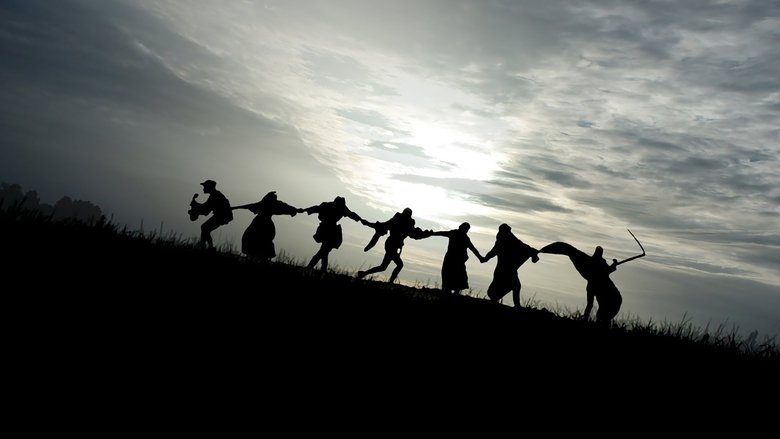
The Dance of Death is a medieval allegory about the universality of death, where people from all walks of life are led to their graves by a personified Death. It symbolizes the idea that no one, from knights to actors to blacksmiths, can escape their ultimate fate.
The film references the Danse Macabre in a fresco being painted in a church. The final, iconic shot of the film is a literal depiction of this, as Jof, the actor, has a vision of the knight and his companions being led over a hill in a grim, silent dance against the stormy sky. This image serves as the film's haunting conclusion about the finality of death.
Wild Strawberries and Milk
This simple meal symbolizes a moment of pure, unadulterated joy, innocence, and communion in a world filled with despair and death. It represents the beauty of a simple life and the profound meaning that can be found in human connection and the present moment, a stark contrast to the knight's tormented search for grand, divine answers. In Swedish culture, wild strawberries represent fleeting happiness.
The knight shares a meal of wild strawberries and milk with the family of actors, Jof and Mia. This scene provides Block with his only moment of true peace and contentment. He declares, "I shall remember this moment: the silence, the twilight, the bowl of strawberries, the bowl of milk... I shall carry this memory carefully in my hands as if it were a bowl brimful of fresh milk. It will be a sign to me, and a great sufficiency."
Philosophical Questions
Can faith exist without knowledge?
The film's central conflict revolves around this question. Antonius Block is a man who wants to believe, but his rational mind demands proof. He asks, "Why can't I kill God in me?" highlighting the torment of having the ingrained need for faith without the intellectual certainty to support it. The film juxtaposes his agonizing quest for knowledge with the simple, unquestioning faith of Jof, who has visions of the Virgin Mary, and the staunch atheism of Jöns. "The Seventh Seal" doesn't provide a clear answer, but suggests that the demand for absolute knowledge may be a barrier to the peace that can be found in either simple faith or humanistic acceptance.
What is the meaning of life in the face of inevitable death and suffering?
This is the quintessential existential question that the film poses. Set against the backdrop of the plague, death is not an abstract concept but a visceral, everyday reality. The knight seeks a grand, singular meaning through a divine purpose or a "meaningful deed." However, the film suggests that meaning might not be found in a single answer but in the small, transient moments of life. The scene with the wild strawberries and milk is the clearest exploration of this, offering a moment of simple, profound joy and connection as a powerful antidote to existential dread. The survival of the family of actors implies that a life lived with love and simple pleasures is, perhaps, the most meaningful response to the absurdity of existence.
What is the nature of good and evil in a world where God is silent?
The film presents a world where religious authority is often corrupt and hypocritical. The man who convinced the knight to join the Crusades is now a thief, and religious processions are driven by fear and hysteria. In this world, acts of genuine goodness come from individuals, often those who are most skeptical of religious dogma. The squire Jöns, a self-proclaimed nihilist, performs several acts of compassion. The knight, in his moment of greatest clarity, performs a selfless act to save the innocent. The film suggests that morality is not contingent on divine reward or punishment, but is a human choice made in the face of a silent universe.
Core Meaning
The core meaning of "The Seventh Seal" revolves around the human struggle to find meaning and purpose in the face of mortality and the apparent silence of God. Director Ingmar Bergman uses the medieval setting and the plague as a backdrop for a profound existential allegory that explores the themes of faith, doubt, and the search for knowledge in a world filled with suffering. The film suggests that while the grand, ultimate answers to life's biggest questions may remain elusive, meaning can be found in small, simple acts of human connection, love, and compassion. This is exemplified in the knight's serene moment sharing wild strawberries and milk with the family of actors, a memory he cherishes as a profound sign of life's value. Ultimately, Bergman's message is not one of nihilistic despair, but rather a call to embrace life and find significance in the transient, beautiful moments of human relationship, even as death remains an inevitable certainty.