
"Fear can hold you prisoner. Hope can set you free."
Director: Frank Darabont
Cast: Tim Robbins, Morgan Freeman, Bob Gunton, William Sadler, Clancy Brown
The Shawshank Redemption — Characters & Cast
Character Analysis
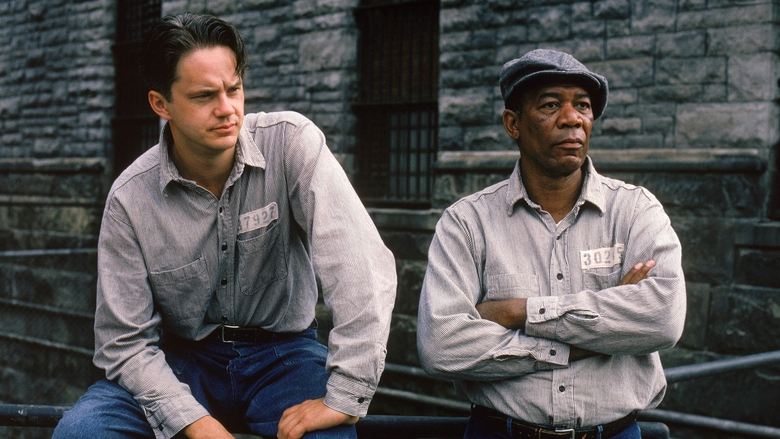
Andy Dufresne
Tim Robbins
Motivation
To remain himself. Concretely: to prove or outlive an injustice, to build something worth having inside the walls, and to reach Zihuatanejo.
Character Arc
A reserved banker convicted of murdering his wife and her lover despite his claims of innocence, he arrives brittle and closed, survives brutality, and converts his one usable skill — finance — into leverage, dignity and finally an exit. Across roughly nineteen years he moves from victim of the institution to the person quietly authoring its undoing.
Ellis "Red" Redding
Morgan Freeman
Motivation
Initially survival and the small comfort of usefulness; ultimately the wish to keep faith with a friend and to be, in Andy's phrase, busy living.
Character Arc
The man who can get things, fluent in Shawshank's economy and resigned to its logic, Red begins as the film's realist — hope, he insists, is dangerous in here. Watching Andy, and later confronting his own institutionalization, he moves from resignation to the risk of wanting something again. The redemption of the title is largely his.
Warden Samuel Norton
Bob Gunton
Motivation
Money, control, and the maintenance of a pious public face — with the prison as private enterprise.
Character Arc
Introduced as a Bible-quoting disciplinarian, he steadily reveals himself as the prison's true criminal, exploiting inmate labor and laundering the proceeds. The more he depends on Andy's expertise, the more completely he is exposed to it; his authority collapses along exactly the line he thought he controlled.
Captain Byron Hadley
Clancy Brown
Motivation
Dominance, and the untroubled exercise of authority without consequence.
Character Arc
The physical instrument of Norton's regime, casually violent from his first scene, he is briefly humanized only when Andy's tax advice serves his interest — and even that transaction is a demonstration of how power in Shawshank can be bargained with rather than defeated.
Brooks Hatlen
James Whitmore
Motivation
To remain needed and legible somewhere — which, after decades, only Shawshank allows.
Character Arc
The aged prison librarian whose long-awaited release becomes catastrophe: unable to adapt to a world that has moved on without him, he embodies the film's argument about the dehumanizing effects of prolonged incarceration. His story is the cautionary shadow cast over Red's own eventual freedom.
Cast
Explore More About This Movie
Dive deeper into specific aspects of the movie with our detailed analysis pages