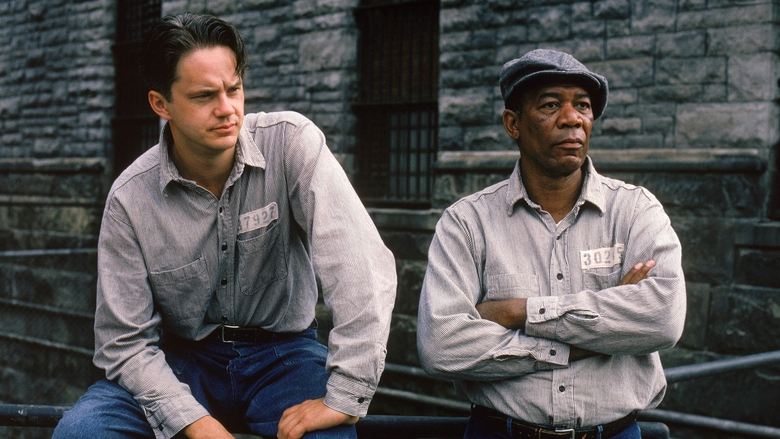
A prison drama that breathes like a hymn: two men trade twenty years of gray stone and iron for one stubborn ember of hope, until the walls themselves seem to dissolve into open sky.
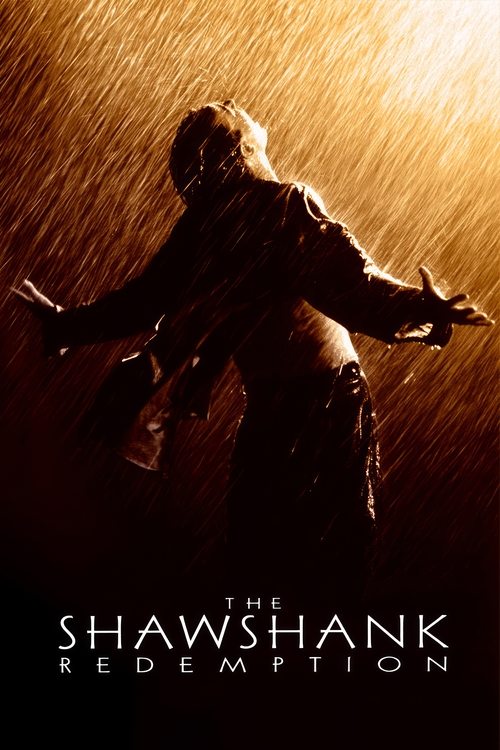
The Shawshank Redemption
"Fear can hold you prisoner. Hope can set you free."
23 September 1994
United States of America
142 min
8.7
(28,964)
Director: Frank Darabont
Cast: Tim Robbins, Morgan Freeman, Bob Gunton, William Sadler, Clancy Brown
Drama
Crime
Hope as survival
Institutionalization
Friendship and loyalty
Justice, injustice and corruption
Dignity, culture and the inner life
Budget:
$25,000,000
Box Office:
$28,341,469
The Shawshank Redemption — Ending Explained
⚠️ Spoiler Analysis
<p><strong>Full spoilers follow.</strong></p><p>Andy Dufresne is innocent. He spends nineteen years in Shawshank for the murder of his wife and her lover, and the film's cruelest turn confirms his innocence only to make it useless: a new inmate can identify the real killer, and Warden Norton — who by now depends on Andy to launder the proceeds of his inmate-labor racket — suppresses the testimony rather than lose his accountant. Norton has the witness killed and throws Andy into solitary. The system does not fail to learn the truth; it learns the truth and buries it.</p><p><strong>The plan.</strong> Everything the film has presented as characterization turns out to be mechanism. The rock hammer, requested as a harmless hobby tool for shaping rocks and chess pieces, has been used for nearly two decades to open a tunnel; the pin-up posters, beginning with Rita Hayworth, have veiled it the whole time. Andy's line to Red about a specific hayfield near Buxton and a package buried there is not wistfulness but an instruction. And <i>"Get busy living, or get busy dying"</i> — which Red hears as a suicide warning — is in fact Andy announcing his departure.</p><p><strong>The escape.</strong> On a storm-covered night Andy crawls the length of the tunnel and then through a sewer pipe to reach open ground. The sequence is written as a <strong>baptism</strong>: he passes through filth and emerges into rain, cleansed and reborn — arms raised, the film's single explicitly transcendent image. The escape doubles as a heist. Andy has spent years maintaining a fictitious identity through which Norton's dirty money was channeled; that man now simply walks into banks and withdraws the warden's fortune, and posts the evidence of the corruption and killings to the press. Hadley is arrested; Norton, facing exposure, shoots himself. The warden is destroyed by the exact instrument he believed he owned.</p><p><strong>Brooks and Red.</strong> Brooks Hatlen, paroled after decades, cannot survive outside and takes his own life — establishing institutionalization as the film's real killer. Red, released later, moves into the same halfway room, sees Brooks's carving on the beam, and comes to the edge of the same choice. What saves him is the promise: he goes to Buxton, finds the package with money and a letter containing the film's thesis — <i>"hope is a good thing, maybe the best of things, and no good thing ever dies."</i> Red violates parole and travels to Zihuatanejo, and the film closes on the two men meeting on the beach.</p><p><strong>What becomes clear afterward.</strong> On a second viewing the film reads as Red's story, not Andy's: Andy never changes, because he was never broken — he is the fixed point against which Red's transformation is measured. The title's redemption belongs to the man who admits his guilt, and the escape narrative is only the vehicle for it. Note too that no legal process ever exonerates Andy; he is freed by fraud, patience and a hole in a wall, which is the film's quiet verdict on institutional justice.</p>
Alternative Interpretations
<p><strong>Religious allegory.</strong> A persistent reading treats the film as a spiritual narrative: Andy as a redeemer figure who suffers within the system and delivers others from it, the warden as a false shepherd quoting scripture while running a criminal enterprise, and the crawl through the sewer pipe as an explicit <i>baptism</i> from which a man emerges cleansed and reborn.</p><p><strong>Political and institutional critique.</strong> Read secularly, the film is an indictment of incarceration itself. Brooks Hatlen's fate argues that the system's deepest damage is psychological, and Norton's inmate-labor racket makes the prison a business. On this reading the story is about the <i>impossibility</i> of justice through the institution — one innocent man escapes by fraud and cunning, not by any working process of law.</p><p><strong>Whose redemption is it?</strong> Since Andy maintains his innocence throughout, some critics argue the title cannot refer to him at all: the man who is actually redeemed is Red, the self-confessed guilty man who must relearn hope. The film is his narration, after all — arguably a story about listening rather than escaping.</p><p><strong>The ending as fantasy.</strong> A minority reading treats the beach reunion as Red's imagining rather than a recorded event, since Andy's parting line — <i>"get busy living, or get busy dying"</i> — is deliberately double-edged and the film's closing images are unusually idyllic against everything preceding them. Most viewers take the ending literally; the ambiguity, however, is written into the dialogue.</p>
Explore More About This Movie
Dive deeper into specific aspects of the movie with our detailed analysis pages