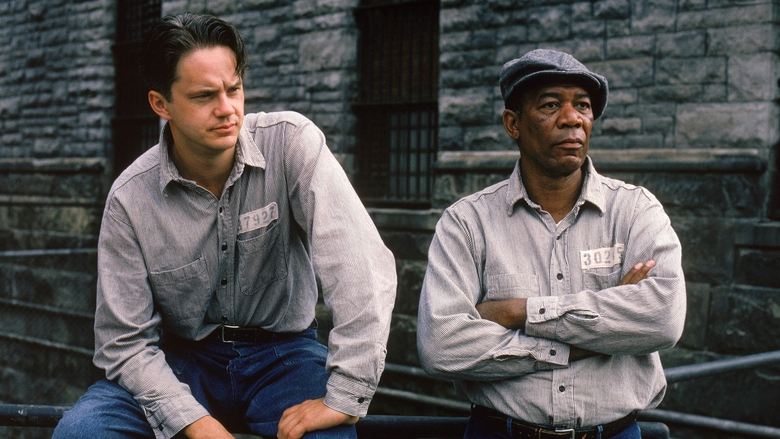
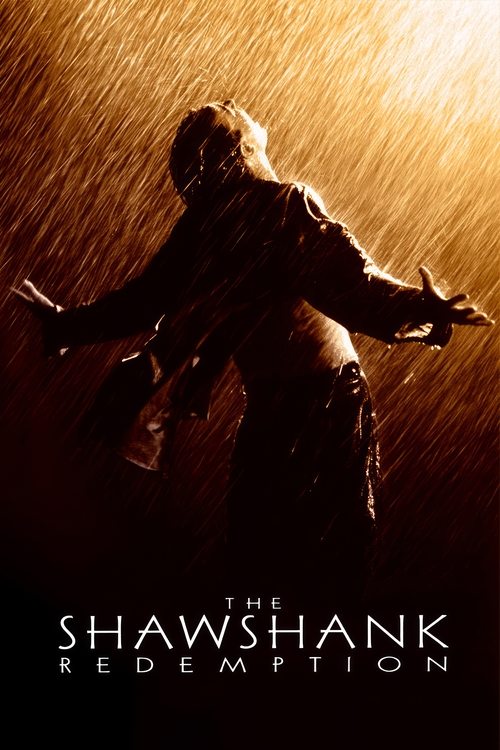
"Fear can hold you prisoner. Hope can set you free."
The Shawshank Redemption - Symbolism & Philosophy
Symbols & Motifs
Rock Hammer
The small rock hammer symbolizes Andy's quiet determination, patience, and unwavering hope for freedom. It is a seemingly insignificant tool, yet over the course of two decades, it becomes the instrument of his liberation, representing the idea that persistent effort, no matter how small, can overcome monumental obstacles.
Andy asks Red to procure the rock hammer early in the film, claiming he wants it for his amateur geology hobby of shaping rocks. For 19 years, he uses it to meticulously chip away at the wall of his cell, hiding the tunnel behind a series of posters.
The Posters of Rita Hayworth and Raquel Welch
The pin-up posters represent a connection to the outside world, a symbol of freedom, and the desire for a life beyond Shawshank's walls. More practically, they serve as a clever concealment for Andy's escape tunnel, symbolizing the hidden nature of his hope and his meticulous planning. The changing posters also mark the passage of time.
Andy gets Red to smuggle in a poster of Rita Hayworth shortly after his arrival. Over the years, he replaces it with posters of Marilyn Monroe and finally Raquel Welch. The tunnel Andy has been digging is always hidden behind the poster in his cell.
The Marriage of Figaro (Music)
The operatic piece symbolizes a moment of transcendent freedom and spiritual rebellion. For a brief period, the music elevates the prisoners above their grim reality, reminding them of a world of beauty and art that exists beyond the prison walls. It represents an inner freedom that the prison authorities cannot touch.
Andy discovers a recording of Mozart's "The Marriage of Figaro" in a donation for the library. He locks himself in the warden's office and plays the duet over the prison's public address system for all inmates to hear. He is subsequently punished with solitary confinement but considers it worth it.
Brooks' Bird (Jake)
Jake, the baby crow that Brooks cares for, symbolizes the fragility of life and the way inmates find purpose and connection in small things. The bird's confinement mirrors the inmates' own. When Brooks is paroled, he sets Jake free, but the bird's fate is uncertain, foreshadowing Brooks' own inability to survive in the outside world.
Brooks Hatlen, the elderly prison librarian, finds and raises a baby crow he names Jake. He keeps the bird inside his coat pocket. Before he is paroled, he sadly sets Jake free, worried about who will take care of the bird.
Zihuatanejo, Mexico
Zihuatanejo and the Pacific Ocean represent the ultimate paradise, a place of peace, freedom, and absolution. Andy describes the Pacific as a place with "no memory," symbolizing a chance to start fresh and wash away the sins and traumas of the past. It is the physical manifestation of Andy's enduring hope.
Andy tells Red about his dream of escaping to Zihuatanejo, a small coastal town in Mexico. This dream becomes the goal that sustains him. After his escape, Andy makes his way there. The film's final scene shows Red violating his parole to follow Andy's instructions, leading to their reunion on a beach in Zihuatanejo.
Philosophical Questions
What is the nature of hope, and is it essential for survival?
The film presents a central debate on the nature of hope through its two main characters. Red initially sees hope as a "dangerous thing" that can drive a man insane within the confines of prison. Andy, in contrast, views hope as the ultimate source of spiritual survival, an inner light that cannot be extinguished. The film explores how hope can be both a source of potential disappointment and the very thing that gives life meaning and drives a person to persevere through unimaginable hardship. Andy's ultimate success suggests that hope, while risky, is essential for the human spirit to remain free.
Can a person truly be free while physically imprisoned?
"The Shawshank Redemption" delves into the distinction between physical and mental freedom. While Andy is confined by walls and bars, he maintains his internal freedom through his love of music, his dedication to the library, and his unwavering sense of self-worth. In contrast, characters like Brooks are physically freed but remain psychologically imprisoned by their institutionalization. The film suggests that true freedom is an internal state of being—the ability to keep one's mind and spirit alive—which can be more powerful and enduring than physical liberty alone.
What constitutes true justice and redemption?
The film juxtaposes institutional "justice" with a more profound, personal form of justice and redemption. The legal system fails Andy by wrongfully convicting him, and the prison system, under Warden Norton, is shown to be corrupt and devoid of any real rehabilitative purpose. Andy must create his own justice by escaping and exposing the corruption. Similarly, Red's redemption doesn't come from the parole board's stamp of approval but from his own internal transformation—his ability to feel remorse, accept his past, and ultimately choose a future guided by hope. The film questions whether societal institutions can ever provide what the human spirit truly needs to heal and be redeemed.
Core Meaning
The core meaning of "The Shawshank Redemption" revolves around the unshakable power of hope and the preservation of one's inner self in the face of soul-crushing adversity. Director Frank Darabont, adapting Stephen King's novella, conveys the message that true freedom is a state of mind that cannot be imprisoned. Andy Dufresne embodies this; despite being physically incarcerated, he maintains his integrity and spirit.
The film argues that one has a fundamental choice in life: "Get busy living, or get busy dying." This choice represents the dichotomy between succumbing to despair and actively holding onto hope for a better future. The film also serves as a powerful allegory for redemption—not just in a religious sense, but in finding salvation and purpose even after making mistakes, as seen through Red's journey. Ultimately, it is a testament to the resilience of the human spirit and its capacity to find light in the darkest of places.