
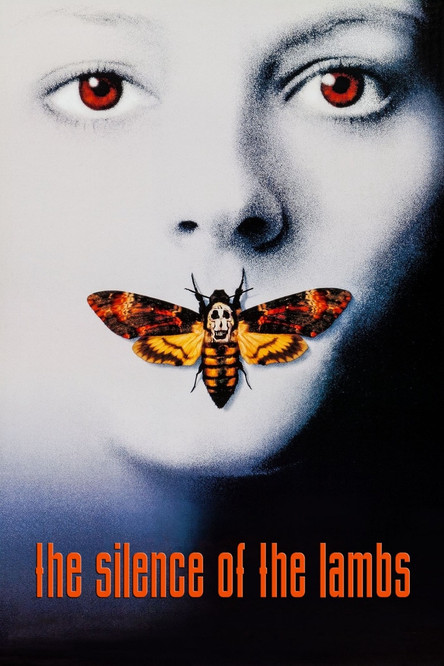
"To enter the mind of a killer she must challenge the mind of a madman."
The Silence of the Lambs - Symbolism & Philosophy
Symbols & Motifs
The Lambs
The lambs symbolize innocence, vulnerability, and the haunting nature of past trauma. For Clarice, the screaming of the lambs she was unable to save as a child represents her deep-seated guilt and her powerful drive to protect the innocent. Saving Catherine Martin becomes a way for her to metaphorically "silence the lambs" of her past.
The symbolism of the lambs is most explicitly revealed in Clarice's 'quid pro quo' sessions with Hannibal Lecter, where she recounts the traumatic childhood memory of trying to save the spring lambs from slaughter on her relatives' farm. The title of the film itself refers to this central metaphor. At the end of the film, Lecter asks Clarice, "Well, Clarice, have the lambs stopped screaming?", questioning whether she has found peace.
The Death's-Head Hawkmoth
The death's-head hawkmoth is a powerful symbol of transformation and death. The moth's life cycle from caterpillar to pupa to winged insect mirrors Buffalo Bill's twisted desire to transform into a woman. The skull-like marking on the moth's back also serves as a chilling omen of death.
Buffalo Bill places the pupa of a death's-head hawkmoth in the throats of his victims, a macabre calling card that signifies his own metamorphosis. The moth also appears on the iconic movie poster, with the skull on its back being a clever composition of naked female bodies, a reference to Salvador Dalí's 'In Voluptas Mors'.
Lecter's Cell
Hannibal Lecter's glass-walled cell represents his contained but ever-present threat. The transparent barrier allows for a chilling intimacy between him and Clarice, highlighting the psychological nature of their battle. It symbolizes the fragility of the boundary between sanity and madness, and the fact that physical confinement cannot contain a dangerous mind.
The majority of Clarice and Lecter's interactions take place on opposite sides of this glass wall. Director Jonathan Demme's use of direct-to-camera shots and reflections on the glass creates a sense of unease and forces the audience into a discomfiting proximity with Lecter.
Buffalo Bill's Well
The deep, dark well in Buffalo Bill's basement where he keeps his victims symbolizes a descent into a personal hell and the depths of human depravity. It represents a place of utter helplessness and the commodification of his victims, who are reduced to objects for his transformative project.
Catherine Martin is imprisoned in the well, where she is taunted by Buffalo Bill with the infamous line, "It rubs the lotion on its skin or else it gets the hose again." Her desperate attempts to escape from this pit highlight her resilience and will to survive in the face of abject horror.
Philosophical Questions
What is the true nature of evil?
The film explores this question by presenting two very different embodiments of evil. Is evil the sophisticated, intellectual malevolence of Hannibal Lecter, who kills out of a sense of superiority and a disdain for the 'rude'? Or is it the chaotic, desperate evil of Buffalo Bill, born from trauma and a twisted desire for transformation? The film suggests that evil is not a monolithic concept but a complex and multifaceted phenomenon with diverse origins and manifestations.
Can one use evil to fight evil without being corrupted?
Clarice Starling must delve into the dark mind of one monster to catch another. Her relationship with Lecter is a dangerous dance on the edge of an abyss. The film raises the question of whether it is possible to engage with such profound darkness without being tainted by it. While Clarice ultimately succeeds in her mission and maintains her moral compass, her final conversation with Lecter suggests a lasting and unsettling connection between them, leaving the audience to ponder the psychological toll of her journey.
To what extent are we shaped by our past traumas?
Both Clarice and Buffalo Bill are profoundly influenced by their traumatic childhoods. Clarice's experience with the slaughter of the lambs fuels her fierce determination to save the innocent. Buffalo Bill's history of abuse is presented as a significant factor in his psychological breakdown and murderous rampage. The film explores how trauma can be a catalyst for both heroic and monstrous behavior, raising questions about free will and the possibility of overcoming a painful past.
Core Meaning
The core meaning of "The Silence of the Lambs" revolves around the harrowing journey of its protagonist, Clarice Starling, as she confronts both external and internal monsters. Director Jonathan Demme explores the nature of evil, not as a simple, monolithic force, but as a complex and multifaceted aspect of the human condition, embodied by the contrasting figures of Hannibal Lecter and Buffalo Bill. The film delves into the themes of psychological manipulation, the struggle for identity, and the pervasive impact of past trauma.
Ultimately, the film is a powerful feminist narrative about a young woman's rite of passage in a male-dominated world. Clarice's quest to "silence the lambs"—to quiet the recurring nightmares of her childhood trauma by saving an innocent victim—is a metaphor for her journey toward self-actualization and finding her voice in a world that constantly tries to diminish her. Demme's message is one of resilience and the courage required to face the darkness, both in the world and within oneself, to achieve justice and a semblance of peace.