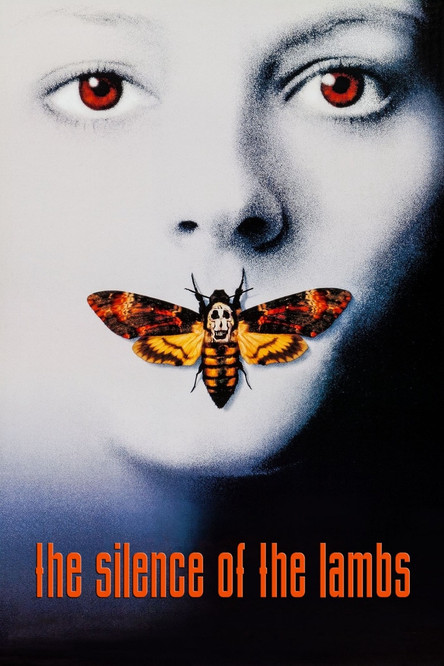
The Silence of the Lambs
"To enter the mind of a killer she must challenge the mind of a madman."
Overview
"The Silence of the Lambs" is a gripping psychological thriller that introduces Clarice Starling, a promising FBI trainee. She is tasked by her superior, Jack Crawford, with a dangerous and unorthodox assignment: to interview Dr. Hannibal Lecter, a brilliant but monstrously insane psychiatrist and cannibalistic serial killer, who is held in a maximum-security institution.
Crawford hopes that Lecter's unique insight can help the FBI in their desperate hunt for another serial killer, known as "Buffalo Bill," who has been abducting and brutally murdering young women. The enigmatic and manipulative Lecter takes a keen interest in Starling, and a twisted psychological game of cat and mouse ensues. In exchange for clues about Buffalo Bill, Lecter demands personal revelations from Clarice, forcing her to confront the demons of her own past.
As Clarice gets closer to uncovering the identity of Buffalo Bill, she finds herself drawn deeper into Lecter's dark world, blurring the lines between hunter and hunted. The film masterfully builds suspense as Starling races against time to save Buffalo Bill's latest victim, all while navigating the treacherous intellect of Hannibal the Cannibal.
Core Meaning
The core meaning of "The Silence of the Lambs" revolves around the harrowing journey of its protagonist, Clarice Starling, as she confronts both external and internal monsters. Director Jonathan Demme explores the nature of evil, not as a simple, monolithic force, but as a complex and multifaceted aspect of the human condition, embodied by the contrasting figures of Hannibal Lecter and Buffalo Bill. The film delves into the themes of psychological manipulation, the struggle for identity, and the pervasive impact of past trauma.
Ultimately, the film is a powerful feminist narrative about a young woman's rite of passage in a male-dominated world. Clarice's quest to "silence the lambs"—to quiet the recurring nightmares of her childhood trauma by saving an innocent victim—is a metaphor for her journey toward self-actualization and finding her voice in a world that constantly tries to diminish her. Demme's message is one of resilience and the courage required to face the darkness, both in the world and within oneself, to achieve justice and a semblance of peace.
Thematic DNA
The Nature of Evil
The film presents two distinct faces of evil through Hannibal Lecter and Jame "Buffalo Bill" Gumb. Lecter is the embodiment of sophisticated, intellectual evil. He is a man of refined tastes and immense intelligence, which makes his cannibalistic tendencies all the more horrifying. In contrast, Buffalo Bill represents a more primal and chaotic form of evil, born from a place of self-hatred and a desperate desire for transformation. The film challenges the audience to contemplate the origins of monstrosity, suggesting that evil can be both a calculated choice and the product of a tormented psyche.
Gender Dynamics and the Male Gaze
"The Silence of the Lambs" is a powerful exploration of a woman navigating a patriarchal world. Clarice Starling is constantly subjected to the male gaze, from the initial elevator scene where she is surrounded by taller men, to the leering of Dr. Chilton and the condescension of other law enforcement officers. The film uses cinematography to emphasize Clarice's perspective, making the audience experience her feelings of isolation and scrutiny. Her journey is a testament to her resilience and determination to prove her worth in a field that consistently underestimates her because of her gender.
Psychological Manipulation and Control
The theme of psychological manipulation is central to the narrative, most notably in the complex relationship between Clarice and Lecter. Their interactions are a high-stakes chess game, where information is currency and every word is laden with hidden meaning. Lecter masterfully exploits Clarice's vulnerabilities and past traumas to satisfy his own intellectual curiosity, while also providing her with the cryptic clues she needs. This theme also extends to Buffalo Bill's manipulation of his victims, luring them into a false sense of security before capturing them.
Transformation and Identity
The film explores the theme of transformation on multiple levels. Buffalo Bill's grotesque mission to create a "woman suit" from the skin of his victims is a literal and horrific attempt at transformation, born from his deep-seated identity issues. Clarice also undergoes a profound transformation, evolving from an eager but inexperienced trainee into a hardened and capable FBI agent. The death's-head moth, a key symbol in the film, explicitly represents this theme of metamorphosis.
Character Analysis
Clarice Starling
Jodie Foster
Motivation
Clarice's primary motivation is to save innocent lives and achieve justice, driven by a deep-seated need to "silence the lambs" of her past. She is also highly ambitious and wants to prove her capabilities as an FBI agent, seeking the approval of her mentor, Jack Crawford, as a surrogate father figure.
Character Arc
Clarice begins as a determined but unproven FBI trainee, haunted by the traumatic death of her father and her inability to save the lambs. Throughout her harrowing investigation and her psychological duel with Lecter, she confronts her fears and insecurities, transforming into a courageous and resourceful agent who can stand her ground in a male-dominated world. Her journey is one of empowerment and finding her voice.
Dr. Hannibal Lecter
Anthony Hopkins
Motivation
Lecter is motivated by a desire for intellectual stimulation and a disdain for rudeness and mediocrity. He is intrigued by Clarice's intelligence and vulnerability, and his interactions with her are a form of amusement. His ultimate motivation is his own freedom, which he masterfully orchestrates.
Character Arc
Lecter, already a convicted serial killer at the start of the film, does not have a traditional character arc of change. Instead, his arc is one of influence and manipulation. He becomes a dark mentor to Clarice, guiding her through the case while simultaneously feeding his own intellectual and psychological curiosities. He ultimately escapes confinement, his malevolence once again unleashed upon the world.
Jame 'Buffalo Bill' Gumb
Ted Levine
Motivation
Gumb is motivated by a profound sense of identity crisis and a desperate desire to become a woman, a desire he believes can be achieved by creating a "woman suit" from the skin of his victims. His actions are driven by a lifetime of systematic abuse and a twisted perception of beauty and transformation.
Character Arc
Jame Gumb's arc is a static portrayal of a deeply disturbed individual. He is trapped in a cycle of self-hatred and a grotesque desire for transformation that manifests in his horrific crimes. He does not evolve or change throughout the film, remaining a monstrous figure until his death.
Jack Crawford
Scott Glenn
Motivation
Crawford's primary motivation is to catch Buffalo Bill and solve the case. He is a dedicated and pragmatic law enforcement officer who is willing to use unconventional methods, such as sending a trainee to interview Lecter, to achieve his goals.
Character Arc
Jack Crawford is a seasoned FBI agent who acts as a mentor to Clarice. While he respects her abilities, he is not above using her to get to Lecter. His arc is largely static, but he does show a paternal pride in Clarice's success at the end of the film. He is also dealing with the personal tragedy of his wife's terminal illness, which adds a layer of depth to his character.
Symbols & Motifs
The Lambs
The lambs symbolize innocence, vulnerability, and the haunting nature of past trauma. For Clarice, the screaming of the lambs she was unable to save as a child represents her deep-seated guilt and her powerful drive to protect the innocent. Saving Catherine Martin becomes a way for her to metaphorically "silence the lambs" of her past.
The symbolism of the lambs is most explicitly revealed in Clarice's 'quid pro quo' sessions with Hannibal Lecter, where she recounts the traumatic childhood memory of trying to save the spring lambs from slaughter on her relatives' farm. The title of the film itself refers to this central metaphor. At the end of the film, Lecter asks Clarice, "Well, Clarice, have the lambs stopped screaming?", questioning whether she has found peace.
The Death's-Head Hawkmoth
The death's-head hawkmoth is a powerful symbol of transformation and death. The moth's life cycle from caterpillar to pupa to winged insect mirrors Buffalo Bill's twisted desire to transform into a woman. The skull-like marking on the moth's back also serves as a chilling omen of death.
Buffalo Bill places the pupa of a death's-head hawkmoth in the throats of his victims, a macabre calling card that signifies his own metamorphosis. The moth also appears on the iconic movie poster, with the skull on its back being a clever composition of naked female bodies, a reference to Salvador Dalí's 'In Voluptas Mors'.
Lecter's Cell
Hannibal Lecter's glass-walled cell represents his contained but ever-present threat. The transparent barrier allows for a chilling intimacy between him and Clarice, highlighting the psychological nature of their battle. It symbolizes the fragility of the boundary between sanity and madness, and the fact that physical confinement cannot contain a dangerous mind.
The majority of Clarice and Lecter's interactions take place on opposite sides of this glass wall. Director Jonathan Demme's use of direct-to-camera shots and reflections on the glass creates a sense of unease and forces the audience into a discomfiting proximity with Lecter.
Buffalo Bill's Well
The deep, dark well in Buffalo Bill's basement where he keeps his victims symbolizes a descent into a personal hell and the depths of human depravity. It represents a place of utter helplessness and the commodification of his victims, who are reduced to objects for his transformative project.
Catherine Martin is imprisoned in the well, where she is taunted by Buffalo Bill with the infamous line, "It rubs the lotion on its skin or else it gets the hose again." Her desperate attempts to escape from this pit highlight her resilience and will to survive in the face of abject horror.
Memorable Quotes
A census taker once tried to test me. I ate his liver with some fava beans and a nice Chianti.
— Dr. Hannibal Lecter
Context:
Lecter delivers this line to Clarice during their first meeting after she tries to get him to fill out a psychological questionnaire. It's a verbal power play designed to shock and intimidate her, immediately establishing the terrifying nature of his character.
Meaning:
This is arguably the film's most iconic and chilling line. It's a testament to Lecter's casual brutality and his intellectual superiority. He's not just a killer; he's a gourmand of the grotesque. The line also contains a hidden medical joke, as the foods mentioned are all things that should be avoided when taking certain types of antidepressants, implying Lecter is not on his medication.
Well, Clarice, have the lambs stopped screaming?
— Dr. Hannibal Lecter
Context:
Lecter says this to Clarice over the phone at the end of the film, after he has escaped from custody. It's his final, unsettling word to her, a reminder of their intimate and twisted connection.
Meaning:
This haunting question gets to the very heart of Clarice's character and the film's central metaphor. Lecter is asking if her success in saving Catherine Martin has finally brought her peace from her childhood trauma. It's a question that lingers long after the credits roll, suggesting that the echoes of our past are not so easily silenced.
It rubs the lotion on its skin, or else it gets the hose again.
— Jame 'Buffalo Bill' Gumb
Context:
Buffalo Bill says this to Catherine Martin, who is imprisoned in his well. He is forcing her to apply lotion to her skin to keep it soft for when he kills and skins her.
Meaning:
This line is a terrifying glimpse into the mind of Buffalo Bill. By referring to his victim as "it," he dehumanizes her, reducing her to an object in his macabre project. The sing-song, almost childish tone in which he delivers the line makes it even more disturbing.
Quid pro quo. I tell you things, you tell me things.
— Dr. Hannibal Lecter
Context:
Lecter proposes this arrangement to Clarice when she comes to him for help with the Buffalo Bill case. It's his way of controlling their interactions and feeding his own insatiable curiosity about her.
Meaning:
This Latin phrase, meaning "something for something," becomes the basis of Clarice and Lecter's twisted relationship. It establishes the rules of their psychological game: his invaluable insights into the criminal mind in exchange for her most painful and personal memories.
Philosophical Questions
What is the true nature of evil?
The film explores this question by presenting two very different embodiments of evil. Is evil the sophisticated, intellectual malevolence of Hannibal Lecter, who kills out of a sense of superiority and a disdain for the 'rude'? Or is it the chaotic, desperate evil of Buffalo Bill, born from trauma and a twisted desire for transformation? The film suggests that evil is not a monolithic concept but a complex and multifaceted phenomenon with diverse origins and manifestations.
Can one use evil to fight evil without being corrupted?
Clarice Starling must delve into the dark mind of one monster to catch another. Her relationship with Lecter is a dangerous dance on the edge of an abyss. The film raises the question of whether it is possible to engage with such profound darkness without being tainted by it. While Clarice ultimately succeeds in her mission and maintains her moral compass, her final conversation with Lecter suggests a lasting and unsettling connection between them, leaving the audience to ponder the psychological toll of her journey.
To what extent are we shaped by our past traumas?
Both Clarice and Buffalo Bill are profoundly influenced by their traumatic childhoods. Clarice's experience with the slaughter of the lambs fuels her fierce determination to save the innocent. Buffalo Bill's history of abuse is presented as a significant factor in his psychological breakdown and murderous rampage. The film explores how trauma can be a catalyst for both heroic and monstrous behavior, raising questions about free will and the possibility of overcoming a painful past.
Alternative Interpretations
One of the most compelling alternative interpretations of "The Silence of the Lambs" casts the film as a modern-day Faustian allegory. In this reading, Clarice Starling makes a metaphorical deal with the devil, Hannibal Lecter, to achieve her goals. She trades her most intimate and traumatic memories (her "soul") for the knowledge she needs to catch Buffalo Bill. Lecter's subsequent escape from his seemingly impenetrable prison can be seen as the devil being unleashed upon the world as a consequence of their pact. The final showdown with Buffalo Bill in complete darkness is interpreted as Clarice having to face evil without the "light" of divine grace, having compromised herself through her association with Lecter.
Another theory suggests that Hannibal Lecter orchestrated the entire Buffalo Bill case as an elaborate long con to secure his own freedom. This interpretation posits that Lecter, having identified Jame Gumb's psychopathic tendencies when he was his patient, manipulated him into becoming a serial killer. Lecter then used his unique knowledge of the case as leverage to bargain for a transfer to a less secure facility, from which he could easily escape. This theory paints Lecter as an even more cunning and diabolical mastermind than he already appears.
Cultural Impact
"The Silence of the Lambs" had a profound and lasting impact on both cinema and popular culture. Released in 1991, it redefined the psychological thriller genre, blending horror with deep character study and suspense in a way that captivated audiences and critics alike. Its critical and commercial success, culminating in its sweep of the top five Academy Awards, legitimized the horror genre in a way that few films have before or since.
The character of Hannibal Lecter, as portrayed by Anthony Hopkins, became an instant cultural icon, a villain of such intelligence and charisma that he was both terrifying and strangely alluring to audiences. The film also gave us a new kind of cinematic hero in Clarice Starling, a strong, intelligent, and vulnerable woman who defied the typical horror movie tropes. The film's influence can be seen in the countless thrillers and crime dramas that followed, many of which have attempted to replicate its unique blend of psychological depth and visceral horror. It also sparked a renewed public fascination with serial killers and criminal profiling, influencing numerous books, television shows, and documentaries on the subject. The film's memorable lines and imagery have been endlessly parodied and referenced in popular culture, cementing its status as a modern classic.
Audience Reception
"The Silence of the Lambs" was met with widespread acclaim from audiences, who were captivated by its intelligent and suspenseful narrative, its complex characters, and its chilling atmosphere. The performances of Jodie Foster and, in particular, Anthony Hopkins were universally praised, with Hopkins' portrayal of Hannibal Lecter becoming one of the most iconic in cinema history. Audiences found the psychological cat-and-mouse game between Clarice and Lecter to be the most compelling aspect of the film. While the film was lauded for its masterful blend of horror and psychological drama, some viewers were critical of its graphic content and disturbing subject matter. The portrayal of Buffalo Bill also sparked controversy, with some LGBTQ+ advocacy groups raising concerns that the character could perpetuate harmful stereotypes about transgender people. Despite these criticisms, the film's powerful storytelling and unforgettable characters have ensured its enduring popularity with audiences for decades.
Interesting Facts
- The film is one of only three in history to win the "Big Five" Academy Awards: Best Picture, Best Director, Best Actor, Best Actress, and Best Adapted Screenplay. The other two are "It Happened One Night" (1934) and "One Flew Over the Cuckoo's Nest" (1975).
- Anthony Hopkins won the Oscar for Best Actor for his portrayal of Hannibal Lecter, despite only being on screen for about 16 minutes.
- The character of Buffalo Bill was a composite of three real-life serial killers: Ted Bundy, Gary Heidnik, and Ed Gein.
- Gene Hackman originally owned the rights to the novel and intended to direct and star as Jack Crawford.
- Jodie Foster was not the first choice for the role of Clarice Starling; Michelle Pfeiffer was initially offered the part but turned it down due to the film's dark subject matter.
- The iconic skull on the back of the moth on the movie poster is actually a recreation of a 1951 photograph by Philippe Halsman titled "In Voluptas Mors," which features seven naked women forming the shape of a skull, inspired by a drawing by Salvador Dalí.
- The infamous dance scene performed by Buffalo Bill was not in the original script and was improvised by actor Ted Levine.
- Director Jonathan Demme has a cameo in the film as a man in a blue shirt at the end of the movie.
Easter Eggs
In one of Hannibal Lecter's drawings in his cell, he depicts the Duomo in Florence as seen from the Belvedere.
This is a clever piece of foreshadowing. At the end of the film, after his escape, Lecter is in a location that resembles the drawing. More importantly, Buffalo Bill's first victim was named Frederica Bimmel, from Belvedere, Ohio. Lecter was giving Clarice a significant clue that she initially missed.
In Jack Crawford's office, there is a newspaper clipping on the wall with the headline 'BILL SKINS FIFTH.'
At first glance, this appears to be about Buffalo Bill. However, upon closer inspection, the article is actually about Hannibal Lecter's past crimes, detailing his medical background and the murder of a museum curator.
When Hannibal Lecter tells Clarice he ate a census taker's liver with 'fava beans and a nice Chianti.'
This line contains a hidden medical joke. Monoamine oxidase inhibitors (MAOIs), a class of antidepressants, have dangerous, potentially fatal, interactions with tyramine-rich foods like liver, fava beans, and red wine. Lecter, a brilliant psychiatrist, is essentially telling Clarice he is not taking his medication.
During the scene where Lecter is in his temporary cell in Memphis, a copy of 'Bon Appétit' magazine can be seen on his table.
This is a dark and humorous nod to Lecter's cannibalistic tastes, subtly placed in the scene as he enjoys a meal of lamb chops.
⚠️ Spoiler Analysis
Click to reveal detailed analysis with spoilers
Frequently Asked Questions
Explore More About This Movie
Dive deeper into specific aspects of the movie with our detailed analysis pages
Comments (0)
No comments yet. Be the first to share your thoughts!