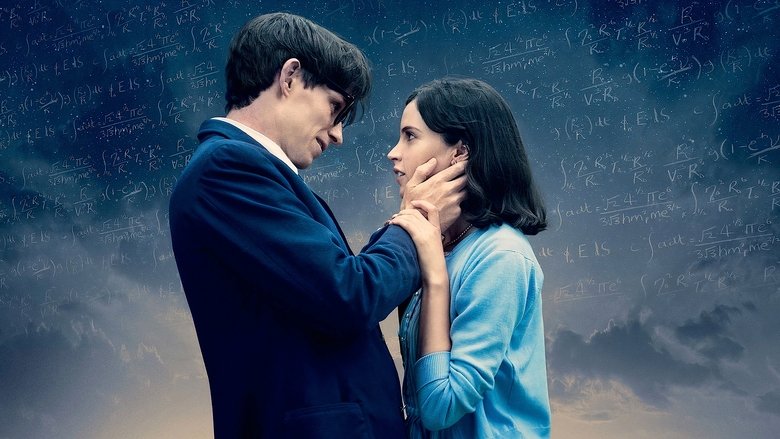
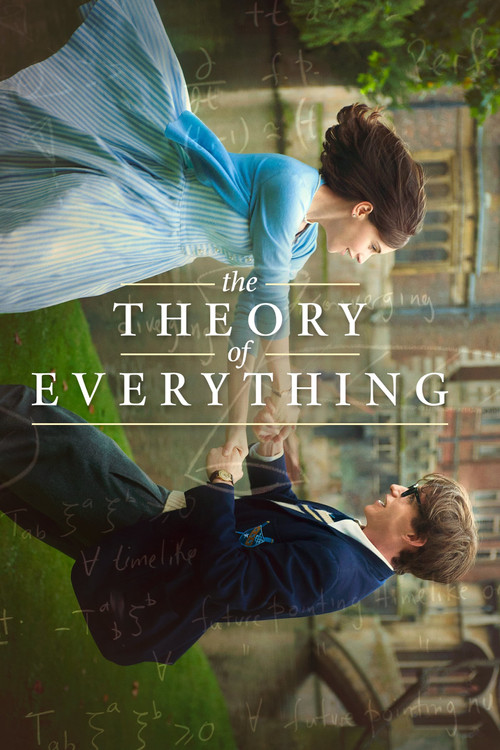
"His mind changed our world. Her love changed his."
The Theory of Everything - Symbolism & Philosophy
Symbols & Motifs
Stairs
Stairs symbolize the immense and increasing physical challenges Stephen faces. They represent the everyday obstacles that his disease turns into insurmountable hurdles, highlighting his loss of mobility and independence.
Early in the film, Stephen navigates stairs with ease. After his diagnosis, a scene where he struggles to climb a staircase to see his first child is particularly poignant. Later, his inability to climb them at all signifies the progression of his illness and the family's need to adapt their lives around his physical limitations.
Chalkboard Equations
The complex equations Stephen writes on chalkboards symbolize the boundless world of his intellect, a space where he is free from physical constraints. They are a visual representation of his genius and his ongoing quest to understand the universe.
Throughout the first half of the film, Stephen is frequently shown working on complex mathematical proofs on chalkboards. As his physical condition worsens and he can no longer write, the chalkboards disappear, replaced by his computerized voice, marking a significant transition in his life and work.
The Universe and Stars
Visual references to stars, galaxies, and the cosmos represent Stephen's intellectual passion and the grand questions of existence he seeks to answer. They also serve as a visual metaphor for the wonder and beauty he and Jane find in their life together, despite the hardships.
The film uses imagery of the cosmos during key moments of scientific breakthrough and personal reflection. The swirling of cream in a coffee cup dissolving into a galaxy is a prime example. The recurring motif visually connects the mundane with the cosmic, mirroring Stephen's theoretical work.
Philosophical Questions
What is the relationship between faith and reason?
The film explores this question through the central relationship between Jane, a devout Christian, and Stephen, a committed atheist. Their love story becomes a microcosm of the larger dialogue between religion and science. Jane's faith provides her with the strength and hope to face their immense challenges, while Stephen's reason drives him to find a complete, rational explanation for the universe. The film does not seek to resolve this conflict but rather presents them as two complementary, though often competing, forces in the human experience, suggesting that a full life may require elements of both.
Can the human spirit triumph over physical limitations?
This is a central question the film addresses directly. Stephen Hawking's life is presented as the ultimate testament to the power of the mind and will over the frailties of the body. The narrative constantly juxtaposes his physical deterioration with his intellectual achievements. His story, as depicted in the film, serves as an inspirational exploration of human potential, arguing that our contributions, our identities, and our ability to live a meaningful life are not ultimately defined by our physical capabilities but by our intellect, our will to persevere, and our capacity for hope.
Does a finite life diminish or enhance its meaning?
Given a two-year prognosis at the age of 21, the concept of limited time becomes the driving force of Stephen's life and work. The film explores whether this death sentence drains his life of meaning or imbues it with a powerful, urgent purpose. His frantic need to complete his work suggests that the awareness of his finitude is precisely what galvanizes him. The film posits that confronting mortality can be a catalyst for extraordinary achievement and a deeper appreciation for the time one has, turning a tragedy into a source of profound meaning.
Core Meaning
The core meaning of "The Theory of Everything" transcends a simple biographical account of Stephen Hawking's life. At its heart, the film is an exploration of the enduring and transformative power of love in the face of immense adversity. Director James Marsh intended to tell an unusual love story set against a challenging backdrop, focusing on how two people transcend the immense complications life throws at them. It posits that human connection and emotional resilience are as profound and essential as the grandest scientific theories. The film suggests that while the universe may be governed by complex equations, the human heart operates on a different, equally powerful plane. It's a testament to the idea that while a brilliant mind can change our understanding of the world, love can fundamentally change and shape a life. The narrative ultimately champions hope and the limitless potential of human endeavor, regardless of physical limitations, encapsulated in Hawking's own words: "While there's life, there is hope."