
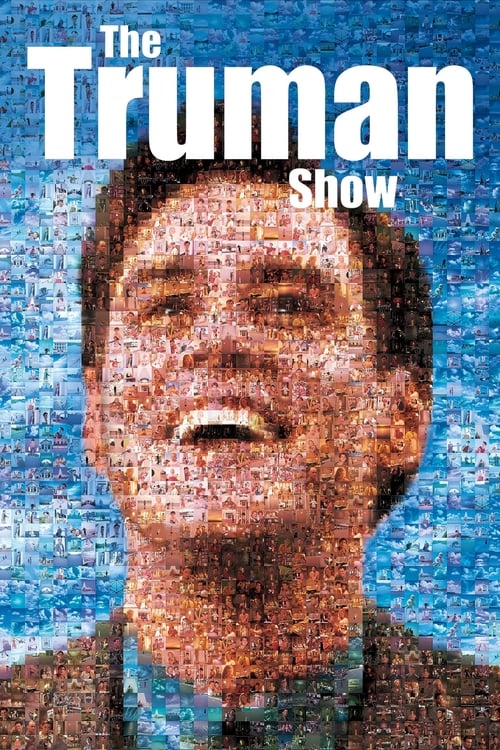
The Truman Show
A satirical comedy-drama's bittersweet journey, where one man's manufactured paradise becomes a prison, questioning the very nature of reality and the human spirit's unyielding desire for truth.
The Truman Show
The Truman Show

"On the air. Unaware."

04 June 1998 United States of America 103 min ⭐ 8.1 (19,351)
Director: Peter Weir
Cast: Jim Carrey, Laura Linney, Noah Emmerich, Natascha McElhone, Holland Taylor
Drama Comedy
Reality vs. Illusion Control and Free Will The Power and Ethics of Media Authenticity and the Human Spirit
Budget: $60,000,000
Box Office: $264,118,712

The Truman Show - Ending Explained

⚠️ Spoiler Analysis

The central twist of "The Truman Show" is that Truman Burbank's entire life is a television show. His hometown of Seahaven is a giant, enclosed set, and everyone he knows is an actor. The film's plot follows his gradual realization of this truth. Key turning points include a falling stage light, his supposedly dead father reappearing as a homeless man before being whisked away, and a radio malfunction that broadcasts the crew's tracking of his movements.

His suspicion culminates in a desperate attempt to leave the island. He confronts his wife, Meryl, who breaks character under pressure, screaming for the director to intervene. His best friend, Marlon, is fed lines by the show's creator, Christof, to convince Truman he is being paranoid. Truman eventually overcomes his iatrogenic fear of water and sets sail in a small boat. In a dramatic climax, Christof creates a life-threatening storm to force him back, but Truman perseveres.

The film's ending reveals the physical limit of his world: his boat crashes into the painted sky wall of the dome. He discovers a staircase leading to an exit door. Christof speaks to him directly for the first time, a disembodied voice from the heavens, pleading with him to stay in the safe, perfect world he created for him. Truman, in a moment of quiet defiance, delivers his catchphrase—"In case I don't see ya, good afternoon, good evening, and good night!"—takes a bow, and steps through the door into the unknown real world. The final scene shows his former global audience, momentarily thrilled by his escape, immediately searching for something else to watch on TV, a final satirical jab at the audience's fickle nature and the disposability of media content.

Alternative Interpretations

Religious Allegory

One of the most common alternative interpretations views the film as a religious or spiritual allegory. In this reading, Truman represents humanity (a "True Man"), and Christof is a god-like figure. Christof's name itself is a clear allusion to "Christ." He creates Truman's world, watches over him from the heavens (the control room in the moon), speaks to him with a disembodied voice, and controls every aspect of his existence. Truman's journey can be seen as humanity's struggle with faith, the problem of evil (as Christof is both a loving creator and a cruel manipulator), and the ultimate choice to leave the safety of the garden (Seahaven) to gain knowledge and free will in the flawed, real world. His escape is akin to a spiritual awakening or breaking free from a dogmatic system.

The Ending as a Metaphor for Death

A darker interpretation suggests Truman's exit from the dome is a metaphor for death. He sails to the edge of his known universe, faces his creator, and then walks into a dark, unknown void. The peaceful acceptance and his final bow could be seen as an embrace of the inevitable. In this view, the "real world" he enters is the afterlife. The audience's immediate channel-surfing after his departure could symbolize how quickly life moves on after someone dies. This interpretation posits that freedom from the prison of existence can only be found in death.

A Critique of the American Dream

Seahaven is presented as the perfect, idyllic American suburb, complete with white picket fences, friendly neighbors, and a stable job—a quintessential representation of the American Dream. The film can be interpreted as a critique of this ideal, suggesting that its perfect surface is an artificial, confining, and ultimately unfulfilling construction. Truman's desire to escape this "paradise" reflects a rejection of a safe, consumer-driven, and conformist lifestyle in favor of the messy, unpredictable, but authentic experiences that define a truly meaningful life.