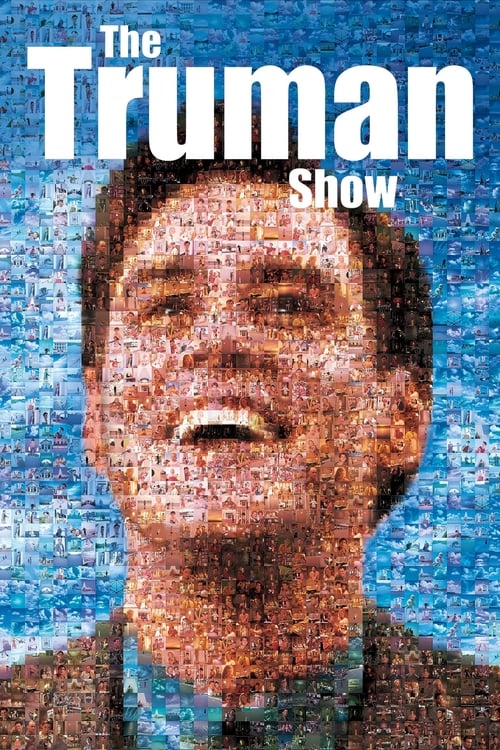
The Truman Show
"On the air. Unaware."
Overview
"The Truman Show" tells the extraordinary story of Truman Burbank, a cheerful and kind-hearted insurance salesman living in the idyllic island town of Seahaven. He believes his life is perfectly ordinary, complete with a loving wife, Meryl, and a loyal best friend, Marlon. However, Truman is completely unaware that he is the star of a 24/7 reality television show that has been broadcasting his entire existence to a global audience since the moment he was born.
Seahaven itself is a massive, technologically advanced soundstage, and everyone in Truman's life, including his family and friends, are paid actors. The show's visionary and often ruthless creator, Christof, orchestrates every aspect of Truman's life from a control room high in the dome's artificial sky. As Truman approaches his 30th birthday, a series of bizarre and inexplicable events begin to unravel the fabric of his carefully constructed reality. A stage light falls from the sky, a radio broadcast details his every move, and he encounters his supposedly deceased father. These glitches in the production spark a growing suspicion in Truman, leading him to question the world around him and igniting a desperate desire to escape and discover the truth.
Core Meaning
The core meaning of "The Truman Show" is a profound exploration of reality, free will, and the human condition in the age of mass media. Director Peter Weir wanted to explore the idea of a controlled existence and the innate human drive to seek authenticity and freedom. The film serves as a powerful allegory for how media and societal expectations can shape and manipulate our lives, often without our consent or knowledge.
At its heart, the film champions the unrelenting pursuit of truth. Truman's journey is a testament to the individual's courage to question a presented reality, even when it is comfortable and safe. Christof's statement, "We accept the reality of the world with which we're presented," is the central thesis the film challenges. Truman’s ultimate choice to leave his fabricated world for an unknown, but real, future suggests that an authentic life, with all its imperfections and struggles, is more valuable than a manufactured paradise. It is a celebration of self-determination and the idea that true humanity lies in the freedom to make one's own choices, unobserved and unscripted.
Thematic DNA
Reality vs. Illusion
This is the central theme of the film. Truman's entire life is a meticulously crafted illusion, a television show set in the idyllic but artificial town of Seahaven. The film constantly blurs the lines between what is real and what is staged. For Truman, the illusion is his only reality until glitches in the production force him to question everything. The film critiques our own media-saturated lives, suggesting that we, too, might accept constructed realities presented to us through television, social media, and advertising. Christof's assertion that the outside world is no more real than the one he created for Truman forces the audience to reflect on the authenticity of their own lives.
Control and Free Will
Christof, the show's creator, acts as a god-like figure, controlling every aspect of Truman's world, from the weather to his personal relationships. This totalitarian control is designed to keep Truman docile and prevent him from discovering the truth. For example, Truman's fear of water was deliberately instilled in him by staging his father's "death" at sea to curb his innate desire to explore. Truman's journey is a powerful struggle for autonomy and free will. His ultimate decision to leave the dome, choosing the unpredictable real world over a safe, controlled existence, is a triumphant assertion of his individuality and right to self-determination.
The Power and Ethics of Media
"The Truman Show" was remarkably prescient, anticipating the rise of reality television and the ethical dilemmas it poses. The film scrutinizes media voyeurism and the commercialization of human life. Truman is unknowingly exploited for global entertainment and profit, his most intimate moments broadcast to billions. The constant product placement by his "wife" Meryl is a sharp satire of consumer culture. The film raises critical questions about privacy, consent, and the moral responsibility of creators and consumers of media. The ending, where viewers immediately look for another show after Truman escapes, critiques the audience's fleeting attention and insatiable appetite for entertainment.
Authenticity and the Human Spirit
Despite living in a completely artificial world, Truman himself is genuine. His emotions, his kindness, and his curiosity are real, which is why the global audience is so captivated. His name, Truman (True-Man), is a direct reference to this. The film suggests that while our environment can be manipulated, the core of the human spirit—the desire for connection, love, and truth—is indomitable. Truman's yearning for Sylvia, a woman who showed him a moment of genuine connection, becomes the catalyst for his quest for freedom, highlighting the fundamental human need for authentic relationships over scripted ones.
Character Analysis
Truman Burbank
Jim Carrey
Motivation
Truman's primary motivation is to find authenticity and freedom, which is crystallized in his desire to travel to Fiji to find Sylvia (Lauren), the one person who he felt a genuine connection with. This longing for a real relationship fuels his quest to break free from the mundane and controlled life he leads in Seahaven.
Character Arc
Truman begins as a cheerful, naive, and content individual, blissfully unaware of his imprisonment. His arc is one of awakening and rebellion. Sparked by strange occurrences and a longing for a lost love, he transforms from a passive participant in his own life into an active seeker of truth. He confronts his deepest fears, challenges the authority that governs him, and ultimately chooses the terrifying uncertainty of freedom over the comfortable security of his cage, embodying the triumph of the human spirit.
Christof
Ed Harris
Motivation
Christof is motivated by a complex mixture of artistic ambition, a desire for control, and a twisted form of paternal love. He aims to create the ultimate work of art, a genuinely real life captured on television. He believes he has created a utopia for Truman and is giving hope and inspiration to millions, justifying his extreme manipulation and stripping of Truman's autonomy.
Character Arc
Christof is the visionary and tyrannical creator of "The Truman Show." He remains a static character, convinced of his righteousness throughout the film. He sees himself not as a jailer, but as a benevolent protector, shielding Truman from the perceived evils of the real world. His arc is less a development and more a revelation of his hubris and god complex. He genuinely seems to care for Truman in a warped, proprietary way, but is willing to psychologically torture and nearly kill him to maintain control of his creation. His failure to keep Truman in the dome represents the failure of absolute control in the face of the human desire for freedom.
Meryl Burbank / Hannah Gill
Laura Linney
Motivation
Hannah Gill's motivation is purely professional and financial. She is an actress in a role of a lifetime. Her primary goal is to perform her part as Truman's wife convincingly, follow Christof's directions, and maintain the illusion of their perfect life. She prioritizes her career and the success of the show over any genuine concern for Truman's well-being.
Character Arc
As an actress playing Truman's wife, Meryl's arc involves the increasing difficulty of maintaining her role as Truman's suspicion grows. Initially, she is the perfect, cheerful 1950s-style wife, but her facade cracks under pressure. Her character is a living embodiment of the show's artificiality, constantly performing and inserting blatant product placements into her conversations. When Truman's behavior becomes erratic and threatening, she breaks character completely, revealing the lie and her own fear. She is ultimately written out of the show, unable to contain the reality she was hired to suppress.
Marlon / Louis Coltrane
Noah Emmerich
Motivation
Louis's motivation is to fulfill his role as Truman's best friend as directed by Christof. He is the show's safety net, brought in whenever Truman is close to discovering the truth. He delivers heartfelt, but completely fabricated, monologues to reassure Truman and reinforce the authenticity of their world. Actor Noah Emmerich believed his character felt a real bond and the burden of his betrayal.
Character Arc
Marlon is Truman's lifelong best friend, but like everyone else, he is an actor named Louis. His character appears to have the most genuine conflict about his role. He delivers scripted lines from Christof to placate Truman's fears and keep him in Seahaven, most notably in the poignant scene on the bridge. While he is a key tool of manipulation for the show, there are hints of real affection and guilt in his performance, suggesting a man burdened by the betrayal of a friendship that, for him, might feel partially real.
Sylvia / Lauren Garland
Natascha McElhone
Motivation
Sylvia's motivation is driven by her genuine affection for Truman and her moral outrage at his exploitation. She is the only character within the show's narrative who actively tries to free him. After being removed, she dedicates herself to exposing the show and waits for the day he might escape.
Character Arc
Sylvia is an extra who was never meant to be a major part of Truman's life but becomes the catalyst for his awakening. During a brief, unscripted encounter, she develops genuine feelings for Truman and attempts to reveal the truth to him before being forcibly removed from the show. Her arc takes place mostly outside the dome, where she becomes a leading voice in the "Free Truman" campaign, watching him from the real world and advocating for his liberation. She represents hope, truth, and the possibility of an authentic life for Truman.
Symbols & Motifs
The Dome / Seahaven
The gigantic dome that houses Seahaven symbolizes the boundaries of Truman's known world and the limitations of his perceived reality. It represents the comfortable but artificial prison created for him. It can also be seen as an allegory for Plato's Cave, where Truman is a prisoner who only knows the shadows on the wall, unaware of the true world outside.
The dome is the physical and metaphorical container of Truman's entire life. The painted sky, the controlled weather, and the physical wall he eventually crashes into all serve as constant reminders of his confinement. His final act of defiance is finding the door in the dome's wall and stepping through it.
Water
Water symbolizes both Truman's greatest fear and his only path to freedom. The producers instilled in him a deep-seated aquaphobia by staging his father's drowning to prevent him from leaving the island of Seahaven. Therefore, overcoming his fear of water is synonymous with overcoming the psychological control exerted over him.
Throughout the film, Truman is shown to be terrified of crossing the bridge over the water or even going to the beach. His ultimate escape involves conquering this fear by sailing a small boat across the man-made sea, enduring a violent, artificial storm orchestrated by Christof, which represents the final, desperate attempt to control him.
The Exit Door
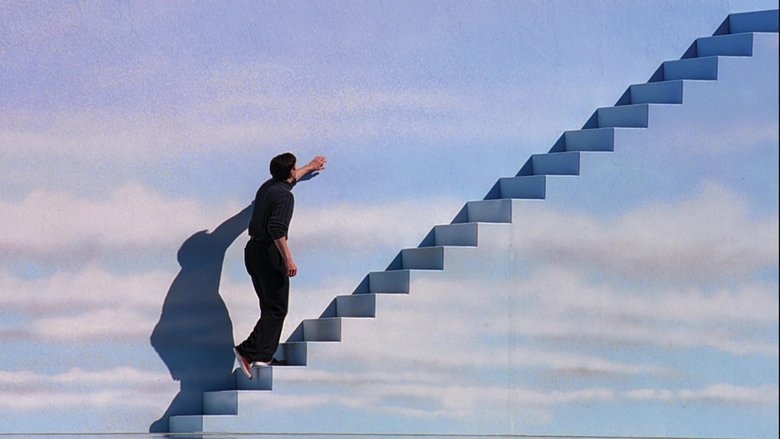
The simple door in the sky-painted wall of the dome, with a staircase leading up to it, represents the gateway to truth, reality, and the unknown. It is the threshold between his manufactured life and an authentic, unscripted existence. Choosing to walk through it is Truman's ultimate act of self-liberation.
After his boat hits the wall of the dome, Truman discovers the staircase and the exit door. In his final confrontation, Christof's disembodied voice speaks to him from the heavens, urging him to stay in the safe, predictable world of the show. Truman's choice to turn his back on his creator and walk through the door into darkness signifies his embrace of free will and the unpredictable nature of real life.
Falling Stage Light (Sirius)
The stage light that falls from the sky early in the film, labeled "Sirius (Canis Major)," is a physical manifestation of the cracks appearing in Truman's reality. It's a piece of the artificial world breaking down, a literal star falling from his fake heaven. It symbolizes that the truth, no matter how well-hidden, will eventually reveal itself.
The light crashes onto the street near Truman's house. A radio broadcast quickly explains it away as a part from a disintegrating aircraft, but the event is too strange for Truman to ignore. It becomes one of the first major catalysts for his suspicion that his world is not what it seems.
Memorable Quotes
Good morning, and in case I don't see ya, good afternoon, good evening, and good night!
— Truman Burbank
Context:
Truman says this line throughout the film as part of his daily routine. The final time is his last line in the film, delivered with a smile and a bow directly to the hidden camera (and to Christof) before he steps through the exit door into the real world.
Meaning:
This is Truman's signature catchphrase, a cheerful greeting he says to his neighbors and into the mirror. Initially, it represents his naive and routine-bound existence. However, when he says it for the final time before exiting the dome, it becomes a powerful, poignant, and defiant farewell to his captors and the global audience, signifying he is taking control of his own narrative.
We accept the reality of the world with which we're presented. It's as simple as that.
— Christof
Context:
Christof says this during an in-show interview when asked why Truman has gone almost 30 years without discovering the truth. He delivers the line with confidence, revealing his cynical view of human nature and his justification for the entire project.
Meaning:
This line is Christof's explanation for why Truman has never seriously questioned his reality before. It is the philosophical core of the film, suggesting that people are conditioned to accept their circumstances without question, especially if they are comfortable. The entire film serves as a rebuttal to this idea, as Truman ultimately rejects his presented reality.
I am the creator... of a television show that gives hope and joy and inspiration to millions.
— Christof
Context:
Christof says this during the televised interview, defending his show against criticism. He speaks with an air of immense pride and artistic authority, completely convinced of the moral righteousness of his life's work.
Meaning:
This quote perfectly encapsulates Christof's god complex and his self-perceived benevolence. He sees himself not as a manipulative captor but as a gifted artist providing a valuable service to the world and a perfect life for his star. It highlights his profound delusion and the moral justification he has constructed for his actions.
You never had a camera in my head!
— Truman Burbank
Context:
After his boat hits the wall of the dome, Christof speaks to Truman directly for the first time. He argues that he knows Truman better than Truman knows himself. Truman screams this line back at the sky, rejecting Christof's claim to total ownership over his being.
Meaning:
This is Truman's powerful retort to Christof during their final confrontation. It asserts that while his external world was completely controlled, his mind, his thoughts, and his spirit remained his own. It is a declaration of inner freedom and the ultimate limit of Christof's power. It echoes the sentiment of philosophers like Descartes, affirming the sovereignty of the individual mind.
Philosophical Questions
What is the nature of reality?
The film is a deep dive into epistemology, the branch of philosophy concerned with knowledge and reality. It directly engages with skeptical thought experiments like Plato's Allegory of the Cave and Descartes' Evil Genius. Truman is the prisoner in the cave who sees only shadows (the staged reality of Seahaven) and eventually breaks free to see the true world. Christof acts as the 'evil genius' deceiving Truman into accepting an illusion as reality. The film forces viewers to ask: How can we be certain that our own reality isn't a similar construction? Christof's quote, "We accept the reality of the world with which we're presented," suggests that reality is subjective and easily manipulated.
Do we have free will, or is our life predetermined?
This question is explored through the conflict between Truman and Christof. Christof represents determinism; he has scripted Truman's life, engineered his phobias, and chosen his wife, all to guide him along a predictable path. Truman's growing suspicion and eventual escape represent the assertion of free will. His unpredictable actions, driven by his innate curiosity and desire for freedom, constantly challenge Christof's control. The film ultimately sides with the existence of free will, suggesting that even in a completely controlled environment, the human spirit's drive to choose its own destiny cannot be entirely suppressed.
Is a safe, happy, and controlled life preferable to a free but potentially painful one?
This is the central ethical dilemma presented to Truman in the film's climax. Christof offers him a choice: stay in the perfect, safe world of Seahaven where he is the star and will never face true harm, or enter the real world, which Christof describes as equally deceptive and far more dangerous. This is a variation of Robert Nozick's "Experience Machine" thought experiment. Truman's choice to leave signifies that authenticity, truth, and the freedom to experience both joy and pain are more valuable than a life of manufactured happiness and security.
Alternative Interpretations
Religious Allegory
One of the most common alternative interpretations views the film as a religious or spiritual allegory. In this reading, Truman represents humanity (a "True Man"), and Christof is a god-like figure. Christof's name itself is a clear allusion to "Christ." He creates Truman's world, watches over him from the heavens (the control room in the moon), speaks to him with a disembodied voice, and controls every aspect of his existence. Truman's journey can be seen as humanity's struggle with faith, the problem of evil (as Christof is both a loving creator and a cruel manipulator), and the ultimate choice to leave the safety of the garden (Seahaven) to gain knowledge and free will in the flawed, real world. His escape is akin to a spiritual awakening or breaking free from a dogmatic system.
The Ending as a Metaphor for Death
A darker interpretation suggests Truman's exit from the dome is a metaphor for death. He sails to the edge of his known universe, faces his creator, and then walks into a dark, unknown void. The peaceful acceptance and his final bow could be seen as an embrace of the inevitable. In this view, the "real world" he enters is the afterlife. The audience's immediate channel-surfing after his departure could symbolize how quickly life moves on after someone dies. This interpretation posits that freedom from the prison of existence can only be found in death.
A Critique of the American Dream
Seahaven is presented as the perfect, idyllic American suburb, complete with white picket fences, friendly neighbors, and a stable job—a quintessential representation of the American Dream. The film can be interpreted as a critique of this ideal, suggesting that its perfect surface is an artificial, confining, and ultimately unfulfilling construction. Truman's desire to escape this "paradise" reflects a rejection of a safe, consumer-driven, and conformist lifestyle in favor of the messy, unpredictable, but authentic experiences that define a truly meaningful life.
Cultural Impact
A Prophecy of Reality TV
Released just before the explosion of reality television, "The Truman Show" is often cited as being eerily prophetic. It anticipated the ethical and moral questions surrounding shows like Big Brother and Survivor, which turn ordinary people's lives into entertainment. The film's critique of voyeurism, the commercialization of private life, and the manipulation of reality for ratings became incredibly relevant in the years that followed its release.
The Truman Show Delusion
The film's impact was so profound that it inspired the term "The Truman Show Delusion" or "Truman Syndrome," a psychological condition where individuals believe they are the unwitting star of a reality show. Psychiatrists Joel and Ian Gold, who coined the term, noted cases of patients who believed their lives were being secretly filmed and broadcast. This demonstrates the film's powerful resonance with modern anxieties about surveillance and authenticity in a media-saturated world.
Philosophical and Academic Influence
"The Truman Show" is frequently used in academic and philosophical discussions to illustrate concepts like Plato's Allegory of the Cave, existentialism, skepticism, and media ethics. Its accessible narrative provides a compelling framework for exploring complex questions about the nature of reality, free will, and the construction of identity. The film is a staple in media studies, sociology, and philosophy courses for its rich thematic content.
Critical and Audience Reception
Upon its release, the film was a critical and commercial success, earning over $264 million worldwide. Critics praised Peter Weir's direction, Andrew Niccol's innovative script, and especially Jim Carrey's nuanced performance, which proved he could handle dramatic roles beyond his well-known comedic persona. The film received three Academy Award nominations and is widely regarded as a modern classic, praised for its intelligence, originality, and emotional depth.
Audience Reception
Audience reception for "The Truman Show" has been overwhelmingly positive since its release. On review aggregation sites like Rotten Tomatoes and IMDb, it holds consistently high audience scores. Viewers widely praise the film for its originality, intelligence, and emotional depth. Many find the concept both fascinating and thought-provoking, leading to extensive online discussions about its themes and meaning decades after its release.
Jim Carrey's performance is a major point of praise. Audiences were impressed and moved by his ability to transition from his usual comedic style to portray Truman's journey with sensitivity and pathos. The supporting cast, especially Ed Harris as the chillingly calm Christof, is also highly regarded. The primary point of criticism, though minor, is sometimes directed at the perceived sentimentality of the ending for some viewers. However, most find the conclusion to be a powerful and uplifting climax. Overall, audiences view "The Truman Show" as a rare example of a big-budget Hollywood film that is both entertaining and intellectually profound.
Interesting Facts
- The film was shot in Seaside, Florida, a real master-planned community whose idyllic, somewhat artificial aesthetic was perfect for the fictional town of Seahaven.
- The original script by Andrew Niccol was much darker and was set in a fake New York City. Director Peter Weir decided to give it a lighter, more satirical tone to make the concept more palatable.
- Ed Harris, who plays Christof, was a last-minute replacement for Dennis Hopper, who was originally cast but was fired after a few days.
- Jim Carrey and Ed Harris never met during filming. Their characters only interact via voiceover, so the actors did not need to be on set at the same time.
- Jim Carrey took a significant pay cut, from his usual $20 million fee to $12 million, to star in the film, as he was passionate about the script and wanted to take on a more dramatic role.
- Director Peter Weir wrote a 10-page backstory for the fictional TV show, detailing its history and how it evolved from a show about a baby to documenting Truman's entire life.
- The film's concept has led to a psychological condition known as "The Truman Show Delusion," where individuals believe their lives are staged reality shows.
- Every street name in Seahaven is named after a famous actor (e.g., Lancaster Square, Barrymore Road), and the main characters' names (Meryl, Marlon, Kirk) are also nods to movie stars.
- Peter Weir considered a meta-theatrical idea of installing video cameras in the movie theaters and, at a key moment, cutting from the film to a live shot of the audience watching it.
Easter Eggs
In the travel agency scene, the poster on the wall shows an airline with a lightning bolt striking its tail, a subliminal message designed to reinforce Truman's fear of travel.
This is a subtle example of the constant, low-level psychological manipulation used by the producers to keep Truman contained in Seahaven. The fear of flying, combined with his fear of water, effectively landlocks him on the island.
The vitamin D bottle on Meryl's breakfast counter is prominently displayed. She tells Truman he needs more of it because he works indoors.
This is a clever nod to the fact that their "sun" is an artificial light inside a dome, meaning Truman would not get natural vitamin D. It's a piece of the show's internal logic that also functions as product placement.
During a flashback to their college days, Meryl is seen with her fingers crossed behind her back when Truman asks her to promise she'll never leave him.
This small visual cue foreshadows her eventual departure and reveals the inherent dishonesty in their relationship from the very beginning. She is an actress performing a role, and her promises are part of the script, not a genuine commitment.
⚠️ Spoiler Analysis
Click to reveal detailed analysis with spoilers
Frequently Asked Questions
Explore More About This Movie
Dive deeper into specific aspects of the movie with our detailed analysis pages
Comments (0)
No comments yet. Be the first to share your thoughts!