"On the air. Unaware."
The Truman Show - Symbolism & Philosophy
Symbols & Motifs
The Dome / Seahaven
The gigantic dome that houses Seahaven symbolizes the boundaries of Truman's known world and the limitations of his perceived reality. It represents the comfortable but artificial prison created for him. It can also be seen as an allegory for Plato's Cave, where Truman is a prisoner who only knows the shadows on the wall, unaware of the true world outside.
The dome is the physical and metaphorical container of Truman's entire life. The painted sky, the controlled weather, and the physical wall he eventually crashes into all serve as constant reminders of his confinement. His final act of defiance is finding the door in the dome's wall and stepping through it.
Water
Water symbolizes both Truman's greatest fear and his only path to freedom. The producers instilled in him a deep-seated aquaphobia by staging his father's drowning to prevent him from leaving the island of Seahaven. Therefore, overcoming his fear of water is synonymous with overcoming the psychological control exerted over him.
Throughout the film, Truman is shown to be terrified of crossing the bridge over the water or even going to the beach. His ultimate escape involves conquering this fear by sailing a small boat across the man-made sea, enduring a violent, artificial storm orchestrated by Christof, which represents the final, desperate attempt to control him.
The Exit Door
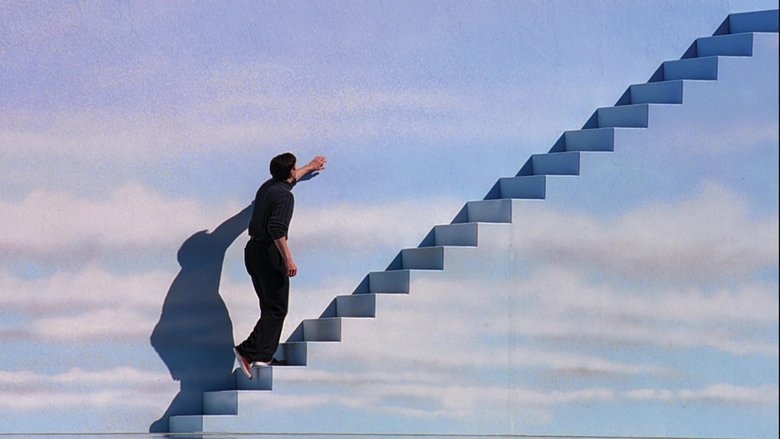
The simple door in the sky-painted wall of the dome, with a staircase leading up to it, represents the gateway to truth, reality, and the unknown. It is the threshold between his manufactured life and an authentic, unscripted existence. Choosing to walk through it is Truman's ultimate act of self-liberation.
After his boat hits the wall of the dome, Truman discovers the staircase and the exit door. In his final confrontation, Christof's disembodied voice speaks to him from the heavens, urging him to stay in the safe, predictable world of the show. Truman's choice to turn his back on his creator and walk through the door into darkness signifies his embrace of free will and the unpredictable nature of real life.
Falling Stage Light (Sirius)
The stage light that falls from the sky early in the film, labeled "Sirius (Canis Major)," is a physical manifestation of the cracks appearing in Truman's reality. It's a piece of the artificial world breaking down, a literal star falling from his fake heaven. It symbolizes that the truth, no matter how well-hidden, will eventually reveal itself.
The light crashes onto the street near Truman's house. A radio broadcast quickly explains it away as a part from a disintegrating aircraft, but the event is too strange for Truman to ignore. It becomes one of the first major catalysts for his suspicion that his world is not what it seems.
Philosophical Questions
What is the nature of reality?
The film is a deep dive into epistemology, the branch of philosophy concerned with knowledge and reality. It directly engages with skeptical thought experiments like Plato's Allegory of the Cave and Descartes' Evil Genius. Truman is the prisoner in the cave who sees only shadows (the staged reality of Seahaven) and eventually breaks free to see the true world. Christof acts as the 'evil genius' deceiving Truman into accepting an illusion as reality. The film forces viewers to ask: How can we be certain that our own reality isn't a similar construction? Christof's quote, "We accept the reality of the world with which we're presented," suggests that reality is subjective and easily manipulated.
Do we have free will, or is our life predetermined?
This question is explored through the conflict between Truman and Christof. Christof represents determinism; he has scripted Truman's life, engineered his phobias, and chosen his wife, all to guide him along a predictable path. Truman's growing suspicion and eventual escape represent the assertion of free will. His unpredictable actions, driven by his innate curiosity and desire for freedom, constantly challenge Christof's control. The film ultimately sides with the existence of free will, suggesting that even in a completely controlled environment, the human spirit's drive to choose its own destiny cannot be entirely suppressed.
Is a safe, happy, and controlled life preferable to a free but potentially painful one?
This is the central ethical dilemma presented to Truman in the film's climax. Christof offers him a choice: stay in the perfect, safe world of Seahaven where he is the star and will never face true harm, or enter the real world, which Christof describes as equally deceptive and far more dangerous. This is a variation of Robert Nozick's "Experience Machine" thought experiment. Truman's choice to leave signifies that authenticity, truth, and the freedom to experience both joy and pain are more valuable than a life of manufactured happiness and security.
Core Meaning
The core meaning of "The Truman Show" is a profound exploration of reality, free will, and the human condition in the age of mass media. Director Peter Weir wanted to explore the idea of a controlled existence and the innate human drive to seek authenticity and freedom. The film serves as a powerful allegory for how media and societal expectations can shape and manipulate our lives, often without our consent or knowledge.
At its heart, the film champions the unrelenting pursuit of truth. Truman's journey is a testament to the individual's courage to question a presented reality, even when it is comfortable and safe. Christof's statement, "We accept the reality of the world with which we're presented," is the central thesis the film challenges. Truman’s ultimate choice to leave his fabricated world for an unknown, but real, future suggests that an authentic life, with all its imperfections and struggles, is more valuable than a manufactured paradise. It is a celebration of self-determination and the idea that true humanity lies in the freedom to make one's own choices, unobserved and unscripted.