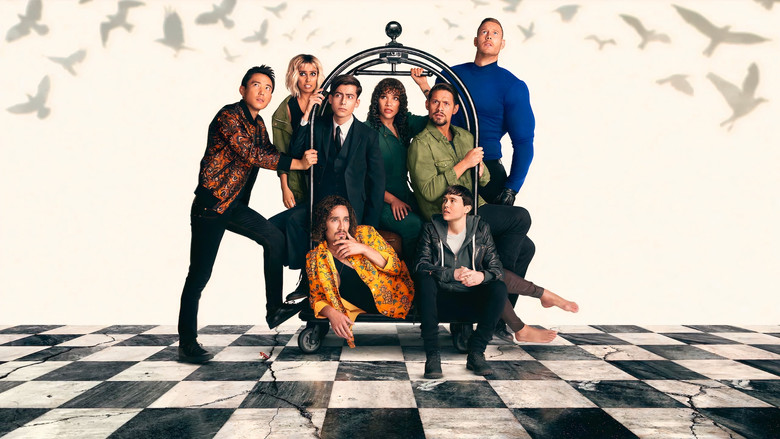

"Too many siblings. Not enough timeline."
The Umbrella Academy - Symbolism & Philosophy
Symbols & Motifs
Umbrellas
The umbrella symbolizes both flawed protection and unity. An umbrella shields from a storm, which is what the Academy was intended to do for the world. However, it's an imperfect shield. Internally, the 'Academy' as an institution failed to protect the children from their father, Sir Reginald. The symbol thus represents their collective identity and potential for unity, but also the inherent dysfunction and trauma of their upbringing.
The symbol is ubiquitous, appearing on their uniforms, the mansion's architecture, and as the group's namesake. It is a constant visual reminder of the ideal they were meant to embody and the fractured reality of their family.
The Moon
The Moon primarily symbolizes isolation and serves as a literal and figurative prison. It is the site of Luther's lonely exile, a mission given to him by his father that ultimately proved meaningless. This reinforces the theme of Reginald's cruel manipulation and the profound loneliness each sibling feels. It also becomes the direct cause of the first apocalypse when Viktor shatters it, turning a symbol of isolation into an instrument of destruction.
Luther's backstory is defined by his time on the moon, a fact that deeply impacts his psyche in Season 1. In the season finale, the moon's destruction is the ultimate apocalyptic event they fail to prevent, making it a pivotal plot device and symbol.
Dance Sequences
The recurring, often surreal, dance sequences symbolize moments of pure, unadulterated connection and emotional expression among the siblings. In a family that struggles to communicate verbally, dancing becomes a non-verbal language of unity, joy, and temporary escape from their trauma and the impending doom. It's when they are most in sync, acting as a genuine family rather than a dysfunctional team.
Iconic dance scenes appear in every season. The most famous is the "I Think We're Alone Now" sequence in the pilot, which perfectly establishes their individual personalities and shared history. Other examples include the wedding dance in Season 3's "Wedding at the End of the World" and various whimsical moments that break the tension of the narrative.
Marigold
Introduced in the final season, the Marigold is the alien energy source that gave the siblings their powers. It symbolizes their very existence as a cosmic mistake or paradox. It is the root of their special abilities but also the reason the timeline is constantly shattering, linking their existence directly to the apocalyptic threat. Its erasure is presented as the only way to restore balance to the universe.
In Season 4, it's revealed that Sir Reginald Hargreeves unleashed the Marigold on Earth. The siblings learn that to truly save the world, all traces of the Marigold—including themselves—must be consumed by 'The Cleanse,' leading to their ultimate sacrifice. The final shot of marigold flowers blooming suggests their essence endures.
Philosophical Questions
Can you escape your past, or are you destined to repeat its mistakes?
The series explores this through its time-traveling, cyclical narrative. The Hargreeves siblings constantly try to escape the trauma of their upbringing and prevent apocalypses, yet their unresolved issues and knee-jerk reactions often lead them to replicate the very disasters they flee. Five is trapped in a literal loop of trying to fix a broken future, while his siblings are in an emotional loop, struggling with the same insecurities and resentments. The series suggests that breaking these cycles requires not a change in circumstance (like time travel) but a profound internal change: confronting trauma, forgiving, and choosing to act differently. Their final act of self-erasure is the ultimate breaking of the cycle, suggesting some destinies can only be escaped through ultimate sacrifice.
What is the true meaning of family?
The Umbrella Academy deconstructs the traditional notion of family. The siblings were raised together but were never a true family due to the lack of love and emotional connection. The show argues that family is not about biology or shared living space, but about a conscious, continuous choice to support and accept one another. Their journey is a testament to this, as they slowly, painfully learn to overcome Reginald's programming and form genuine bonds. The introduction of the Sparrow Academy in Season 3 further explores this, presenting a team that is more efficient as superheroes but even more dysfunctional as a family, reinforcing the idea that shared trauma alone does not create a loving home.
Does immense power absolve one of moral responsibility?
This question is central to Allison's character arc. Her ability to rewrite reality is incredibly powerful, and she initially uses it with little thought to the ethical consequences. As the series progresses, she is forced to confront the harm she has caused. However, after experiencing profound loss, she regresses, believing her suffering gives her the right to use her power to get what she wants, regardless of who it hurts. Her journey serves as a cautionary tale, suggesting that power doesn't negate morality; it amplifies the need for it. The series constantly questions whether the siblings' attempts to 'save the world' justify their often chaotic and destructive methods.
Core Meaning
The core meaning of The Umbrella Academy is an exploration of familial trauma and the long, messy, and often paradoxical journey toward healing and self-acceptance. The series posits that the greatest superpower isn't controlling reality or time, but the ability to break destructive cycles and form genuine connections despite a deeply fractured past. Through their repeated failures and small victories, the creators, Steve Blackman and Jeremy Slater, suggest that family is not defined by shared blood or a common mission, but by the conscious choice to show up for one another, flaws and all. The recurring apocalypses serve as a grand metaphor for the internal cataclysms wrought by their upbringing; saving the world is secondary to saving themselves from the emotional wreckage of their father's impossible expectations. Ultimately, the series argues that one's identity is not predetermined by destiny or a dysfunctional past, but is forged in the struggle to find love and belonging.