The Umbrella Academy
"Too many siblings. Not enough timeline."
Overview
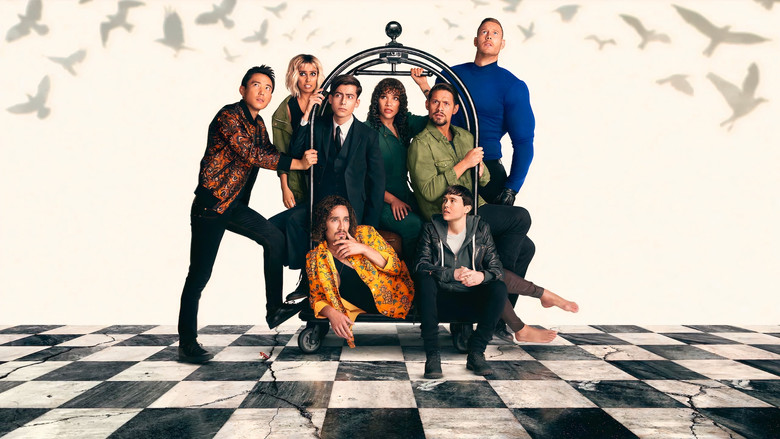
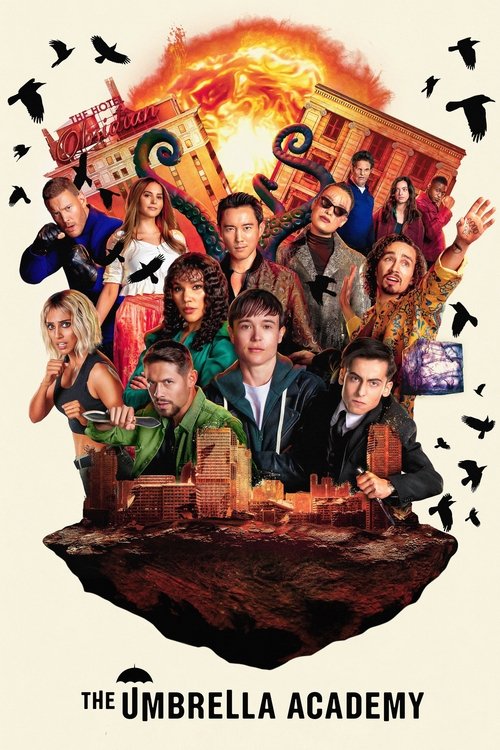
Based on the comic book series by Gerard Way and Gabriel Bá, The Umbrella Academy follows a dysfunctional family of adopted sibling superheroes who reunite after their father's mysterious death. Raised by the eccentric and emotionally distant billionaire Sir Reginald Hargreeves, the seven siblings—each with extraordinary abilities—were trained to save the world. Now adults, they are estranged and broken by their traumatic childhoods. Their reunion forces them to confront their personal demons and strained relationships while grappling with the imminent threat of a global apocalypse—a threat that seems to follow them through time.
Across its four seasons, the series sees the Hargreeves siblings repeatedly time-traveling to prevent world-ending catastrophes, only to often be the inadvertent cause of them. From the 1960s Dallas to an alternate present where they've been replaced by the 'Sparrow Academy,' they battle assassins, secret organizations, and cosmic paradoxes. The core of the story, however, remains their struggle to heal as a family, overcome their shared trauma inflicted by their father, and accept their identities, all while the fate of existence hangs in the balance.
Core Meaning
The core meaning of The Umbrella Academy is an exploration of familial trauma and the long, messy, and often paradoxical journey toward healing and self-acceptance. The series posits that the greatest superpower isn't controlling reality or time, but the ability to break destructive cycles and form genuine connections despite a deeply fractured past. Through their repeated failures and small victories, the creators, Steve Blackman and Jeremy Slater, suggest that family is not defined by shared blood or a common mission, but by the conscious choice to show up for one another, flaws and all. The recurring apocalypses serve as a grand metaphor for the internal cataclysms wrought by their upbringing; saving the world is secondary to saving themselves from the emotional wreckage of their father's impossible expectations. Ultimately, the series argues that one's identity is not predetermined by destiny or a dysfunctional past, but is forged in the struggle to find love and belonging.
Thematic DNA
Dysfunctional Family and Shared Trauma
This is the central theme of the series. The Hargreeves siblings are bound not just by their powers, but by the shared trauma of their abusive and neglectful upbringing under Sir Reginald. Their inability to function as a team in Season 1 stems directly from years of resentment and emotional scars. Throughout the series, their arcs are defined by their attempts to overcome this trauma. For example, Luther must unlearn his desperate need for his father's approval, while Viktor's journey is about overcoming the extreme gaslighting that suppressed his identity and powers. The show consistently argues that their greatest antagonists are not external threats, but the psychological wounds they inflicted on each other as a result of their father's manipulation. Their gradual, painful progress toward becoming a true family is the series' main emotional throughline.
Identity vs. Expectation
Each character grapples with the identity forged for them by Reginald versus the person they want to become. Luther struggles with his role as 'Number One,' Allison with the ethical ramifications of her reality-bending powers, and Diego with his vigilante complex born from a desire to prove his worth. Klaus's journey is a flamboyant rebellion against conformity, while also being a flight from the terrifying nature of his powers. Viktor's entire arc across the series is the most potent exploration of this theme, as he first discovers his suppressed powers and later transitions, fully embracing his true identity in a powerful narrative of self-acceptance supported by his family.
Free Will vs. Destiny
The constant threat of the apocalypse and the mechanics of the Temps Commission raise fundamental questions about fate. Five spends his life fighting a future he has already seen, convinced that it can be changed. The siblings' actions frequently seem to cause the very disasters they are trying to prevent, creating a cyclical, almost deterministic loop of destruction and salvation. The series explores whether their choices truly matter or if they are merely cogs in a cosmic machine. The finale ultimately suggests their very existence is a paradox that shatters timelines, forcing them to make an ultimate choice to erase themselves and break the cycle, questioning if their heroic struggles were destined to end in sacrifice.
The Nature of Power
The Umbrella Academy explores power not just as a superhero ability, but as a corrupting influence and a burden. Allison's power to rewrite reality by saying "I heard a rumor..." is shown to be deeply problematic; she uses it for personal gain, to manipulate her child, and ultimately her siblings, revealing the seductive and dangerous nature of absolute control. Viktor's immense power is directly linked to his emotional state, making his personal stability a matter of global security. The series shows that the siblings' powers have isolated them as much as they have empowered them, serving as a constant source of their trauma and alienation.
Character Analysis
Number Five
Aidan Gallagher
Motivation
His primary motivation is survival and preventing the apocalypse at any cost. This singular focus is a result of decades spent alone in a desolate future. This evolves into a fierce, albeit dysfunctional, desire to protect his family, even if it means making morally gray decisions. He feels an immense burden of knowledge and responsibility, which drives his often-abrasive behavior.
Character Arc
Five begins the series as an arrogant, traumatized old man trapped in a teenager's body, solely focused on stopping the apocalypse he witnessed alone. His arc is about slowly and painfully learning to reconnect with his family and rely on them. Initially, he sees his siblings as incompetent obstacles. Over the seasons, particularly through his relationships with Klaus and his paradoxical love for the mannequin Dolores, he rediscovers his humanity. By the end, while still cynical, he makes decisions for the good of his family, not just the mission. His ultimate realization that the family itself is the problem leads him to guide them toward their final, selfless sacrifice.
Viktor Hargreeves (formerly Vanya Hargreeves)
Elliot Page
Motivation
Initially, his motivation is a desperate search for belonging and acceptance from a family that has always excluded him. This vulnerability makes him susceptible to manipulation. As he gains control of his powers and embraces his identity as Viktor, his motivation shifts to protecting his family and using his incredible abilities responsibly, finally finding the belonging he always craved through self-acceptance.
Character Arc
Viktor's arc is the most transformative. He begins as Vanya, the supposedly ordinary sibling, ostracized and made to feel worthless by her family and father. Her journey in Season 1 is one of discovering her immense, suppressed power, which, when manipulated, leads her to become the apocalyptic White Violin. Across the subsequent seasons, Vanya learns to control her abilities and heal from her trauma. A pivotal moment in Season 3 sees the character transition to Viktor, a storyline handled with sensitivity and acceptance by his family. His arc is a powerful journey of self-discovery and empowerment, moving from the family's most broken member to one of its emotional anchors.
Klaus Hargreeves
Robert Sheehan
Motivation
His primary motivation is to escape pain—the pain of his powers, his traumatic childhood, and his grief. He seeks oblivion through drugs and chaotic behavior. As the series progresses, this evolves into a desire to connect, both with the spirits he can see (especially Ben) and with the living family he continually pushes away. He eventually seeks to master his powers rather than run from them.
Character Arc
Klaus starts as a hedonistic, flamboyant drug addict, using substances to suppress his terrifying ability to communicate with the dead. His arc is a journey from self-destruction to self-acceptance and a surprising level of maturity. His experiences in the Vietnam War during Season 1 and his relationship with Dave mark a turning point, forcing him to confront genuine love and loss. Over the series, he sobers up intermittently and begins to explore the full, incredible potential of his powers, including immortality and manifestation. He evolves from the family's comic relief into its spiritual guide, often providing unexpected moments of wisdom and emotional clarity.
Allison Hargreeves
Emmy Raver-Lampman
Motivation
Her driving motivation is her love for her daughter, Claire. Initially, this is a pure, protective instinct. As she loses more and more, this motivation curdles into a desperate, all-consuming obsession to reunite with Claire, no matter the cost to the world or her siblings. This singular focus drives her to make increasingly selfish and destructive choices.
Character Arc
Allison's arc is a tragic deconstruction of her seemingly perfect life. She begins as a famous actress whose success is built on the unethical use of her reality-warping power. After losing her voice and her family, she is forced to confront the moral cost of her abilities. Her time in the 1960s as a civil rights activist shows her finding a new voice without her powers. However, the trauma of losing her 1960s husband, Raymond, and being separated from her daughter, Claire, across timelines causes her to break bad in later seasons. She becomes darker, more manipulative, and willing to betray her siblings to get what she wants, culminating in a morally ambiguous deal with Reginald that resets the universe but gives her the family she lost.
Luther Hargreeves
Tom Hopper
Motivation
For most of his early life, his motivation was to please his father, Sir Reginald, and to be the perfect leader of the Umbrella Academy. Following his disillusionment, his motivation shifts to protecting his siblings and keeping the family together. He deeply craves connection and a sense of belonging, which drives his often-awkward attempts to foster unity among the group.
Character Arc
Luther begins as the dutiful, unquestioning leader, 'Number One,' whose entire identity is tied to his father's approval and the Umbrella Academy mission. His arc is about liberating himself from this rigid mindset. His discovery that his moon mission was pointless shatters his worldview. Over the seasons, he sheds his blind loyalty and learns to think for himself, often becoming the emotional heart of the group. His love for Allison and later his marriage to Sloane from the Sparrow Academy show him finding a purpose outside of his father's shadow. He evolves from a stiff, melancholic leader into a more relaxed, caring brother who prioritizes his family's well-being over any perceived mission.
Symbols & Motifs
Umbrellas
The umbrella symbolizes both flawed protection and unity. An umbrella shields from a storm, which is what the Academy was intended to do for the world. However, it's an imperfect shield. Internally, the 'Academy' as an institution failed to protect the children from their father, Sir Reginald. The symbol thus represents their collective identity and potential for unity, but also the inherent dysfunction and trauma of their upbringing.
The symbol is ubiquitous, appearing on their uniforms, the mansion's architecture, and as the group's namesake. It is a constant visual reminder of the ideal they were meant to embody and the fractured reality of their family.
The Moon
The Moon primarily symbolizes isolation and serves as a literal and figurative prison. It is the site of Luther's lonely exile, a mission given to him by his father that ultimately proved meaningless. This reinforces the theme of Reginald's cruel manipulation and the profound loneliness each sibling feels. It also becomes the direct cause of the first apocalypse when Viktor shatters it, turning a symbol of isolation into an instrument of destruction.
Luther's backstory is defined by his time on the moon, a fact that deeply impacts his psyche in Season 1. In the season finale, the moon's destruction is the ultimate apocalyptic event they fail to prevent, making it a pivotal plot device and symbol.
Dance Sequences
The recurring, often surreal, dance sequences symbolize moments of pure, unadulterated connection and emotional expression among the siblings. In a family that struggles to communicate verbally, dancing becomes a non-verbal language of unity, joy, and temporary escape from their trauma and the impending doom. It's when they are most in sync, acting as a genuine family rather than a dysfunctional team.
Iconic dance scenes appear in every season. The most famous is the "I Think We're Alone Now" sequence in the pilot, which perfectly establishes their individual personalities and shared history. Other examples include the wedding dance in Season 3's "Wedding at the End of the World" and various whimsical moments that break the tension of the narrative.
Marigold
Introduced in the final season, the Marigold is the alien energy source that gave the siblings their powers. It symbolizes their very existence as a cosmic mistake or paradox. It is the root of their special abilities but also the reason the timeline is constantly shattering, linking their existence directly to the apocalyptic threat. Its erasure is presented as the only way to restore balance to the universe.
In Season 4, it's revealed that Sir Reginald Hargreeves unleashed the Marigold on Earth. The siblings learn that to truly save the world, all traces of the Marigold—including themselves—must be consumed by 'The Cleanse,' leading to their ultimate sacrifice. The final shot of marigold flowers blooming suggests their essence endures.
Memorable Quotes
We didn't choose this life, we're just living in it.
— Number Five
Context:
This line is spoken in Season 1, Episode 6, "The Day That Wasn't," as Five tries to explain the gravity of their situation and the relentless nature of the threats they face.
Meaning:
This quote encapsulates the theme of destiny versus free will that runs through the series. The siblings never asked for their powers or the immense responsibility that came with them. It speaks to their shared sense of being pawns in a cosmic game they don't understand, constantly reacting to apocalyptic threats rather than living their own lives.
If you believe in yourself, just once, great things are gonna happen for you.
— Vanya Hargreeves
Context:
Vanya says this to her student in Season 1, Episode 3, "Extra Ordinary." It's a moment of projecting her own yearning for validation onto someone else.
Meaning:
Spoken by Vanya (now Viktor) before the full discovery of his powers, this quote is deeply ironic yet poignant. It reflects his desperate desire for self-worth after a lifetime of being told he was ordinary and insignificant. The quote becomes a self-fulfilling prophecy, as his belief in himself, manipulated by Leonard, unleashes the very 'great'—and terrible—power that causes the apocalypse.
Eternal peace is probably overrated.
— Klaus Hargreeves
Context:
Klaus makes this remark in Season 1, Episode 7, "The Day That Was," after returning from a brief trip to the afterlife. It showcases his cavalier attitude toward mortality, which is both a coping mechanism and a core part of his identity.
Meaning:
This quip perfectly captures Klaus's character: a tragic figure who uses flamboyant wit to mask deep pain. Having literally died and come back, he has a unique perspective on life and death. The line reflects his embrace of chaos and his reluctance to find peace, as peace would mean confronting the ghosts he's always running from.
We all wanted to be loved by a man incapable of giving love.
— Number Five
Context:
Five delivers this powerful line in Season 2, Episode 6, "A Light Supper," during the tense family dinner where they confront a younger version of Reginald Hargreeves.
Meaning:
This line cuts to the heart of the Hargreeves' collective trauma. It succinctly explains the root of their dysfunction: their entire childhood was a futile quest for affection and approval from their cold, calculating adoptive father, Sir Reginald. This unfulfilled need shaped their personalities, their relationships with each other, and their lifelong insecurities.
The future, it's shit by the way.
— Number Five
Context:
Spoken in the very first episode, "We Only See Each Other at Weddings and Funerals," moments after Five dramatically reappears in the Academy's courtyard, responding to his siblings' questions about where he's been.
Meaning:
This is one of Five's first lines upon his return and it perfectly establishes his blunt, cynical personality and the stakes of the series. It's a darkly comedic summary of his decades-long trauma and serves as the inciting incident for the entire show, immediately plunging his unprepared siblings into a race against time.
Episode Highlights
We Only See Each Other at Weddings and Funerals
The pilot episode masterfully introduces the seven dysfunctional Hargreeves siblings, their powers, and their deeply fractured relationships as they reunite for their father's funeral. It establishes the series' unique tone—a blend of dark humor, family drama, and sci-fi action—and ends with the shocking return of Number Five, who brings with him the news of an impending apocalypse.
This episode lays the groundwork for the entire series. It not only sets up the central mystery of the apocalypse but, more importantly, establishes the core emotional conflict: the family's inability to overcome their shared trauma and work together. The final dance sequence to "I Think We're Alone Now" is an iconic moment that defines the show's quirky style.
I Heard a Rumor
A devastating episode where the family's darkest secrets unravel. It's revealed that Reginald forced Allison to use her powers to convince Vanya she was ordinary, suppressing her abilities. When Vanya discovers this betrayal, she lashes out in a fit of rage, slitting Allison's throat with her violin bow and fully embracing her dark path.
This episode is the emotional climax of the first season. It transforms Vanya (Viktor) from a sympathetic outcast into the story's antagonist, the White Violin, making the impending apocalypse a deeply personal family tragedy rather than just a sci-fi event.
The White Violin
The family confronts Vanya at the Icarus Theater to stop her from causing the apocalypse. In a climactic battle, they manage to subdue her, but inadvertently redirect a beam of energy into the moon, shattering it and causing the very apocalypse they were trying to prevent. To survive, Five time-travels the entire family away to an unknown era.
The finale solidifies the show's core theme of tragic irony. Their attempts to save the world are what doom it, establishing a pattern that continues throughout the series. The cliffhanger ending—with the family's fate unknown—perfectly set the stage for the time-traveling antics of Season 2.
Right Back Where We Started
The Season 2 premiere kicks off with a spectacular action sequence, showing the siblings scattered across the early 1960s in Dallas. Each has built a new life, but their arrival has, once again, started a doomsday clock—this time leading to a nuclear apocalypse related to the JFK assassination. Five arrives last to find a new apocalypse in progress and must rewind time to reunite his family.
This episode serves as a brilliant soft reboot, re-contextualizing the characters in a vibrant historical setting. It immediately raises the stakes and demonstrates the series' confidence by throwing the audience and characters into a new, complex timeline filled with fresh conflicts and opportunities for character growth.
The End of Something
In the Season 2 finale, the siblings successfully prevent the 1963 apocalypse and defeat The Handler. They return to their own time, believing they have finally fixed the timeline. However, they arrive in an altered 2019 where Sir Reginald is alive, and the Umbrella Academy has been replaced by the 'Sparrow Academy,' led by a living, and hostile, Ben.
This episode showcases the siblings at their most united, particularly in their support for Viktor. The finale delivers satisfying emotional resolutions while executing a shocking twist that completely upends the show's status quo, proving that their actions always have unforeseen and massive consequences.
Wedding at the End of the World
With another apocalypse—the Kugelblitz—consuming reality, Luther and Sloane decide to get married, prompting a rare moment of celebration. The episode balances the joy of the wedding with the encroaching dread of oblivion. It features a heartfelt family dance and culminates in Reginald making a dark deal with Allison to reset the universe.
This episode highlights the show's ability to find humanity and humor in the face of annihilation. Luther's wedding is a poignant act of defiance against despair. It also marks a turning point for Allison's character, as her grief and desperation lead her to betray her siblings, setting up the endgame of the season.
Oblivion
Reginald sacrifices Luther and forces the remaining siblings into the portal to the Hotel Oblivion, a machine in another dimension. There, he attempts to use them to fuel a universal reset. Allison, having made a deal with him, kills Reginald but completes the reset herself. The siblings emerge in a new universe, powerless, with Luther resurrected, but Sloane missing.
The episode finally reveals Reginald's true, centuries-long plan: to resurrect his dead wife by rewriting reality. The loss of the siblings' powers creates a completely new paradigm for the final season, stripping them of the very thing that has defined and tormented them their entire lives.
The End of the Beginning
The series finale reveals the ultimate truth: the siblings' very existence, as a result of the 'marigold' particles, is a paradox that constantly splinters the timeline, causing every apocalypse. To save the original timeline and everyone they love, they must allow themselves to be erased from existence by a cosmic 'Cleanse.' In a final, heartbreaking act, they sacrifice themselves, waking up in a restored timeline where they were never born but their loved ones are safe.
The finale brings the series' central themes of sacrifice and destiny to a definitive, poignant conclusion. The Hargreeves' final heroic act is not to fight, but to cease to exist, completing their journey from dysfunctional individuals to a family willing to make the ultimate sacrifice for the greater good. It reframes their entire chaotic journey as a long, painful path to this one moment of pure selflessness.
Philosophical Questions
Can you escape your past, or are you destined to repeat its mistakes?
The series explores this through its time-traveling, cyclical narrative. The Hargreeves siblings constantly try to escape the trauma of their upbringing and prevent apocalypses, yet their unresolved issues and knee-jerk reactions often lead them to replicate the very disasters they flee. Five is trapped in a literal loop of trying to fix a broken future, while his siblings are in an emotional loop, struggling with the same insecurities and resentments. The series suggests that breaking these cycles requires not a change in circumstance (like time travel) but a profound internal change: confronting trauma, forgiving, and choosing to act differently. Their final act of self-erasure is the ultimate breaking of the cycle, suggesting some destinies can only be escaped through ultimate sacrifice.
What is the true meaning of family?
The Umbrella Academy deconstructs the traditional notion of family. The siblings were raised together but were never a true family due to the lack of love and emotional connection. The show argues that family is not about biology or shared living space, but about a conscious, continuous choice to support and accept one another. Their journey is a testament to this, as they slowly, painfully learn to overcome Reginald's programming and form genuine bonds. The introduction of the Sparrow Academy in Season 3 further explores this, presenting a team that is more efficient as superheroes but even more dysfunctional as a family, reinforcing the idea that shared trauma alone does not create a loving home.
Does immense power absolve one of moral responsibility?
This question is central to Allison's character arc. Her ability to rewrite reality is incredibly powerful, and she initially uses it with little thought to the ethical consequences. As the series progresses, she is forced to confront the harm she has caused. However, after experiencing profound loss, she regresses, believing her suffering gives her the right to use her power to get what she wants, regardless of who it hurts. Her journey serves as a cautionary tale, suggesting that power doesn't negate morality; it amplifies the need for it. The series constantly questions whether the siblings' attempts to 'save the world' justify their often chaotic and destructive methods.
Alternative Interpretations
One of the most debated aspects of the series is Sir Reginald Hargreeves's true motivation. One interpretation paints him as a purely Machiavellian villain—an alien who adopted the children solely as tools to power his universe-resetting machine and resurrect his wife, with no genuine affection for them. His abuse and manipulation were calculated steps in his grand design.
An alternative, more charitable interpretation suggests that while his methods were monstrous, he did possess a twisted form of love for the children. This view posits that he understood their paradoxical, world-ending nature and believed that putting them through extreme trauma was the only way to forge them into heroes capable of making the ultimate sacrifice needed to fix the timeline. His final words and actions could be seen as a necessary evil from a being with a cosmic perspective, pushing his children toward a destiny he knew was unavoidable. The ending, therefore, isn't just his victory, but a grim fulfillment of the purpose he created for them.
Furthermore, the series finale can be interpreted in multiple ways. The most direct reading is that the siblings are permanently erased, and their sacrifice created a perfect, stable timeline. However, the final shot of marigold flowers blooming in the park suggests a more ambiguous, poetic interpretation: that while the Hargreeves as individuals are gone, their essence or spirit—their love and sacrifice—has become a natural, beautiful part of this new world, forever embedded in the timeline they saved.
Cultural Impact
The Umbrella Academy premiered in 2019, entering a television landscape saturated with superhero content. However, it distinguished itself by prioritizing dysfunctional family drama over conventional heroics, resonating with audiences fatigued by more straightforward comic book adaptations. Its quirky, Wes Anderson-inspired aesthetic, retro soundtrack, and dark humor set it apart from the grittier Marvel Netflix shows or the interconnected MCU. The series was praised for its character-driven storytelling, with critics noting that the superpowers were often secondary to the emotional and psychological conflicts of the Hargreeves siblings.
The show's first two seasons received strong critical and audience acclaim, with many praising the cast's chemistry and the inventive plot twists. Season 3 was notable for its thoughtful integration of Elliot Page's real-life transition into his character's arc, which was widely commended as a positive and affirming example of transgender representation on screen. However, audience reception saw a decline in the later seasons. Season 3's audience score dropped significantly, and the final, shorter six-episode season received the lowest critic and audience scores in the show's history, with many viewers citing a rushed plot and an unsatisfying conclusion as major issues. Despite the divisive ending, the series has left a mark on pop culture, particularly for its memorable dance sequences and its championing of oddball, deeply flawed characters. Its legacy is that of a show that successfully used the superhero genre as a vibrant, surrealist canvas to explore the enduring themes of trauma, identity, and the messy, beautiful chaos of family.
Audience Reception
The Umbrella Academy was met with a generally positive audience reception for its first two seasons, which hold audience scores of 85% and 88% on Rotten Tomatoes, respectively. Viewers praised the show's unique style, quirky humor, compelling character dynamics, and stellar soundtrack. The chemistry of the main cast was frequently cited as a major strength. Season 3 saw a significant drop in audience approval, with its Rotten Tomatoes score falling to 55%. While some praised the handling of Viktor's transition, others criticized the pacing and the Sparrow Academy storyline. The most significant decline came with the fourth and final season, which received a catastrophically low audience score ( plummeting to as low as 17-18%). The primary complaints centered on the reduced six-episode count, which audiences felt resulted in a rushed narrative, underdeveloped plot points, and a deeply unsatisfying and bleak ending that failed to provide proper closure for characters fans had followed for years. Overall, while the series began as a fan-favorite, its legacy is marred by a finale that many longtime viewers found to be a profound disappointment.
Interesting Facts
- The comic book series was created by Gerard Way, the lead singer of the band My Chemical Romance, and illustrated by Gabriel Bá. Way and Bá serve as executive producers on the Netflix series.
- Showrunner Steve Blackman has cited filmmaker Wes Anderson, particularly his film 'The Royal Tenenbaums,' as a major visual and tonal inspiration for the series, especially in its portrayal of a dysfunctional family of former prodigies.
- In the original comic, the siblings are not as close, and their relationships are even more antagonistic. The show deliberately softened some edges to focus more on the theme of a family trying to heal.
- Elliot Page's transition was incorporated into the third season of the show. Showrunner Steve Blackman worked with Page and GLAAD to ensure Viktor's transition story was told authentically and respectfully.
- The dance numbers, which have become a signature of the show, were not a major part of the original comics but were added by the creative team to provide moments of connection and levity.
- The role of Number Five was highly sought after, but Aidan Gallagher, who was 14 at the time of his audition, was one of the first to be seen and immediately impressed the creators with his ability to portray an old, world-weary man in a young boy's body.
- Many of the elaborate sets, including the main Umbrella Academy mansion, were built on soundstages in Toronto and Hamilton, Ontario, Canada, where the series was primarily filmed.
Easter Eggs
Throughout the series, especially in Season 1, the logo for the evil Temps Commission features a crossed-out equals sign, a subtle nod to the mathematical symbol for 'inequality,' reflecting their mission to maintain a specific, unchangeable timeline.
This is a clever piece of visual design that hints at the Commission's rigid and authoritarian philosophy, viewing any deviation from their prescribed timeline as an 'unequal' or invalid outcome that must be corrected.
In Season 1, when Vanya buys a copy of her own autobiography, 'Extra Ordinary: My Life as Number Seven,' the cover is a direct homage to the cover of the first issue of 'The Umbrella Academy' comic, 'Apocalypse Suite,' which features a similar portrait of Vanya holding a white violin.
This is a direct visual tribute to the source material created by Gerard Way and Gabriel Bá, connecting the show's version of the character back to her comic book origins.
The final scene of the entire series features Tommy James and the Shondells' song 'I Think We're Alone Now,' playing in the park of the new, corrected timeline.
This is a poignant callback to the first iconic dance scene in the pilot episode. Using the original version of the song (Tiffany's cover was used in Season 1) brings the series full circle, signifying a return to a more 'original' and peaceful state, albeit one where the heroes we followed no longer exist.
In Season 3, one of the Sparrows is a floating, telekinetic cube named Christopher.
This bizarre character is lifted directly from the comics. His inclusion is a testament to the show's commitment to embracing the weirdest and most surreal elements of Gerard Way's source material, which features many absurdist concepts.
⚠️ Spoiler Analysis
Click to reveal detailed analysis with spoilers
Frequently Asked Questions
Explore More About This Movie
Dive deeper into specific aspects of the movie with our detailed analysis pages
Comments (0)
No comments yet. Be the first to share your thoughts!