
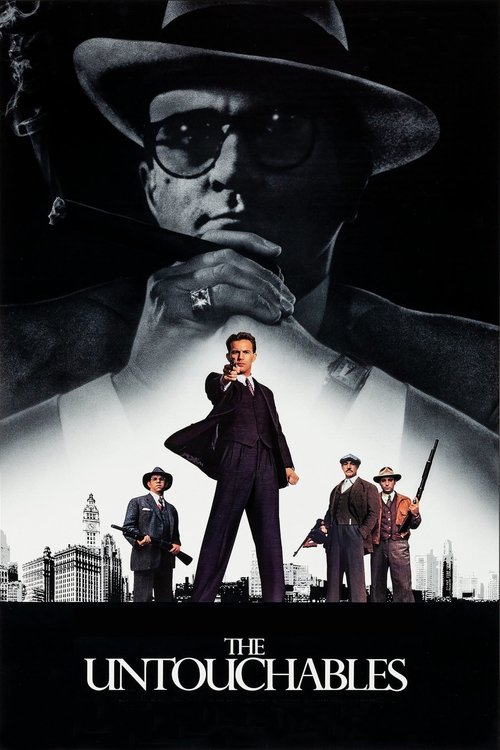
"What are you prepared to do?"
The Untouchables - Symbolism & Philosophy
Symbols & Motifs
The Baby Carriage
Representing innocence amidst chaos, the carriage rolling down the Union Station steps is a visual metaphor for the collateral damage of the war on crime. It raises the stakes, showing that the most vulnerable are caught in the crossfire.
During the climactic shootout at the train station, a mother struggles with a pram. As bullets fly, the carriage tumbles down the stairs in slow motion, creating unbearable tension while Ness tries to save the child and stop the gangsters.
St. Jude Medallion
A symbol of lost causes and police martyrdom. It connects the characters of Malone and Ness through faith and sacrifice.
Malone carries the medallion as the patron saint of police. Before dying, he passes it to Ness (via the bloodied callbox key), and Ness eventually passes it to George Stone, signifying the transfer of the guardian role.
The Baseball Bat
A brutal instrument of totalitarian power. It demonstrates that Capone's charm is a thin veneer over savage violence.
At a dinner party, Capone gives a speech about 'teamwork' while holding a bat, only to suddenly beat a disappointing underling to death in front of his terrified guests.
Capone's White Suits
Irony and false purity. Capone dresses impeccably to hide his moral filth, projecting an image of a legitimate businessman.
Capone is frequently shown in bright, expensive clothing, contrasting with the dark, grey, and brown suits of the Untouchables, visually inverting the traditional 'white hat vs. black hat' trope.
Philosophical Questions
Do the ends justify the means?
The film explicitly asks if breaking the law is acceptable to enforce it. Ness initially refuses to bend the rules, but eventually commits acts that are technically illegal (killing Nitti, coercing witnesses) to stop a greater evil. The film supports Malone's pragmatic consequentialism over Ness's initial deontological ethics.
Is justice possible in a corrupt system?
The film presents a cynical view where the judicial system is impotent against organized money. It suggests that true justice is not found in courtrooms, but through individual acts of courage and violence—a 'natural law' approach that supersedes civic law.
Core Meaning
At its heart, The Untouchables acts as a cinematic debate on the morality of violence and the cost of integrity. Director Brian De Palma transforms a historical police procedural into a mythic struggle between Good and Evil, ultimately asking: 'What are you prepared to do?' The film suggests that in a world devoid of rules, the righteous man must stain his hands to protect the innocent, sacrificing a piece of his soul to save the law.