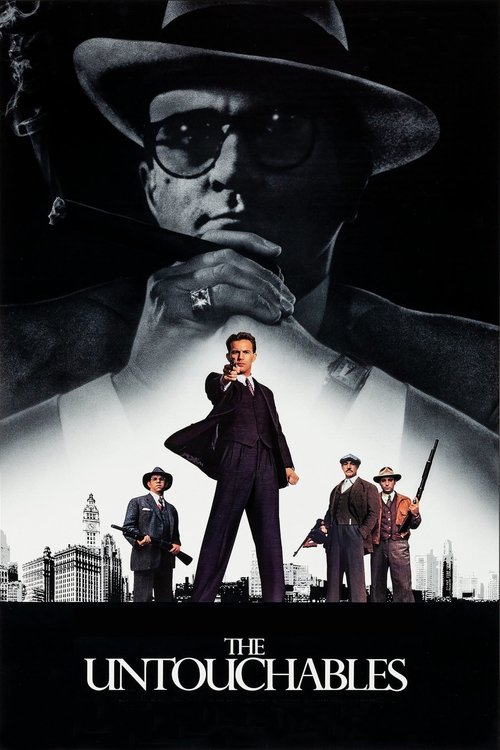
The Untouchables
A mythic Western disguised as a gangster film, pulsing with operatic violence and moral compromise. Amidst the blood-soaked streets of Prohibition Chicago, an idealist learns that justice often requires a gun rather than a gavel.
The Untouchables

The Untouchables

"What are you prepared to do?"

03 June 1987 United States of America 119 min ⭐ 7.8 (6,017)
Director: Brian De Palma
Cast: Kevin Costner, Sean Connery, Robert De Niro, Charles Martin Smith, Andy Garcia
Crime History Thriller
The Chicago Way (Ends vs. Means) Fatherhood and Family Mentorship and Brotherhood Corruption vs. Purity
Budget: $25,000,000
Box Office: $76,270,454

Overview

In 1930s Chicago, Prohibition has turned the city into a war zone controlled by the ruthless crime lord Al Capone. Bureau of Prohibition agent Eliot Ness arrives with a mandate to clean up the streets, but his initial by-the-book raids are thwarted by a deeply corrupt police force. Realizing he cannot trust the established system, Ness seeks out those who operate outside of Capone's payroll.

He forms a small, hand-picked team: Jim Malone, a weary but street-wise Irish beat cop; Oscar Wallace, a bespectacled accountant; and George Stone, a sharp-shooting rookie. Together, they are dubbed 'The Untouchables' by the press for their refusal to take bribes. As they dismantle Capone's liquor empire, the mobster retaliates with escalating brutality, forcing Ness to abandon his high ideals and embrace 'the Chicago Way' to bring Capone to justice.
Core Meaning

At its heart, The Untouchables acts as a cinematic debate on the morality of violence and the cost of integrity. Director Brian De Palma transforms a historical police procedural into a mythic struggle between Good and Evil, ultimately asking: 'What are you prepared to do?' The film suggests that in a world devoid of rules, the righteous man must stain his hands to protect the innocent, sacrificing a piece of his soul to save the law.

Thematic DNA

The Chicago Way (Ends vs. Means) 40%
Fatherhood and Family 25%
Mentorship and Brotherhood 20%
Corruption vs. Purity 15%

The Chicago Way (Ends vs. Means)

The film's central philosophy is articulated by Malone: 'He pulls a knife, you pull a gun.' This theme explores the necessity of escalating violence to combat unchecked evil. Ness begins as a pacifist believer in the written law but learns that legal structures fail against total corruption.

Fatherhood and Family

Ness is motivated primarily by his role as a father and husband, seeking to make a safe world for his family. This is juxtaposed against the 'family' of the mob. The loss of life—specifically the death of a young girl in the opening bombing—serves as the emotional catalyst for the entire narrative.

Mentorship and Brotherhood

The relationship between the weary veteran Malone and the naive Ness forms the film's emotional core. Malone teaches Ness not just police work, but survival. The four 'Untouchables' form a bond of blood that transcends professional duty, making their losses deeply personal.

Corruption vs. Purity

Chicago is depicted as a fallen city where judges and cops are bought. The 'Untouchables' are defined not by their skill, but by their purity—their refusal to be bought. This binary opposition is visually represented in the clash between Ness's drab modesty and Capone's opulent excess.

Character Analysis

Eliot Ness

Kevin Costner

Archetype: The Idealist / The Crusader
Key Trait: Unwavering Integrity

Motivation

To protect his family and restore order to a lawless city. He is driven by a black-and-white sense of right and wrong that is tested by reality.

Character Arc

Starts as a naive, by-the-book bureaucrat who believes the law is enough. Through tragedy and mentorship, he hardens into a ruthless warrior willing to break the rules to enforce them. He ends the film morally compromised but successful.

Jim Malone

Sean Connery

Archetype: The Mentor / The Warrior
Key Trait: Pragmatic Wisdom

Motivation

To strike one final, meaningful blow against the corruption he has hated for years but felt powerless to stop.

Character Arc

A cynical, beat-down street cop who finds a last chance at redemption. He steps out of the shadows to teach Ness how to survive, ultimately sacrificing his life to ensure the mission succeeds.

Al Capone

Robert De Niro

Archetype: The Tyrant / The Shadow
Key Trait: Volatile Charisma

Motivation

Absolute power and the maintenance of his public image. He views his criminal empire as a legitimate business and himself as a public servant.

Character Arc

He begins as the untouchable king of Chicago, reveling in his media celebrity. As his empire crumbles, he descends into rage and desperation, finally reduced to a common criminal fighting a tax evasion charge.

George Stone

Andy Garcia

Archetype: The Sharpshooter / The Rookie
Key Trait: Grace Under Pressure

Motivation

To prove his worth as an American lawman and distance himself from the stereotype of the Italian criminal.

Character Arc

Initially dismissed due to his Italian heritage, he proves his loyalty and skill. He transforms from an academy recruit into a hardened enforcer, eventually catching the symbolic 'baby' (innocence) during the shootout.

Symbols & Motifs

The Baby Carriage

Meaning:

Representing innocence amidst chaos, the carriage rolling down the Union Station steps is a visual metaphor for the collateral damage of the war on crime. It raises the stakes, showing that the most vulnerable are caught in the crossfire.

Context:

During the climactic shootout at the train station, a mother struggles with a pram. As bullets fly, the carriage tumbles down the stairs in slow motion, creating unbearable tension while Ness tries to save the child and stop the gangsters.

St. Jude Medallion

Meaning:

A symbol of lost causes and police martyrdom. It connects the characters of Malone and Ness through faith and sacrifice.

Context:

Malone carries the medallion as the patron saint of police. Before dying, he passes it to Ness (via the bloodied callbox key), and Ness eventually passes it to George Stone, signifying the transfer of the guardian role.

The Baseball Bat

Meaning:

A brutal instrument of totalitarian power. It demonstrates that Capone's charm is a thin veneer over savage violence.

Context:

At a dinner party, Capone gives a speech about 'teamwork' while holding a bat, only to suddenly beat a disappointing underling to death in front of his terrified guests.

Capone's White Suits

Meaning:

Irony and false purity. Capone dresses impeccably to hide his moral filth, projecting an image of a legitimate businessman.

Context:

Capone is frequently shown in bright, expensive clothing, contrasting with the dark, grey, and brown suits of the Untouchables, visually inverting the traditional 'white hat vs. black hat' trope.

Memorable Quotes

You wanna know how to get Capone? They pull a knife, you pull a gun. He sends one of yours to the hospital, you send one of his to the morgue. That's the Chicago way!

— Jim Malone

Context:

Malone explains to a naive Ness in a church what it will actually take to defeat a man like Capone.

Meaning:

The definitive line of the film, encapsulating the theme that extraordinary evil requires extraordinary (and violent) measures to defeat.

What are you prepared to do?

— Jim Malone

Context:

Asked by Malone when Ness first recruits him, and repeated throughout the film as the stakes rise.

Meaning:

The recurring philosophical question of the movie. It challenges Ness to decide if he is willing to sacrifice his moral purity to achieve justice.

Here endeth the lesson.

— Jim Malone / Eliot Ness

Context:

Malone says this after a raid to teach a corrupt cop a lesson. Ness repeats it to Capone after defeating him in court, showing he has fully absorbed Malone's teachings.

Meaning:

A signifier of closure and grim education. It marks the transition from theory to harsh reality.

I think I'll have a drink.

— Eliot Ness

Context:

Spoken to a reporter at the very end of the film when asked what he will do if Prohibition is repealed.

Meaning:

An ironic final line. The man who fought to enforce Prohibition admits he will partake in alcohol once it's legal, showing his rigidity has softened and he is no longer defined solely by the law.

You're nothing but a lot of talk and a badge!

— Al Capone

Context:

Screamed at Ness in the courtroom after Ness provokes him, marking the moment Capone loses his composure.

Meaning:

Capone's dismissal of legal authority. He believes real power comes from violence and money, not the state.

Philosophical Questions

Do the ends justify the means?

The film explicitly asks if breaking the law is acceptable to enforce it. Ness initially refuses to bend the rules, but eventually commits acts that are technically illegal (killing Nitti, coercing witnesses) to stop a greater evil. The film supports Malone's pragmatic consequentialism over Ness's initial deontological ethics.

Is justice possible in a corrupt system?

The film presents a cynical view where the judicial system is impotent against organized money. It suggests that true justice is not found in courtrooms, but through individual acts of courage and violence—a 'natural law' approach that supersedes civic law.

Alternative Interpretations

Critics often interpret the film as a Western in urban drag. The plot follows classic Western beats: a lawman arrives in a lawless town, recruits a posse (the deputy, the old timer, the rookie), and engages in a shootout at the 'corral' (the border/courthouse). Another reading focuses on the Corruption of the Hero: Ness does not win by being better than Capone; he wins by becoming him—using illegal wiretaps, coercion, and vigilante justice (killing Nitti). The ending suggests that while the battle was won, Ness's moral innocence was the casualty.

Cultural Impact

The Untouchables is credited with revitalizing the gangster genre in the late 80s, moving it away from the gritty realism of the 70s back to a more mythic, Hollywood style. It solidified Kevin Costner as a leading man and gave Sean Connery a career renaissance as an elder statesman of cinema. The film's visual style—specifically the Armani suits—influenced men's fashion for years. Historically, while inaccurate, it permanently fixed the image of Eliot Ness as a hands-on action hero in the public consciousness, superseding the real administrative figure.

Audience Reception

Audiences and critics generally praised the film for its stylistic direction, Ennio Morricone's score, and the powerhouse performances of Connery and De Niro. It holds a high rating on review aggregators. Praised aspects include the tension of the set pieces (especially the train station) and the chemistry of the cast. Criticisms often focus on the script's historical inaccuracies and the sometimes cartoonish villainy of Capone. However, the verdict is that it is a masterpiece of pop-cinema entertainment.

Interesting Facts

  • Robert De Niro insisted on wearing the same style of silk underwear that the real Al Capone wore, even though they were never seen on camera, to help him 'feel' the character.
  • Sean Connery won his only Academy Award (Best Supporting Actor) for his role as Jim Malone.
  • The iconic 'Union Station' steps scene with the baby carriage was not in the original script; it was improvised by Brian De Palma because he didn't have the budget or time to film the originally planned train chase.
  • The film's score was composed by Ennio Morricone, bringing a Western-style auditory landscape to a gangster film.
  • Kevin Costner was not the first choice for Eliot Ness; Harrison Ford and Mel Gibson were considered, but Costner was cast just as his star was rising.
  • Al Capone's barber in the film was played by a real barber who was known for his shaky hands, which terrified De Niro during the shaving scene.
  • The film was costume designer Giorgio Armani's major entry into Hollywood cinema; he designed the suits to ensure the period look was stylish yet authentic.

Easter Eggs

Battleship Potemkin Homage

The shootout at Union Station is a shot-for-shot homage to the 'Odessa Steps' sequence in Sergei Eisenstein's 1925 film Battleship Potemkin, specifically the montage of the pram rolling down the stairs.

Ness's Home Life

Ness's home address in the film is actually the location of a famous historical house in Chicago, adding a layer of local authenticity.

Opera Music

The opera Capone attends is Pagliacci, specifically the aria 'Vesti la giubba', which is about a clown who must laugh on the outside while his heart is breaking—mirroring Capone's public facade vs. his inner rage.

⚠️ Spoiler Analysis

Click to reveal detailed analysis with spoilers

Frequently Asked Questions

Explore More About This Movie

Dive deeper into specific aspects of the movie with our detailed analysis pages

Comments (0)

Leave a comment

No comments yet. Be the first to share your thoughts!