Jungfrukällan
"Ravished innocence... brings terrible revenge!"
The Virgin Spring - Symbolism & Philosophy
Symbols & Motifs
The Spring
The spring that miraculously appears where Karin's head rested symbolizes grace, purification, and the potential for redemption from sin. It represents a sign from God—an ambiguous response to Töre's pain, doubt, and his vow of penance. Screenwriter Ulla Isaksson viewed it as a symbol of Karin's innocence. It offers a form of salvation and cleansing, as seen when Ingeri washes herself in its waters.
In the final scene, after Töre has exacted his revenge and pledged to build a church, he and Märeta lift their daughter's body. A spring of clear water emerges from the ground beneath her head. Ingeri, tormented by guilt, immediately uses the water to wash her face, symbolizing her absolution and a release from her pagan past.
The Toad
The toad that Ingeri places inside a loaf of bread represents a pagan curse, malice, and her hidden resentment towards the seemingly perfect Karin. It is a manifestation of evil and dark magic, directly contrasting with the Christian sacrament of breaking bread and sharing a meal, which Karin later does with her murderers.
As Ingeri prepares the food for Karin's journey, she performs a pagan ritual. She catches a toad and hides it within the bread meant for her stepsister. This act is a secret curse, wishing ill upon Karin's journey, which tragically comes to pass.
Birch Sapling
The birch sapling Töre uproots and uses to whip himself symbolizes a ritual of purification and penance before he commits the violent act of revenge. It is a physical manifestation of his internal torment, a self-flagellation to prepare himself for the sin of murder, blending pagan ritual with a distorted form of Christian asceticism.
After discovering Karin's fate, Töre walks out to the forest. He finds a slender birch tree, tears it from the ground with his bare hands, and then uses its branches to whip his own back in a steam-filled bathhouse. This ritual precedes him taking the slaughtering-knife to kill the herders.
Karin's Fine Clothes
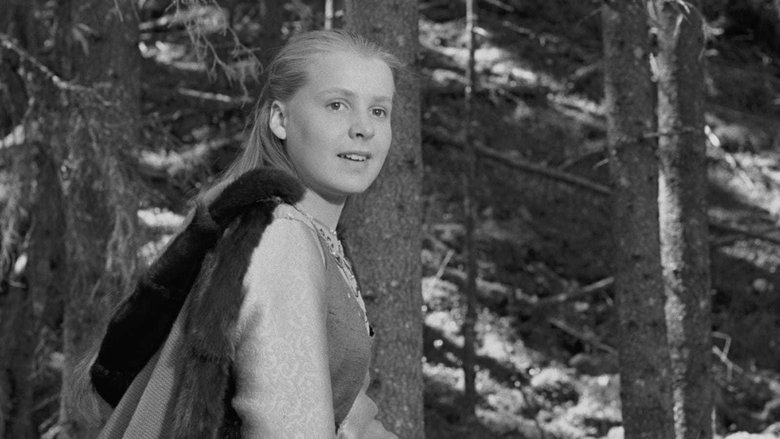
Karin's beautiful dress, proudly described by her mother as being "sewn by fifteen maidens," symbolizes her purity, social status, and cherished innocence. The theft of the clothes by the murderers after her death becomes the tangible proof of their crime, the object that transfers the knowledge of evil from the forest back to the domestic sphere of the farm.
Karin wears the elaborate dress for her special journey to the church. After her murder, the herders steal it. Later, seeking shelter at Töre's farm, they offer the dress to Märeta for sale, unwittingly revealing their crime and sealing their fate.
Philosophical Questions
Can faith withstand the reality of absolute evil and the silence of God?
The film poses this question directly through Töre's experience. He is a man of strong faith, yet God allows his innocent daughter to be brutally murdered. Töre's desperate cry, "I don't understand you," is a challenge to the very nature of a benevolent God. The film doesn't provide an easy answer. Instead, it explores the human response to this divine silence. Töre's choice is to continue believing, not out of understanding, but out of a desperate need for a framework to live by. The final "miracle" can be seen either as a divine answer or as a catalyst that allows humans to re-establish their own faith in a world where God's motives are incomprehensible.
Is vengeance a justifiable response to profound suffering?
"The Virgin Spring" serves as a progenitor of the rape-revenge genre but treats the act of vengeance with moral horror rather than catharsis. Töre's revenge is methodical and brutal, particularly his killing of the young boy. The film presents this violence not as a triumphant righting of wrongs, but as a descent into the very savagery that destroyed his daughter. He loses his own humanity in the process and is immediately consumed by guilt, recognizing that his actions have created a new sin that requires atonement. The film suggests that while the impulse for revenge is a powerful, perhaps primal, human instinct, it ultimately leads to spiritual damnation, not justice.
What is the relationship between civilization, religion, and primal instinct?
The film frames the conflict between Christianity and paganism as a metaphor for the struggle between civilization and primal savagery. Töre's Christian farm is an island of order and piety. The forest, however, is a lawless, pagan space where violence erupts without reason. When Töre is wronged, he abandons his "civilized" Christian morals and unleashes a pagan-like fury. The film complicates a simple good-vs-evil binary, showing that the capacity for brutal violence exists even within the heart of a devout man, suggesting that civilization and faith are fragile constructs built over a foundation of untamed human instinct.
Core Meaning
"The Virgin Spring" is a profound exploration of faith's resilience in the face of unspeakable evil and the complex relationship between primal vengeance and Christian forgiveness. Director Ingmar Bergman uses this medieval morality tale to question the silence of God and the human response to suffering. The central message is not a simple affirmation of faith, but a difficult and painful examination of its foundations. Töre's vow to build a church is not an act of triumphant piety, but a desperate bargain with a God he can no longer understand—an attempt to create meaning and impose order on a chaotic, violent world. The film suggests that faith is not a shield from horror, but a difficult, perhaps even absurd, path one must choose to follow even after innocence is shattered and hands are stained with blood.