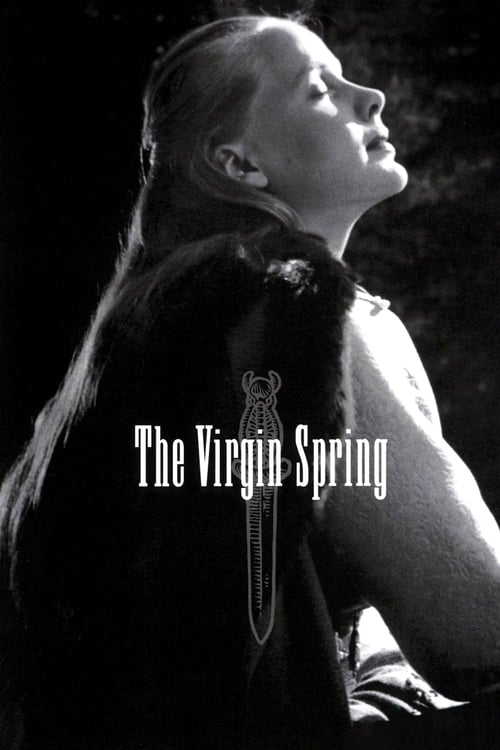
The Virgin Spring
A stark, medieval ballad of faith tested by brutality, where vengeance carves a wound in the earth from which a miracle of grace springs forth.
The Virgin Spring

The Virgin Spring

Jungfrukällan

"Ravished innocence... brings terrible revenge!"

08 February 1960 Sweden 90 min ⭐ 7.8 (644)
Director: Ingmar Bergman
Cast: Max von Sydow, Birgitta Valberg, Gunnel Lindblom, Birgitta Pettersson, Axel Düberg
Drama History
Faith vs. Doubt Revenge vs. Forgiveness Paganism vs. Christianity Loss of Innocence
Box Office: $700,000

Overview

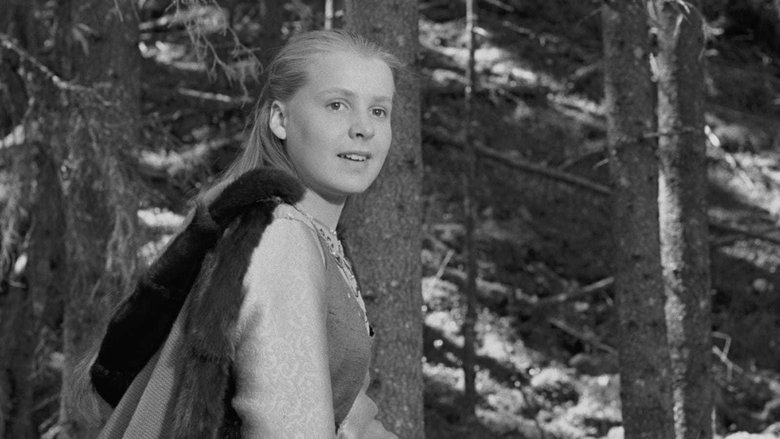
Set in 14th-century Sweden, "The Virgin Spring" follows the journey of Karin, the innocent and beloved daughter of devout Christian landowners, Töre and Märeta. Accompanied by her pregnant and secretly pagan servant, Ingeri, Karin sets out on horseback to deliver candles to the church. Ingeri, resentful of Karin's pampered life, harbors ill will and abandons her in the forest.

Alone, Karin encounters three goat herders—two men and a young boy. In an act of kindness, she shares her meal with them. This gesture of innocence is met with savage brutality as the two older men rape and murder her, an act witnessed from a distance by a horrified Ingeri. Later, seeking shelter from the cold, the herders unknowingly arrive at the farm of Karin's parents. They are given food and lodging, but their fate is sealed when they try to sell Karin's stolen clothing to her mother.

Upon this horrifying discovery, Töre is consumed by a cold, ritualistic fury. The film culminates in his violent revenge and a subsequent spiritual crisis, leading to a miraculous event that questions the nature of faith, sin, and divine intervention in a world where profound cruelty exists.

Core Meaning

"The Virgin Spring" is a profound exploration of faith's resilience in the face of unspeakable evil and the complex relationship between primal vengeance and Christian forgiveness. Director Ingmar Bergman uses this medieval morality tale to question the silence of God and the human response to suffering. The central message is not a simple affirmation of faith, but a difficult and painful examination of its foundations. Töre's vow to build a church is not an act of triumphant piety, but a desperate bargain with a God he can no longer understand—an attempt to create meaning and impose order on a chaotic, violent world. The film suggests that faith is not a shield from horror, but a difficult, perhaps even absurd, path one must choose to follow even after innocence is shattered and hands are stained with blood.

Thematic DNA

Faith vs. Doubt 35%
Revenge vs. Forgiveness 30%
Paganism vs. Christianity 25%
Loss of Innocence 10%

Faith vs. Doubt

The film's central conflict revolves around the characters' relationship with God. Töre and Märeta are devout Christians, but their faith is brutally tested by their daughter's murder. Töre's climactic monologue is a direct confrontation with God's silence: "You see it, God, you see it... You allowed it. I don't understand you." His subsequent act of building a church is born from a spiritual crisis, an attempt to find reconciliation and meaning in the face of divine incomprehensibility. The film explores whether faith can survive when confronted with the absurd cruelty of the world.

Revenge vs. Forgiveness

When Töre discovers his daughter's murderers, his Christian values are eclipsed by a primal need for vengeance. His revenge is not a spontaneous act of rage but a cold, methodical ritual, suggesting a regression to an older, pagan code of justice ("an eye for an eye"). This act of "ritualized pagan vengeance" directly conflicts with the Christian ethic of forgiveness. Töre is torn between these two imperatives, ultimately killing the perpetrators before begging God for forgiveness, highlighting the immense difficulty of reconciling human instinct with spiritual ideals.

Paganism vs. Christianity

The film is set during a time when Sweden was transitioning from Norse paganism to Christianity, and this tension is a constant undercurrent. Ingeri, the servant, secretly worships Odin, the god of war and death, and her resentment of the Christian Karin sets the tragedy in motion. The conflict is symbolized throughout: Ingeri's dark, coarse clothing contrasts with Karin's pure, white dress; the sinister, one-eyed bridge-keeper evokes Odin; and Töre's brutal revenge is more aligned with pagan savagery than Christian mercy. This clash represents a broader struggle between old, instinctual ways and a new, structured morality.

Loss of Innocence

Karin is the embodiment of innocence, a cherished virgin daughter on a holy errand. Her brutal rape and murder represent the destruction of purity by senseless violence. The film presents this loss on multiple levels: Karin's physical and spiritual violation, and her father Töre's loss of moral innocence as he becomes a murderer himself. Ingeri, who begins the film already compromised by her out-of-wedlock pregnancy, witnesses the ultimate loss of innocence in Karin and is herself transformed by guilt and remorse, seeking purification in the end.

Character Analysis

Töre

Max von Sydow

Archetype: The Patriarch / The Avenger
Key Trait: Righteous

Motivation

Initially, his motivation is to live a pious Christian life and protect his family. After Karin's death, his motivation shifts entirely to exacting a merciless and absolute revenge on her killers.

Character Arc

Töre begins as a prosperous, devout, and loving Christian father. The murder of his daughter shatters his moral and spiritual foundation. He regresses from a man of God to a vengeful killer, embracing a brutal, pre-Christian code of justice. After enacting his revenge, he is plunged into a profound spiritual crisis, consumed by guilt and confusion over God's silence. His arc concludes not with certainty, but with a desperate act of faith—vowing to build a church as penance, seeking reconciliation with both God and himself.

Ingeri

Gunnel Lindblom

Archetype: The Outcast / The Witness
Key Trait: Resentful

Motivation

Her primary motivation is a bitter resentment of her social and moral position compared to the favored, pure Karin. This jealousy motivates her to invoke pagan forces against her stepsister. Later, guilt becomes her driving force.

Character Arc

Ingeri starts as a sullen, resentful outcast, pregnant out of wedlock and secretly worshipping the pagan god Odin. Her jealousy of Karin leads her to curse her and abandon her in the woods. However, she is forced to witness Karin's horrific fate, which transforms her. Wracked with guilt, she ultimately guides the parents to Karin's body and is the first to seek purification from the miraculous spring, symbolizing her redemption and potential embrace of a new faith.

Karin

Birgitta Pettersson

Archetype: The Innocent / The Martyr
Key Trait: Innocent

Motivation

Her motivation is simple and pure: to please her parents and fulfill her religious duty by delivering candles to the church. Her inherent kindness and naivety lead her to trust the strangers who will become her murderers.

Character Arc

Karin is portrayed as a pure, somewhat spoiled, and naive virgin. Her character does not have a traditional arc of development; instead, she is a static symbol of innocence whose brutal violation is the catalyst for the entire plot. Her journey is one from pampered purity to tragic victimhood. Her death is akin to a martyrdom, which ultimately results in a miracle, transforming the site of her murder into a place of potential holiness.

Märeta

Birgitta Valberg

Archetype: The Matriarch
Key Trait: Pious

Motivation

Her motivation is her deep Christian faith and her powerful love for her daughter, Karin. She is concerned with duty, honor, and upholding the family's religious devotion.

Character Arc

Märeta is a pious Christian mother, deeply proud of her daughter but also aware of her vanity. She represents the steadfast, if sometimes anxious, heart of the Christian household. Her arc is one of suffering and grief. It is her recognition of Karin's stolen dress that confirms the tragedy. While Töre's response is violent action, hers is one of sorrow and enduring faith, culminating in the quiet cleaning of her daughter's face with the miraculous spring water.

Symbols & Motifs

The Spring

Meaning:

The spring that miraculously appears where Karin's head rested symbolizes grace, purification, and the potential for redemption from sin. It represents a sign from God—an ambiguous response to Töre's pain, doubt, and his vow of penance. Screenwriter Ulla Isaksson viewed it as a symbol of Karin's innocence. It offers a form of salvation and cleansing, as seen when Ingeri washes herself in its waters.

Context:

In the final scene, after Töre has exacted his revenge and pledged to build a church, he and Märeta lift their daughter's body. A spring of clear water emerges from the ground beneath her head. Ingeri, tormented by guilt, immediately uses the water to wash her face, symbolizing her absolution and a release from her pagan past.

The Toad

Meaning:

The toad that Ingeri places inside a loaf of bread represents a pagan curse, malice, and her hidden resentment towards the seemingly perfect Karin. It is a manifestation of evil and dark magic, directly contrasting with the Christian sacrament of breaking bread and sharing a meal, which Karin later does with her murderers.

Context:

As Ingeri prepares the food for Karin's journey, she performs a pagan ritual. She catches a toad and hides it within the bread meant for her stepsister. This act is a secret curse, wishing ill upon Karin's journey, which tragically comes to pass.

Birch Sapling

Meaning:

The birch sapling Töre uproots and uses to whip himself symbolizes a ritual of purification and penance before he commits the violent act of revenge. It is a physical manifestation of his internal torment, a self-flagellation to prepare himself for the sin of murder, blending pagan ritual with a distorted form of Christian asceticism.

Context:

After discovering Karin's fate, Töre walks out to the forest. He finds a slender birch tree, tears it from the ground with his bare hands, and then uses its branches to whip his own back in a steam-filled bathhouse. This ritual precedes him taking the slaughtering-knife to kill the herders.

Karin's Fine Clothes

Meaning:

Karin's beautiful dress, proudly described by her mother as being "sewn by fifteen maidens," symbolizes her purity, social status, and cherished innocence. The theft of the clothes by the murderers after her death becomes the tangible proof of their crime, the object that transfers the knowledge of evil from the forest back to the domestic sphere of the farm.

Context:

Karin wears the elaborate dress for her special journey to the church. After her murder, the herders steal it. Later, seeking shelter at Töre's farm, they offer the dress to Märeta for sale, unwittingly revealing their crime and sealing their fate.

Memorable Quotes

Du ser det, Gud. Du ser det. Den oskyldiga barnets död och min hämnd. Du tillät det. Jag förstår dig inte. Ändå ber jag dig nu om förlåtelse. Jag vet inget annat sätt att försonas med mina egna händer. Jag vet inget annat sätt att leva.

— Töre

Context:

After finding Karin's body in the forest, Töre collapses in grief. He looks to the sky and speaks these words directly to God, confessing to the revenge he has just taken on the murderers. It is a moment of complete spiritual and emotional breakdown, immediately preceding his vow to build a church on the spot.

Meaning:

This is the film's central monologue, encapsulating the core theme of faith versus doubt. Töre directly confronts God, acknowledging His omniscience but questioning His inaction and incomprehensible will. It's not a rejection of God, but a raw, painful confession of a shattered faith that he nonetheless chooses to cling to, as it's the only way he knows how to live. His vow to build a church is a desperate act of penance born from this crisis.

Philosophical Questions

Can faith withstand the reality of absolute evil and the silence of God?

The film poses this question directly through Töre's experience. He is a man of strong faith, yet God allows his innocent daughter to be brutally murdered. Töre's desperate cry, "I don't understand you," is a challenge to the very nature of a benevolent God. The film doesn't provide an easy answer. Instead, it explores the human response to this divine silence. Töre's choice is to continue believing, not out of understanding, but out of a desperate need for a framework to live by. The final "miracle" can be seen either as a divine answer or as a catalyst that allows humans to re-establish their own faith in a world where God's motives are incomprehensible.

Is vengeance a justifiable response to profound suffering?

"The Virgin Spring" serves as a progenitor of the rape-revenge genre but treats the act of vengeance with moral horror rather than catharsis. Töre's revenge is methodical and brutal, particularly his killing of the young boy. The film presents this violence not as a triumphant righting of wrongs, but as a descent into the very savagery that destroyed his daughter. He loses his own humanity in the process and is immediately consumed by guilt, recognizing that his actions have created a new sin that requires atonement. The film suggests that while the impulse for revenge is a powerful, perhaps primal, human instinct, it ultimately leads to spiritual damnation, not justice.

What is the relationship between civilization, religion, and primal instinct?

The film frames the conflict between Christianity and paganism as a metaphor for the struggle between civilization and primal savagery. Töre's Christian farm is an island of order and piety. The forest, however, is a lawless, pagan space where violence erupts without reason. When Töre is wronged, he abandons his "civilized" Christian morals and unleashes a pagan-like fury. The film complicates a simple good-vs-evil binary, showing that the capacity for brutal violence exists even within the heart of a devout man, suggesting that civilization and faith are fragile constructs built over a foundation of untamed human instinct.

Alternative Interpretations

While the film's ending is often seen as a miraculous affirmation of God's grace, several alternative interpretations exist. One reading suggests the ending is deeply ambiguous, if not ironic. The spring could be interpreted not as a divine miracle, but as a natural phenomenon, with the characters merely projecting their desperate need for meaning onto it. Is God rewarding Töre's vow, or is he mocking Töre's doubt and violence with a conveniently timed marvel? This reading portrays Töre's decision to build a church as an act of "philosophical suicide"—a retreat into dogma because he cannot face the absurd, meaningless reality of the violence that has occurred.

Another interpretation focuses on the triumph of pagan nature over organized religion. The raw, elemental force of the water bursting from the earth could be seen as a pagan response, a natural cycle of renewal that exists independently of Christian doctrine. Ingeri, the Odin-worshipper, is the one who finds cleansing in this natural spring, suggesting a synthesis or even a victory of primal forces over the rigidities of sin and penance. The film, in this light, doesn't resolve the conflict between paganism and Christianity but leaves it in a state of uneasy tension, suggesting that beneath the veneer of Christian faith lie primal, untamable instincts and natural forces.

Cultural Impact

"The Virgin Spring" holds a significant place in film history, marking a transitional period for Ingmar Bergman and solidifying his international reputation. Winning the 1961 Oscar for Best Foreign Language Film brought him wider recognition, especially in the United States. The film's stark depiction of violence was shocking for its time and pushed cinematic boundaries, directly inspiring the rape-revenge subgenre of horror films, most notably Wes Craven's notorious debut "The Last House on the Left" (1972).

Historically, the film tapped into a post-war spiritual anxiety, using a medieval setting to explore timeless questions of faith, evil, and the silence of God that resonated with contemporary audiences. The collaboration between Bergman and cinematographer Sven Nykvist, which began in earnest with this film, would become one of cinema's most legendary partnerships, defining a visual style characterized by naturalism and psychological intimacy. Despite Bergman's own later dismissal of the film, its powerful narrative, moral complexity, and unflinching brutality have cemented its influence, making it a key work in the art-house cinema canon and a touchstone for filmmakers exploring themes of retribution and morality.

Audience Reception

Audience reception for "The Virgin Spring" was polarized, largely depending on cultural context. In the United States, the film was a significant art-house success and was generally well-received for its powerful themes and stark beauty, culminating in its Oscar win. American audiences, perhaps more accustomed to religious themes in cinema, responded to its exploration of faith and morality. However, the film's violence, particularly the prolonged rape scene, was shocking for 1960 and controversial, leading to censorship and walkouts during some screenings. In its native Sweden and in France, the reception was more critical. Some reviewers found the film's religious and metaphysical concerns to be simplistic or out of step with a modern, secular society. Many viewers praise the stunning black-and-white cinematography by Sven Nykvist and the powerful performance by Max von Sydow, while others find the narrative slow, predictable, and emotionally remote.

Interesting Facts

  • The film is based on a 13th-century Swedish ballad titled "Töres döttrar i Wänge" ("Töre's Daughters in Vänge").
  • "The Virgin Spring" won the Academy Award for Best Foreign Language Film in 1961, which helped bolster Ingmar Bergman's international prestige and career financially.
  • This was the first major collaboration between director Ingmar Bergman and cinematographer Sven Nykvist. Nykvist would become Bergman's regular collaborator, and his preference for more natural lighting gave the film a fresh, realistic look compared to Bergman's earlier work.
  • Ingmar Bergman later expressed dissatisfaction with the film, calling it "a wretched imitation of Kurosawa" and an "aberration" in his work, despite its critical success. He was a great admirer of Akira Kurosawa's "Rashomon" (1950), which was a clear influence.
  • Wes Craven's controversial 1972 exploitation horror film "The Last House on the Left" was heavily inspired by and is essentially an unacknowledged remake of "The Virgin Spring".
  • Bergman chose novelist Ulla Isaksson to write the screenplay, hoping her reputation for historical realism would avoid the criticism of historical inaccuracy that his previous film, "The Seventh Seal" (1957), had received.
  • The explicit (for its time) rape scene caused significant controversy and was subject to censorship in the United States.
  • While the film was a major success in the United States, its reception in Sweden was more mixed, with some critics finding its metaphysical questions out of touch with modern, secular Sweden.

⚠️ Spoiler Analysis

Click to reveal detailed analysis with spoilers

Frequently Asked Questions

Explore More About This Movie

Dive deeper into specific aspects of the movie with our detailed analysis pages

Comments (0)

Leave a comment

No comments yet. Be the first to share your thoughts!