Le Salaire de la peur
"‘Dynamic’ ‘Tremendous’ ‘Shattering’"
The Wages of Fear - Symbolism & Philosophy
Symbols & Motifs
Nitroglycerin
The nitroglycerin is the film's central and most potent symbol. It represents not only a literal, constant threat of sudden, violent death, but also the inherent instability and precariousness of life itself. It symbolizes the razor's edge on which the characters exist, where any misstep leads to annihilation. Furthermore, it embodies the corrupting lure of money; it is both the source of their potential salvation (the paycheck) and their likely destruction.
The substance is the entire focus of the second half of the film. Every bump in the road, every sharp turn, and every obstacle is amplified by the audience's awareness of the volatile liquid shaking in the back of the trucks. The characters' gingerly handling of it is the primary source of the film's excruciating tension.
The Oil
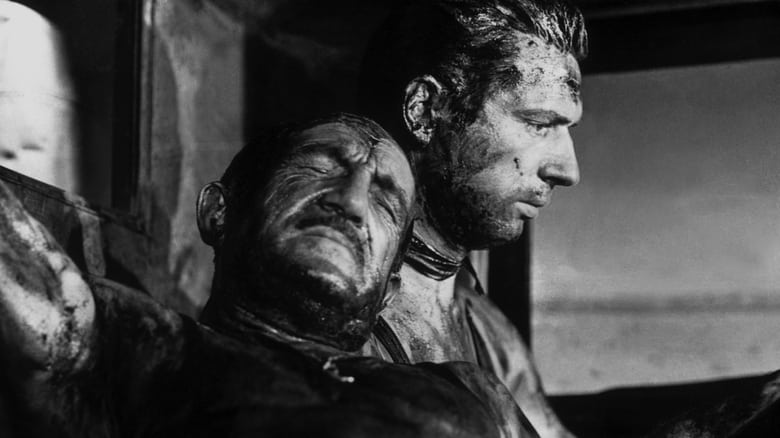
The oil, both the burning well and the pool that traps Mario and Jo, symbolizes the corrupting, all-consuming force of capitalism and corporate greed. It is the source of the SOC's wealth and power, but also the cause of death and destruction. The black, viscous pool of crude oil that nearly swallows their truck is a physical manifestation of the filth and moral mire created by the relentless pursuit of profit, a trap from which it is almost impossible to escape.
The entire plot is initiated by the oil well fire. The most harrowing sequence involves Mario and Jo navigating a large, deep pool of spilled oil from a pipeline. The scene is physically and metaphorically suffocating, leading to Jo sustaining the injuries that will ultimately kill him.
The Cockroaches
The film's opening shot of a child tormenting cockroaches tied together with a string serves as a powerful metaphor for the main characters' situation. The insects are trapped, powerless, and subject to the whims of a cruel and indifferent force. This perfectly mirrors the men in Las Piedras, who are similarly trapped and toyed with by the larger, amoral forces of poverty and the SOC.
This is the very first image of the film after the opening credits. A young boy watches the tethered cockroaches struggle against each other before becoming distracted by a passing vendor, only to return and find a vulture has eaten his 'toys.' This opening sequence establishes the film's themes of powerlessness and the cheapness of life in this environment.
The Trucks
The dilapidated, barely functional trucks symbolize the characters' own worn-out, fragile lives. They are unreliable vehicles for a desperate journey, much like the men are flawed and damaged vessels for their own ambitions. The trucks are constantly on the verge of breaking down or exploding, mirroring the psychological and physical fragility of the drivers themselves as they are pushed to their breaking points.
The two trucks are the primary setting for the second half of the film. Their physical struggles—getting stuck, navigating treacherous turns, backing onto a rotten platform—are the main set pieces of the thrilling journey and are central to every moment of suspense.
Philosophical Questions
What is the nature of courage in the face of certain death?
The film relentlessly questions traditional definitions of courage. Jo, the outwardly brave character, is revealed as a coward, while others who do not boast of their bravery manage to persevere. The film explores whether true courage is stoicism (Bimba), hopeful desperation (Luigi), or cynical survivalism (Mario). Ultimately, it suggests that in an absurd universe, such distinctions may be meaningless, as fate is arbitrary and does not reward the brave or punish the cowardly. Death comes for them all, making their displays of courage or fear seem like futile gestures in the face of oblivion.
Can individuals exercise free will when trapped by economic and social circumstances?
The Wages of Fear is a stark portrayal of determinism, where the characters' choices are severely constrained by their poverty. The men 'choose' to take the job, but it is a choice made under extreme duress, with the only alternative being a slow 'croaking' in Las Piedras. The film asks whether this can be considered true freedom. The all-powerful SOC dictates the terms of their existence, making them pawns in a corporate game. This raises the existential question of whether free will is an illusion when one's environment is so overwhelmingly oppressive.
Is there any meaning or morality in a world governed by greed and chance?
The film presents a deeply nihilistic worldview, suggesting that the world is amoral and chaotic. The actions of the SOC are driven purely by profit, with no regard for human life. The protagonists' journey is a series of random, life-threatening events. The tragic deaths of all four drivers, especially Mario's at the very moment of his supposed triumph, powerfully argues that their sacrifices were meaningless. The film seems to conclude that in such a world, the pursuit of money is a hollow goal and survival is merely a temporary postponement of an inevitable, senseless end.
Core Meaning
At its core, The Wages of Fear is a deeply cynical and existential examination of the human condition under extreme pressure. Director Henri-Georges Clouzot uses the high-stakes, life-or-death scenario not just to create a masterful thriller, but to explore the corrupting influence of greed and the futility of human endeavor in a seemingly indifferent universe. The film posits that in a world dominated by amoral corporate power and overwhelming desperation, qualities like courage and cowardice become blurred and ultimately meaningless in the face of arbitrary fate.
The director's message is a scathing critique of capitalism and American corporate imperialism, where human lives are expendable commodities in the pursuit of profit. The Southern Oil Company's willingness to sacrifice the desperate for a task too dangerous for their own unionized workers highlights a world devoid of morality. Ultimately, Clouzot suggests that the 'wages of fear' are not the monetary reward, but death and spiritual emptiness. Even when the mission is accomplished, the reward is rendered meaningless by the ironic and tragic hand of fate, underscoring a profoundly nihilistic worldview that questions the very possibility of escape or redemption.