
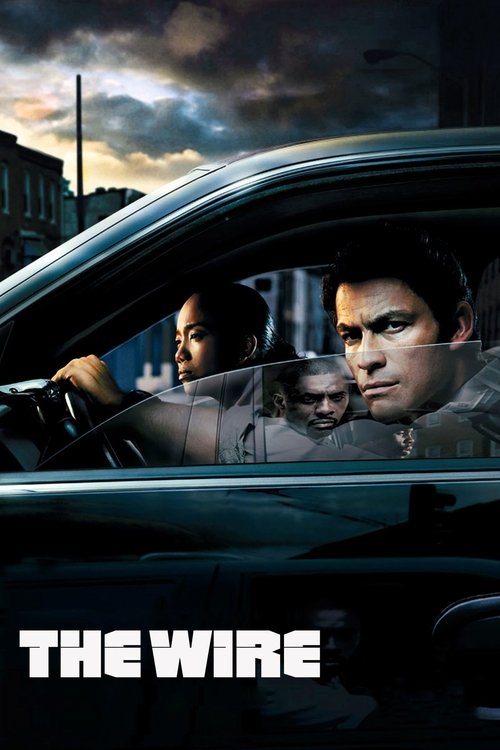
"Listen carefully."
Cast: Dominic West, Lance Reddick, Sonja Sohn, Wendell Pierce, Deirdre Lovejoy
The Wire — Characters & Cast
Character Analysis
Jimmy McNulty
Dominic West
Motivation
McNulty's primary motivation is his intellectual vanity and the thrill of the chase. He views a complex case as a personal challenge, an affront to his intelligence that he must solve. While he sometimes exhibits a sense of justice, his superiors and even his partners believe his crusades are more about proving his own cleverness and defying authority than about the victims. This singular drive costs him his marriage and fuels his alcoholism, as the job is the only thing that gives him a sense of purpose.
Character Arc
Jimmy McNulty begins as a talented but insubordinate homicide detective, driven by an intellectual arrogance and a belief that he is the smartest person in the room. His arc is a cyclical journey of self-destruction and redemption. In Season 1, his defiance of the chain of command gets him exiled to the marine unit. He spends Season 2 in this purgatory before maneuvering his way back to major cases. He finds a period of contentment and stability in Season 4 as a patrolman, but his fundamental nature pulls him back into the chaos. His final act in Season 5—inventing a serial killer to fund an investigation—is the ultimate expression of his hubris and his belief that the ends justify the means. He is ultimately forced out of the department, finding a quiet, ambiguous peace, seemingly free from the institutional battles that defined him.
Russell "Stringer" Bell
Idris Elba
Motivation
Stringer's core motivation is the pursuit of legitimacy and insulation from the risks of the drug trade. He believes that by adopting the rational, profit-driven models of corporate America, he can achieve sustainable wealth and power without the constant threat of violence and prison. He is driven by a desire to be seen as more than just a gangster; he wants to be a businessman, a respected player in the world of real estate and politics. This ambition blinds him to the unwritten codes of both the street and the corridors of power, leading to fatal miscalculations.
Character Arc
Stringer Bell is the second-in-command of the Barksdale drug empire, a calculating and ambitious figure who aspires to transform their criminal enterprise into a legitimate business. His arc across the first three seasons is a tragic attempt to escape the violence and chaos of "the game" by applying principles of economics and business strategy. He attends community college, chairs meetings using Robert's Rules of Order, and tries to form a cooperative with other drug kingpins. However, his efforts are constantly undermined by his partner Avon's street-level mentality and his own naivety about the legitimate business world, where he is easily conned. His downfall comes when he realizes he belongs to neither world—he's not ruthless enough for the streets (ordering D'Angelo's murder, a move Avon would never sanction) and not savvy enough for the boardroom. His arc culminates in his death, betrayed by Avon and cornered by Omar and Brother Mouzone.
Omar Little
Michael K. Williams
Motivation
Omar is motivated by a unique combination of survival, revenge, and adherence to his personal code. His primary income is robbing drug dealers, which he views as fair game ("It's all in the game"). A major driver of his actions is vengeance, particularly after the Barksdale crew tortures and murders his partner, Brandon, in Season 1. This event fuels a personal war that lasts for years. Above all, Omar is motivated by his code: he does not harm civilians (or "taxpayers") and believes "a man must have a code." This internal compass distinguishes him from nearly every other character in the criminal world.
Character Arc
Omar Little is a legendary Baltimore stick-up artist who exclusively robs drug dealers, operating by a strict personal code. His character subverts gangster tropes: he is openly gay, doesn't use profanity, and cares for his grandmother. His arc is not one of transformation but of consistency and consequence. He lives as a force of nature within the city's ecosystem, a lone predator who enforces his own brand of justice. He serves as a recurring antagonist to the Barksdale and Stanfield organizations and an occasional, reluctant informant for the police. His arc explores the nature of reputation and the inevitability of street life. Despite his legendary status, his death is not epic; he is unceremoniously shot in the head by a young boy, Kenard, a stark statement that in the game, a fearsome reputation can't save you from a random bullet.
Howard "Bunny" Colvin
Robert Wisdom
Motivation
Colvin is motivated by a deep-seated disillusionment with the status quo of policing and a genuine desire to make a tangible difference. After decades of fighting a losing war on drugs, he is desperate to try anything that might actually work. His motivation is not career advancement—he is at the end of his career—but a moral and pragmatic need to find a better way. In Season 4, this transforms into a paternalistic drive to understand and save the next generation of kids who are being failed by every institution around them.
Character Arc
Major Bunny Colvin is introduced in Season 3 as a police district commander on the verge of retirement. Frustrated with the futility of the drug war, his arc centers on a radical act of dissent: he secretly decriminalizes drugs in a designated area of his district, nicknamed "Hamsterdam." This experiment, while effective at reducing crime in other neighborhoods, is a spectacular failure politically, leading to his forced retirement and the loss of his pension. In Season 4, he finds a new purpose as a researcher working with at-risk youth, where he attempts to understand and mentor the "corner boys." His adoption of Namond Brice offers a small, personal victory in a system defined by failure, showing that while he couldn't save the system, he could save one individual from it.
Cast
Explore More About This Movie
Dive deeper into specific aspects of the movie with our detailed analysis pages