The film ends on a note of crushing circularity. After being fired for his radicalism and abandoned by his partner, Lulù is ultimately rehired through the efforts of the union. However, his "victory" is hollow. He is placed back on the assembly line, now fully aware of his status as a tool but unable to escape. The final sequence shows him frantically working while recounting a dream about a wall that leads only to fog. This reveals the "Paradise" of the title to be a delusion; the worker's only escape from the machine is madness or death, and until then, they are doomed to repeat the cycle in a state of cognitive dissonance.
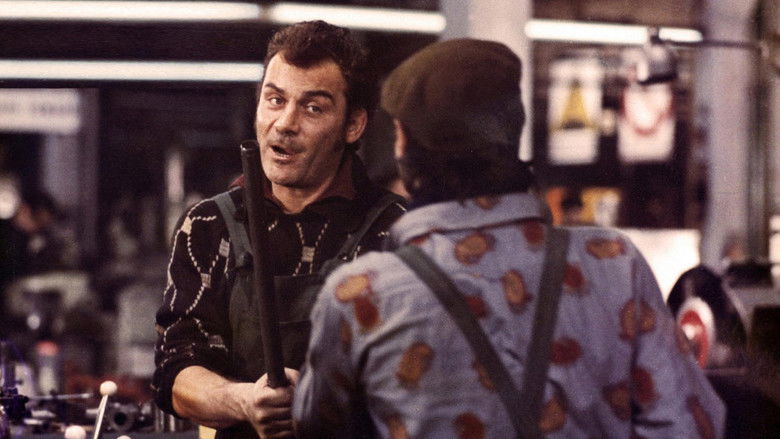
A frantic industrial fever dream where flesh meets cold steel, capturing the jagged soul of a man-machine who discovers his humanity only through the violent severing of a finger.

The Working Class Goes to Heaven
La classe operaia va in paradiso
17 September 1971
Italy
113 min
7.8
(364)
Director: Elio Petri
Cast: Gian Maria Volonté, Mariangela Melato, Salvo Randone, Gino Pernice, Luigi Diberti
Drama
Alienation and Dehumanization
The Failures of the Left
Workplace Madness (The Trilogy of Neurosis)
Consumerism as a Trap
The Working Class Goes to Heaven — Ending Explained
⚠️ Spoiler Analysis
Alternative Interpretations
While often read as a Marxist critique, some critics argue the film is deeply pessimistic about all forms of collective action. This reading suggests that Lulù is just as much a victim of the students and unions as he is of the bosses. Another interpretation focuses on the film as a psychoanalytic study, where the factory represents the Id and the piecework is a form of masturbatory obsession that eventually leads to castration (the lost finger).
Explore More About This Movie
Dive deeper into specific aspects of the movie with our detailed analysis pages