There Will Be Blood
An epic drama of corrosive avarice, where the black blood of the earth mirrors the darkening soul of a man obsessed with fortune and domination.
There Will Be Blood
There Will Be Blood

"There will be greed. There will be vengeance."

26 December 2007 United States of America 158 min ⭐ 8.1 (7,014)
Director: Paul Thomas Anderson
Cast: Daniel Day-Lewis, Paul Dano, Kevin J. O'Connor, Ciarán Hinds, Dillon Freasier
Drama
Capitalism and Greed Religion vs. Commerce Family and Alienation Power and Corruption
Budget: $25,000,000
Box Office: $77,208,711

There Will Be Blood - Ending Explained

⚠️ Spoiler Analysis

The plot of "There Will Be Blood" follows Daniel Plainview's inexorable rise and moral decay. Initially a lone silver prospector, he discovers oil and adopts H.W., the son of a worker killed in an accident, to craft a relatable "family man" persona for business deals. He is lured to Little Boston, California, by Paul Sunday with the promise of an ocean of oil under his family's ranch. There, he meets Paul's twin brother Eli, a charismatic preacher who becomes his primary antagonist.

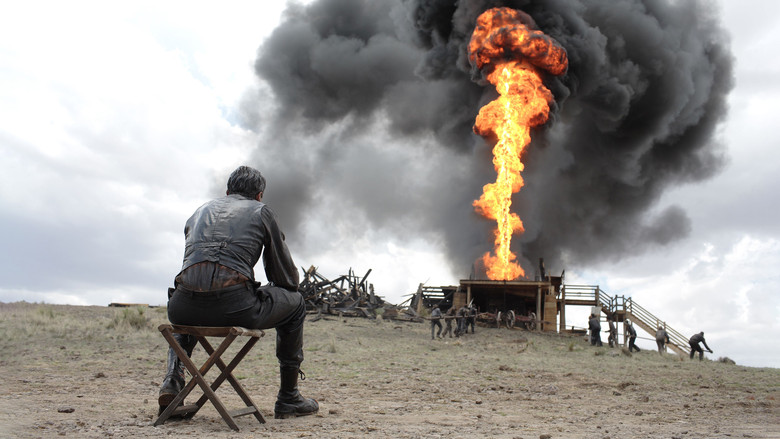
A key turning point is an oil derrick explosion that deafens H.W., creating a rift between him and Daniel. Later, a man claiming to be Daniel's half-brother, Henry, arrives, providing Daniel a brief sense of family before he discovers Henry is an impostor and murders him. To secure a pipeline deal, a landowner forces Daniel to be publicly baptized and humiliated by Eli.

The narrative jumps to 1927. Daniel is now an immensely wealthy but alcoholic recluse in a vast mansion. A grown H.W. announces he is moving to Mexico to start his own oil company, leading Daniel to viciously disown him, cruelly revealing his orphan origins. Shortly after, a desperate Eli visits. His investments were wiped out in the market crash, and he offers to sell Daniel the drilling rights to the last remaining oil-rich property. Daniel agrees, but only if Eli denounces his faith and admits God is a superstition. Eli complies, only for Daniel to reveal the devastating truth: he has already drained all the oil from that land years ago via drainage from his surrounding wells, famously taunting him with the line, "I drink your milkshake!" In a final, shocking explosion of rage, Daniel chases Eli around his private bowling alley and bludgeons him to death with a bowling pin. The film ends with Daniel, surrounded by his wealth and the body of his foe, calmly stating, "I'm finished."

Alternative Interpretations

While the primary reading of the film centers on the corrupting influence of greed, several alternative interpretations exist. Some critics view Daniel Plainview not as a simple villain but as a tragic figure shaped by a harsh and unforgiving environment, a man whose misanthropy is a defense mechanism developed from a life of hardship and betrayal. His actions, from this perspective, are a brutal but logical response to the world as he sees it.

Another interpretation posits the film as a Nietzschean allegory. Plainview can be seen as an embodiment of the 'Übermensch' or 'Superman,' a man who operates beyond conventional morality, creating his own values based on his will to power. His conflict with Eli isn't just about business but about one worldview (a post-moral, self-determined one) supplanting another (a traditional, faith-based one).

The ending itself is also open to debate. Daniel's final line, "I'm finished," can be read as a declaration of victory, a confession of exhaustion, or a statement of his own spiritual damnation. Is he triumphant in his destruction, or has he just realized the utter emptiness of his life's pursuit? The ambiguity allows for multiple readings of his ultimate fate.