There Will Be Blood
"There will be greed. There will be vengeance."
Overview
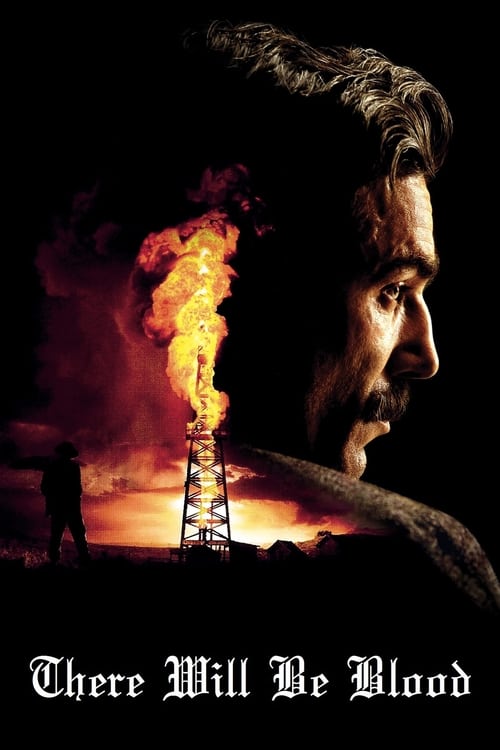
Set on the frontier of California's turn-of-the-century oil boom, "There Will Be Blood" chronicles the relentless rise of Daniel Plainview (Daniel Day-Lewis), a silver miner who transforms himself into a formidable oil tycoon. After adopting the orphaned son, H.W. (Dillon Freasier), of a deceased worker, Plainview uses the boy to project a wholesome, family-man image to persuade landowners to sign over their drilling rights.
His unquenchable thirst for wealth and power brings him to Little Boston, a small town where a young preacher, Eli Sunday (Paul Dano), has foreseen a prosperous future for his church through the town's oil deposits. What ensues is a gripping and escalating conflict between Plainview's brutal capitalism and Eli's fervent, yet equally opportunistic, religious fervor. Their rivalry becomes the battleground for the soul of the community, as both men are driven by an insatiable hunger for control, one through earthly riches and the other through spiritual influence.
As Plainview's empire expands, his humanity erodes. He becomes increasingly isolated, paranoid, and misanthropic, pushing away everyone, including his son. The film is a monumental character study, tracing Plainview's descent from a determined prospector into a monstrous figure consumed by his own success, culminating in a devastating and unforgettable climax.

Core Meaning
"There Will Be Blood" serves as a powerful and haunting allegory for the dark side of the American Dream, exploring the corrosive nature of unchecked ambition, greed, and the fraught relationship between capitalism and religion. Director Paul Thomas Anderson presents a narrative where the pursuit of wealth leads not to fulfillment, but to moral and spiritual decay. The central conflict between Daniel Plainview, the embodiment of ruthless industry, and Eli Sunday, who represents opportunistic faith, suggests that both institutions can be twisted into tools for manipulation and power. Ultimately, the film poses the philosophical question of what is gained and, more importantly, what is lost in the relentless quest for success. It suggests that the very drive that builds empires can simultaneously hollow out the human soul, leaving behind an empty vessel of bitterness and isolation.
Thematic DNA
Capitalism and Greed
The film is a stark critique of capitalism, portraying it as a force that inevitably leads to moral corruption. Daniel Plainview embodies the ultimate capitalist, driven by a relentless desire for wealth that transcends necessity and becomes a pure pursuit of domination. His story is a tragic interpretation of the American Dream, where rags-to-riches success is achieved at the cost of his humanity, family, and soul. The narrative suggests that this unbridled ambition ultimately leads to profound emptiness and destruction.
Religion vs. Commerce
The central conflict between Daniel Plainview and Eli Sunday frames the film's exploration of the contentious relationship between religion and capitalism. Both men are depicted as manipulators who use their respective platforms—business and faith—to exploit the community for personal gain. Eli's religion is shown to be as much a performance and a tool for power as Daniel's business dealings. The film's climax, where Daniel forces Eli to renounce his faith before revealing his financial ruin, symbolizes the ultimate triumph of a brutal, materialist capitalism over a hollow, opportunistic spirituality in 20th-century America.
Family and Alienation
The theme of family is explored primarily through Daniel's fraught relationships. He adopts H.W. to present a more palatable, family-oriented image for his business, viewing his son as a partner and a prop. His inability to form genuine human connections is a core aspect of his character. This is further highlighted by his brief and violent relationship with a man claiming to be his half-brother, Henry. Ultimately, Daniel's paranoia and misanthropy lead him to alienate and disown H.W., choosing his wealth over his only familial bond, which seals his fate as a lonely and broken man.
Power and Corruption
The film is a study in how the absolute pursuit of power corrupts absolutely. Daniel's initial drive as a prospector devolves into a hunger for complete control over people and resources. He sees everyone as a competitor and is willing to use lies, manipulation, and violence to win. This corrupting influence is not limited to Daniel; Eli Sunday also craves power, using his congregation's faith to elevate his own status and influence. The film suggests that this insatiable desire for power is a destructive force, leading to madness and moral bankruptcy.
Character Analysis
Daniel Plainview
Daniel Day-Lewis
Motivation
His primary motivation is an insatiable desire for wealth and, more importantly, the power to dominate others and be free from them. He professes a deep-seated hatred for most people and sees success as a means of building a fortress against a world he despises. He wants to earn so much money that he can get away from everyone.
Character Arc
Daniel begins as a determined, solitary prospector, defined by his resilience and ambition. As he builds his oil empire, his ambition curdles into misanthropic greed. He adopts H.W. as a business prop, and his capacity for trust and love erodes completely after being deceived by a false half-brother. By the end of the film, he has achieved immense wealth but has devolved into an isolated, alcoholic recluse who has alienated his son and murdered his rival, leaving him utterly alone and spiritually bankrupt.
Eli Sunday
Paul Dano
Motivation
Eli is motivated by a lust for power and influence, which he seeks through the guise of religious authority. He wants recognition and control over the community, viewing Daniel not just as a sinner but as a direct competitor for the town's soul and resources. His ambition is cloaked in piety, but it is ultimately just as materialistic as Daniel's.
Character Arc
Eli starts as a young, charismatic preacher who sees Daniel's arrival as an opportunity to fund his church, the "Church of the Third Revelation." He presents himself as a pious man of God but is equally as ambitious and greedy as Daniel. He enjoys a moment of dominance when he publicly humiliates Daniel at a baptism. However, his influence wanes as Daniel's power grows. His arc culminates in utter degradation, as he loses his wealth in the stock market crash and comes groveling to Daniel, renouncing his faith for a business deal only to be murdered.
H.W. Plainview
Dillon Freasier
Motivation
H.W.'s motivation evolves from a child's need for a father's love and approval to an adult's desire for independence and a life separate from Daniel's toxic influence. He wants to forge his own path and escape the shadow of his corrupt and abusive adoptive father.
Character Arc
H.W. begins as Daniel's adopted son and business "partner," a symbol of the family life Daniel pretends to have. After losing his hearing in an oil derrick explosion, he becomes increasingly distant from his father, who struggles to communicate with him and eventually sends him away. As a young man (played by Russell Harvard), he returns to sever his business ties with Daniel to start his own company. This act of independence enrages Daniel, who viciously disowns him. H.W.'s final departure, stating he is glad they are not related by blood, marks the final severing of Daniel's last human connection.
Symbols & Motifs
Oil
Oil represents wealth, power, corruption, and the very "blood" of the land that Daniel covets. It is a source of life for industry but a poison for the soul. Its blackness visually mirrors the darkness consuming Daniel's character. The film equates this thirst for oil with a vampiric lust, draining the earth and the humanity of those who seek it.
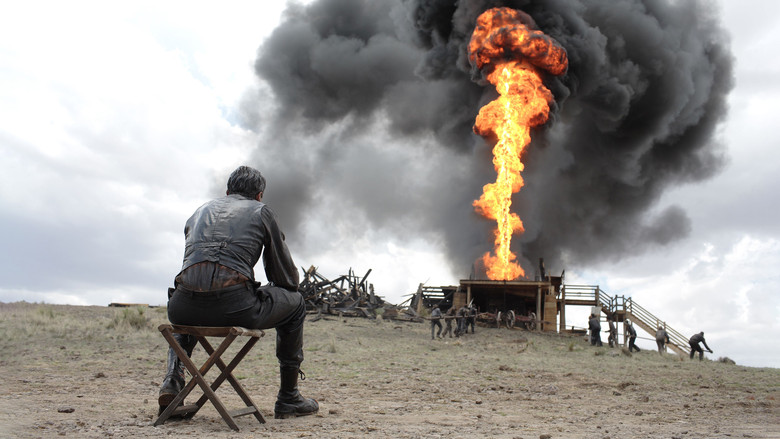
Oil is the central driving force of the entire plot. From Daniel's first discovery, its presence dictates every action. The gusher fire is a pivotal scene, a destructive yet beautiful display of oil's immense power. Daniel's obsession with it leads him to betray, manipulate, and murder.
The Milkshake
The "milkshake" analogy for oil drainage (specifically, slant drilling) symbolizes Daniel's ultimate competitive philosophy: a ruthless, all-encompassing approach to capitalism where one party can secretly drain the resources of another until nothing is left. It represents his victory through superior cunning and utter annihilation of his competition.
In the final scene, Daniel uses this metaphor to taunt and mentally destroy Eli Sunday. He explains how he has already drained all the oil from the neighboring Bandy tract, which Eli had hoped to sell him, rendering Eli's final gambit worthless. The line "I drink your milkshake!" has become an iconic declaration of total, crushing victory.
Baptism
Baptism, typically a symbol of purification and rebirth, is subverted to represent humiliation, performance, and a transactional exchange of power. For Daniel, it is not a spiritual act but a calculated business move he must endure to gain access to land for his pipeline. For Eli, it is a performance of spiritual authority and an opportunity to dominate and humble his rival.
Daniel is forced by William Bandy to be baptized in Eli's church to secure a pipeline easement. Eli seizes the moment, slapping Daniel and forcing him to confess to abandoning his son. The scene marks a turning point where Daniel's simmering hatred for Eli solidifies into a vow of vengeance, which he ultimately fulfills in the final scene.
Bowling Alley
The private bowling alley in Daniel's mansion symbolizes the isolated, grotesque, and hollow nature of his success. It is a playground built for a man who has no one to play with. It becomes the arena for the final, brutal confrontation between capitalism and religion, a place of profane judgment where Daniel becomes the ultimate arbiter.
The film's climax takes place in the bowling alley. A drunken Daniel torments Eli, who has come begging for money. The vast, empty space highlights Daniel's loneliness and madness. He ultimately bludgeons Eli to death with a bowling pin, a perverse and mundane instrument of murder that underscores the banality of his evil.
Memorable Quotes
I drink your milkshake! I drink it up!
— Daniel Plainview
Context:
In the final scene, Eli, desperate for money, tries to sell Daniel the drilling rights to the last untouched parcel of land in Little Boston. Daniel toys with him before revealing that the land is worthless because he has already drained the oil through surrounding wells. He screams the line while chasing a broken Eli around his private bowling alley, just before murdering him.
Meaning:
This iconic line is the culmination of Daniel's victory over Eli. The milkshake is a metaphor for oil drainage, symbolizing how Daniel has surreptitiously taken all the oil—the source of wealth and power—from under Eli's feet. It's a declaration of absolute, humiliating dominance, signifying that Daniel has not just won, but has consumed his rival entirely.
I'm finished.
— Daniel Plainview
Context:
Daniel utters this line to his butler after having just bludgeoned Eli Sunday to death with a bowling pin. He is sitting on the floor of his bowling alley, beside the corpse of his lifelong adversary, in his vast, empty mansion. The line is delivered with a sense of finality and exhaustion.
Meaning:
This is the final line of the film, and it is deeply ambiguous. It can be interpreted as Daniel declaring that his destructive work is done—he has vanquished his final enemy. Alternatively, it can mean that he himself is spiritually and morally finished, having achieved everything he ever wanted only to find himself empty and at the end of his journey with nothing left to strive for.
I have a competition in me. I want no one else to succeed. I hate most people.
— Daniel Plainview
Context:
Daniel says this to the man impersonating his half-brother, Henry, during a moment of supposed intimacy and confession. He is explaining why he is the way he is, admitting to his own deep-seated envy and contempt for humanity, which he believes separates him from others.
Meaning:
This is a rare moment of stark self-awareness from Daniel, where he plainly states his misanthropic and competitive philosophy. It encapsulates his entire worldview: life is a zero-sum game, and his purpose is not just to win, but to ensure everyone else loses. It reveals the deep-seated hatred that fuels his ambition.
I am the third revelation!
— Daniel Plainview
Context:
Daniel screams this line maniacally at Eli during their final confrontation in the bowling alley. He is mocking Eli's faith and asserting his own dominance, effectively declaring that his power (derived from oil and money) has superseded Eli's (derived from a false spirituality).
Meaning:
By shouting this, Daniel usurps Eli's religious authority. Earlier, Eli claimed to be the vessel of the 'third revelation.' For Daniel to scream it while terrorizing Eli signifies his belief that he has become the true prophet of the new American religion: capitalism. In this new world order, wealth and power, not God, are the ultimate forces, and Daniel is their messenger.
Philosophical Questions
Does the pursuit of the American Dream inevitably lead to moral compromise and corruption?
The film explores this question through Daniel Plainview's tragic arc. He achieves the American Dream of immense wealth and success, but does so by sacrificing his humanity, familial bonds, and any sense of morality. His story serves as a cautionary tale, suggesting that unchecked ambition, a core tenet of the dream, can be a spiritually corrosive force that rots a person from the inside out, leaving them with material riches but profound emotional and ethical poverty.
In a world driven by capital, can faith remain pure, or does it inevitably become another commodity?
The film scrutinizes the relationship between spirituality and materialism through the character of Eli Sunday. Eli's church and his role as a preacher are portrayed not as genuine sources of faith but as a business enterprise designed to secure power and influence. He uses religion to manipulate his flock and attempts to leverage it for financial gain from Daniel. The film suggests that in a society that worships wealth, even religion can be co-opted and commodified, becoming just another performance in the service of greed.
Is humanity fundamentally driven by competition and a will to dominate?
Daniel Plainview's explicit philosophy is that he has a "competition" in him and wants "no one else to succeed." The film uses his character to explore a cynical view of human nature. His relationships are all transactional and based on power dynamics. His conflict with Eli is a zero-sum game. The narrative seems to align with a Nietzschean perspective that the 'will to power' is a primary driving force of human action, often masked by more palatable motivations like community or faith. Daniel is simply more honest about this impulse than those around him.
Alternative Interpretations
While the primary reading of the film centers on the corrupting influence of greed, several alternative interpretations exist. Some critics view Daniel Plainview not as a simple villain but as a tragic figure shaped by a harsh and unforgiving environment, a man whose misanthropy is a defense mechanism developed from a life of hardship and betrayal. His actions, from this perspective, are a brutal but logical response to the world as he sees it.
Another interpretation posits the film as a Nietzschean allegory. Plainview can be seen as an embodiment of the 'Übermensch' or 'Superman,' a man who operates beyond conventional morality, creating his own values based on his will to power. His conflict with Eli isn't just about business but about one worldview (a post-moral, self-determined one) supplanting another (a traditional, faith-based one).
The ending itself is also open to debate. Daniel's final line, "I'm finished," can be read as a declaration of victory, a confession of exhaustion, or a statement of his own spiritual damnation. Is he triumphant in his destruction, or has he just realized the utter emptiness of his life's pursuit? The ambiguity allows for multiple readings of his ultimate fate.
Cultural Impact
"There Will Be Blood" was met with widespread critical acclaim upon its release and is widely regarded as one of the greatest films of the 21st century. It earned eight Academy Award nominations, winning for Best Actor (Daniel Day-Lewis) and Best Cinematography (Robert Elswit). Day-Lewis's portrayal of Daniel Plainview is considered one of the most powerful acting performances in modern cinema history.
The film's influence extends into popular culture, particularly the line "I drink your milkshake!", which became a widely recognized and parodied catchphrase. The movie sparked renewed interest in the work of director Paul Thomas Anderson and is often cited as his masterpiece. Its stark, ambitious, and uncompromising tone has influenced a generation of filmmakers. Philosophically, the film entered the cultural lexicon as a potent examination of the dark side of American capitalism, ambition, and the complex interplay between industry and religion, themes that continue to be relevant in contemporary discourse.
Audience Reception
Audience reception for "There Will Be Blood" has been largely positive, though often polarized. Many viewers praise it as a masterpiece, citing Daniel Day-Lewis's towering performance, Robert Elswit's Oscar-winning cinematography, and Jonny Greenwood's unsettling musical score as high points. It is frequently lauded as a profound and compelling character study and a powerful statement on its core themes.
However, some viewers find the film to be slow, bleak, and emotionally distant. A common point of criticism is the lack of sympathetic characters, particularly the relentlessly misanthropic protagonist, which can make the film a challenging and uncomfortable watch. The abrupt and violent ending is also a point of contention for some, who find it either brilliant or bizarre. Overall, while it is not considered an easy or universally enjoyable film, it is widely respected for its craft and ambition, and it has garnered a strong following among cinephiles.
Interesting Facts
- The film is loosely based on the first 150 pages of Upton Sinclair's 1927 novel "Oil!".
- Paul Thomas Anderson wrote the screenplay with Daniel Day-Lewis in mind for the lead role and sent him the script before it was even finished.
- Paul Dano was originally cast only in the small role of Paul Sunday. The actor playing his brother, Eli, was replaced a few weeks into shooting, and Anderson then asked Dano to play both roles, giving him only four days to prepare for the much larger part of Eli.
- During filming in Marfa, Texas, the pyrotechnic test for the oil derrick fire scene created a massive plume of smoke that interrupted shooting for the Coen Brothers' film "No Country for Old Men," which was filming nearby.
- The iconic line "I drink your milkshake!" was paraphrased from a 1924 congressional testimony by Senator Albert Fall regarding the Teapot Dome oil scandal, where he used the analogy to explain oil drainage.
- The actor who played young H.W., Dillon Freasier, was not a professional actor. He was found during a casting search in Texas, and his mother was reportedly hesitant to let him be in the movie until she met Daniel Day-Lewis and he convinced her.
- The final scenes were filmed at the Greystone Mansion in Beverly Hills, a historic location built by oil tycoon Edward Doheny. Coincidentally, the mansion was the site of a real-life murder-suicide shortly after it was built.
- Daniel Day-Lewis appears in all but two scenes of the film.
- The first 15 minutes of the film have almost no dialogue, establishing Daniel Plainview's character through action and perseverance alone.
⚠️ Spoiler Analysis
Click to reveal detailed analysis with spoilers
Frequently Asked Questions
Explore More About This Movie
Dive deeper into specific aspects of the movie with our detailed analysis pages
Comments (0)
No comments yet. Be the first to share your thoughts!