
Three Billboards Outside Ebbing, Missouri - Symbolism & Philosophy
Symbols & Motifs
The Three Billboards
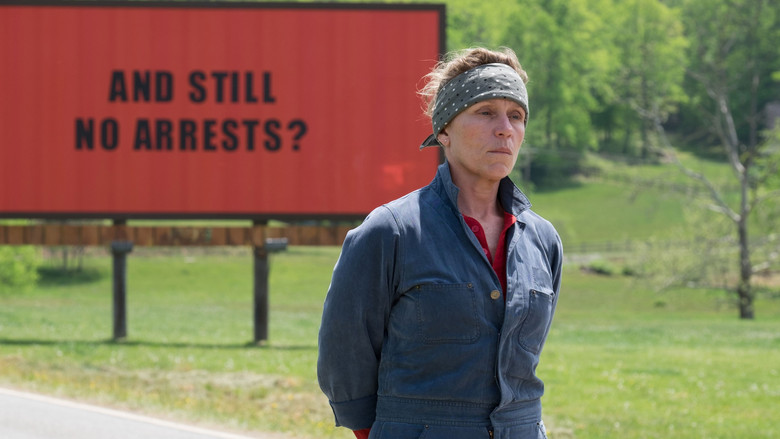
The billboards are the central symbol of the film, representing unyielding grief, public accusation, and a demand for accountability. Their stark red color symbolizes Mildred's rage and the violence of the crime. They are a physical manifestation of her pain, refusing to let the town forget her daughter's unsolved murder. They also symbolize a challenge to authority and the status quo.
Mildred rents the three dilapidated billboards on Drinkwater Road to publicly shame Chief Willoughby and the Ebbing police department for their failure to find her daughter's killer. They are a constant visual presence throughout the film, looming over Mildred's house and the town. They are vandalized, burned down, and eventually restored, mirroring the persistence of Mildred's quest and the escalating conflict.
The Deer
The deer symbolizes a moment of peace, innocence, and perhaps a spiritual connection to Mildred's deceased daughter. It represents a brief respite from her all-consuming anger. While Mildred explicitly rejects the idea that the deer is a reincarnation of Angela ("You're pretty, but you ain't her"), the gentle encounter allows her a moment of vulnerability and a flicker of her softer side, reminding the audience of the loving mother beneath the hardened warrior.
While Mildred is planting flowers by the billboards, a lone deer calmly approaches her. In a quiet, poignant monologue, she speaks to the animal, sharing her feelings of doubt and sorrow. This serene moment stands in stark contrast to the violence and rage that otherwise define her actions.
Fire
Fire symbolizes purification, destruction, and rebirth. It is a tool for both vengeance and, paradoxically, transformation. Mildred's use of fire is an act of pure rage meant to destroy the institution she blames. However, the same fire inadvertently sets Dixon on a path to redemption, as he must literally pass through the flames, saving Angela's case file in the process, to begin his change.
After the billboards are burned down (by her ex-husband, as it turns out), Mildred retaliates by throwing Molotov cocktails at the police station, believing it to be empty. Dixon, however, is inside reading Willoughby's letter. He is badly burned but manages to escape with the case file, an act that marks the beginning of his transformation.
Willoughby's Letters
The letters left by Chief Willoughby after his suicide symbolize wisdom, guidance, and posthumous grace. They are his final acts, intended to bring peace and clarity rather than chaos. The letter to Mildred offers understanding and support, while the letter to Dixon provides the paternal advice and moral compass he desperately needed, directly telling him that love, calm, and thought are the keys to becoming a good man.
After taking his own life to spare his family from his illness, Willoughby leaves several letters. His wife delivers one to Mildred, in which he explains his suicide was not her fault and that he secretly paid to keep the billboards up for another month. Dixon reads his letter alone in the police station, a moment that serves as the catalyst for his redemption arc just before the station is set ablaze.
Philosophical Questions
Can true redemption be achieved without full atonement?
The film explores this question through the character of Dixon. He is a violent racist who has caused significant harm. While he undergoes a profound transformation, he never fully apologizes for or atones for his racist past. The film asks whether his subsequent acts of bravery and his change of heart are enough to constitute redemption. It challenges the viewer to consider if a person can be redeemed by their future actions even if their past sins are never fully reconciled, presenting redemption not as a destination but as a continuous, difficult process.
What is the nature of justice when the legal system fails?
When the investigation into her daughter's murder stalls, Mildred takes matters into her own hands. The film's entire plot is driven by the failure of institutional justice. This raises questions about what constitutes justice in such a vacuum. Is public shaming a valid tool? Is personal vengeance justified? The film's unresolved ending, where Mildred and Dixon embark on a vigilante mission, leaves this question open. It suggests that when formal systems fail, humans are drawn to create their own, often morally gray, forms of justice.
Is all-consuming anger a justifiable response to tragedy, or is it inherently self-destructive?
The film presents Mildred's rage as both her greatest strength and her most destructive flaw. It fuels her quest for justice and gives her the strength to stand up to the entire town, but it also isolates her, hurts her son, and leads her to violence. The film doesn't condemn her anger but meticulously documents its corrosive effects, asking the audience to weigh the righteousness of her cause against the damage it creates. It suggests that while rage is a powerful catalyst, it cannot sustain a person and must eventually give way to something else, like forgiveness or at least a shared purpose, to avoid complete self-destruction.
Core Meaning
The core meaning of "Three Billboards Outside Ebbing, Missouri" revolves around the complex and often paradoxical nature of grief, rage, forgiveness, and redemption. Director Martin McDonagh explores the idea that all-consuming anger, while a valid response to profound tragedy, is ultimately a destructive force that begets more violence and pain. The film posits that true healing and the possibility of justice cannot be found through hatred alone.
Chief Willoughby's posthumous letters explicitly state this theme, particularly his advice to Dixon that letting go of hate is the only way to become a better man and a competent detective. The film suggests that forgiveness is not about condoning wrongful acts but is a necessary step for the aggrieved to break free from the cycle of suffering. It also delves into the elusiveness of clear-cut justice, ultimately arguing that in a world of moral ambiguity, the path forward lies not in vengeance, but in finding common humanity and the possibility of change, even in the most flawed individuals.