蜘蛛巣城
Throne of Blood - Symbolism & Philosophy
Symbols & Motifs
Fog
The pervasive fog symbolizes moral confusion, uncertainty, and the obscuring of truth and reason. It represents the characters being lost, both physically in the forest and metaphorically in their own ambition and paranoia. The fog creates an eerie, dream-like atmosphere, suggesting a world where the lines between reality and the supernatural are blurred.
The film opens and closes with shots of the castle ruins shrouded in fog. Washizu and Miki are first lost in a thick fog when they encounter the spirit in the Spider's Web Forest. The fog frequently blankets the landscape, visually representing Washizu's clouded judgment and the inescapable, suffocating nature of his fate.
Spider's Web Forest and Castle
The name itself, "Spider's Web Castle" (Kumonosu-jō), symbolizes the inescapable trap of fate and ambition that Washizu finds himself in. The forest is a labyrinth that leads not to clarity but to a damning prophecy. The castle becomes his web, a place of power that is also his prison and, ultimately, his tomb. He is entangled in a web of his own making.
The film is set around the Spider's Web Forest and Castle. Washizu and Miki get lost in the forest at the beginning. Washizu becomes the lord of the castle, only to be besieged within its walls. The spirit's prophecy, that he cannot be defeated until the forest moves against the castle, is literally fulfilled when his enemies advance under the cover of tree branches.
Blood
Blood symbolizes the guilt and the irreversible consequences of violence. It is both a literal and psychological stain. The act of murder leaves a mark that cannot be removed, haunting the perpetrators until their demise.
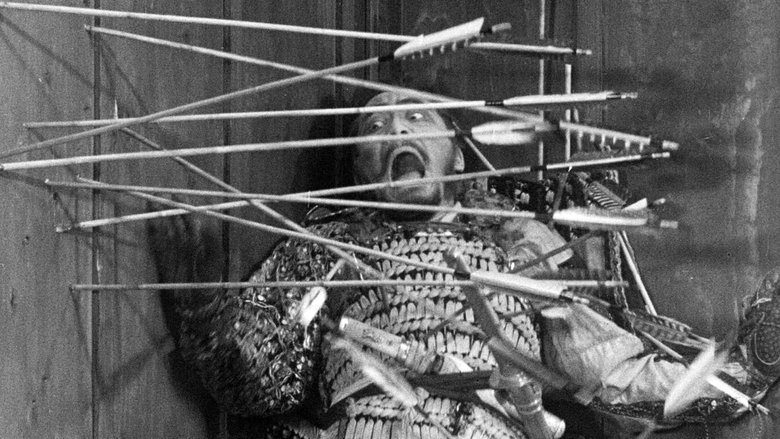
After murdering their lord, Asaji takes the bloody spear to frame the guards. Later, she is found in a trance, frantically trying to wash imaginary blood from her hands, a direct parallel to Lady Macbeth's famous scene. The film ends with Washizu being riddled with arrows, a bloody and visceral end to his violent reign.
The Forest Spirit's Spinning Wheel
The spirit spinning thread represents the weaving of fate. Like the Moirai (Fates) of Greek mythology, her spinning symbolizes the predetermined, intertwined destinies of the characters. The thread represents the lifeline of a person, being spun and eventually cut, highlighting the film's fatalistic themes.
When Washizu and Miki first encounter the spirit in the forest, she is sitting in a hut, endlessly spinning thread at her wheel and chanting prophecies about their futures. This image is a powerful and unsettling representation of the forces controlling the characters' lives.
Philosophical Questions
Are we controlled by fate, or are our lives the product of our own free will?
The film delves deeply into this question through the prophecies of the forest spirit. The spirit foretells Washizu's rise and the eventual reign of Miki's lineage, suggesting a predetermined path. However, the prophecy itself becomes the catalyst for Washizu's actions. He might never have considered treason had the idea not been planted in his mind. His wife, Asaji, actively chooses to interpret the prophecy as a command to act, pushing him to murder. Therefore, the film suggests a complex interplay: fate may present a path, but it is human choice, driven by ambition and fear, that ultimately walks it. The tragedy is that in trying to secure the fate he desires and avoid the one he fears, Washizu's choices lead him directly to his doom.
What is the nature of evil?
"Throne of Blood" explores evil not as a simple, malevolent force, but as a poison born from human weakness. Washizu is not inherently evil, but his ambition and susceptibility to suggestion make him capable of horrific acts. Asaji embodies a more calculated, cold form of evil, driven by a lust for power. The film suggests that evil is a choice, a transgression against one's own honor and humanity. It also presents a cyclical view of evil, where one act of violence begets another, trapping society in a seemingly endless loop of bloodshed and betrayal, reflecting a pessimistic view of human nature.
Core Meaning
"Throne of Blood" explores the corrupting nature of unchecked ambition and the cyclical, inescapable nature of violence. Director Akira Kurosawa uses the framework of Shakespeare's Macbeth to comment on the human condition, suggesting that the lust for power is a timeless and universal flaw. The film presents a fatalistic worldview, heavily influenced by Buddhist philosophy, where characters are trapped in a predetermined cycle of suffering brought on by their own base desires. Ultimately, the film posits that individual lives are transient and often meaningless in the grand, unending history of human violence and betrayal.