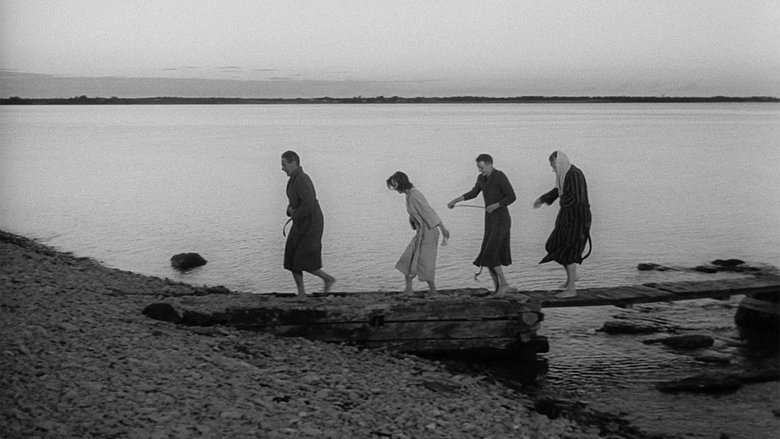

Såsom i en spegel
Through a Glass Darkly - Symbolism & Philosophy
Symbols & Motifs
The Spider-God
A symbol of a cruel, lecherous, and terrifying deity. It represents the subversion of the benevolent 'Father' figure in religion, reflecting Karin's trauma and the predatory nature of the men in her life.
Appears in Karin's final breakdown when she believes God is coming through the closet door, only to see a monstrous spider that tries to 'penetrate' her.
The Wallpaper
Symbolizes the thin, decaying membrane between reality and the 'other side' (madness/the spiritual world). It represents Karin's obsession with finding meaning behind the visible surface of life.
Karin frequently presses herself against the wallpaper in the upstairs room, claiming to hear the voices of people waiting for God.
The Shipwreck
Represents the family's state—a decaying, abandoned structure that offers no real protection. It also serves as a site for the breakdown of societal taboos.
The location where Karin and Minus seek shelter during a rainstorm and where their incestuous encounter occurs.
The Helicopter
Symbolizes the cold, mechanical intrusion of the modern world into a spiritual crisis. It also visually echoes the spider-god with its spindly legs and mechanical noise.
Used to transport Karin back to the mental hospital at the end of the film.
Philosophical Questions
If God is silent, can human love suffice as a surrogate for the divine?
The film poses David's theory that 'God is love' against the reality of the characters' failures to love one another properly. It asks if love is a genuine spiritual force or just a protective 'magic circle' we draw around ourselves.
Is the pursuit of art inherently immoral when it exploits the suffering of others?
Through David’s diary, Bergman explores his own guilt as an artist, questioning if the 'genius' of capturing human experience justifies the emotional coldness required to observe it objectively.
Core Meaning
The core of the film lies in the search for a meaningful existence in a world where God is silent and human connection is fraught with ego and exploitation. Ingmar Bergman uses Karin’s madness as a lens to explore the "Silence of God," a recurring motif in his work. The film suggests that traditional religious concepts are often replaced by horrific projections of our own trauma (the spider-god), yet it offers a tenuous hope: that God may not be a divine entity at all, but simply the manifestation of human love and empathy.