
Through a Glass Darkly
A haunting psychological drama where fractured family bonds and mental decay collide on a stark island. Shimmering Baltic waters mirror the fragility of faith and the horrific vision of a silent, predatory God.
Through a Glass Darkly

Through a Glass Darkly

Såsom i en spegel

16 October 1961 Sweden 91 min ⭐ 7.8 (521)
Director: Ingmar Bergman
Cast: Harriet Andersson, Gunnar Björnstrand, Max von Sydow, Lars Passgård
Drama
The Silence of God Artistic Exploitation and Parasitism Isolation and Mental Illness Incest and Familial Trauma
Box Office: $8,939

Overview

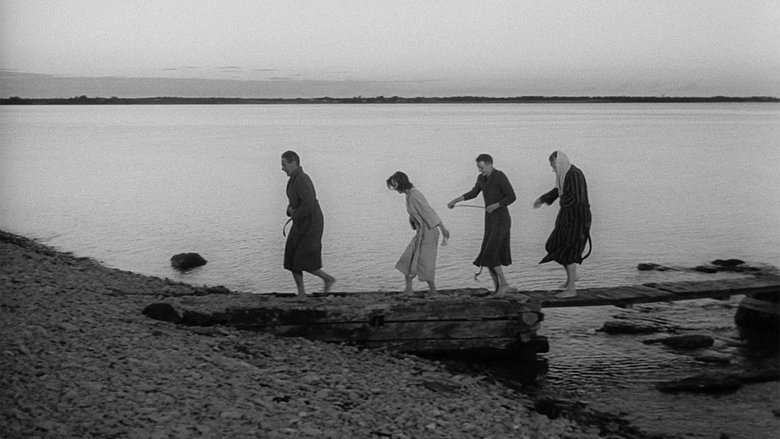
Through a Glass Darkly follows a small family vacationing on the remote island of Fårö. The central figure is Karin, a young woman recently released from a mental institution after being treated for schizophrenia. She is accompanied by her husband Martin, a rational physician who struggles to reach her emotionally; her younger brother Minus, a frustrated teenager seeking connection; and her father David, a cold, successful novelist who has recently returned from Switzerland.

As the family attempts to maintain a facade of normalcy through communal meals and a play performed by the siblings, tensions simmer beneath the surface. Karin’s condition begins to deteriorate as she hears voices beckoning her from behind the wallpaper of an upstairs room. The psychological isolation of the island intensifies when David’s secret diary is discovered, revealing his clinical, predatory interest in documenting his daughter’s mental descent for his own artistic gain.

The film reaches a harrowing climax as Karin’s religious delusions manifest into a terrifying vision of the divine, forcing the family to confront the emptiness of their relationships and the silence of the God they seek. It is a claustrophobic chamber piece that examines the limits of human love and the predatory nature of art.


Core Meaning

The core of the film lies in the search for a meaningful existence in a world where God is silent and human connection is fraught with ego and exploitation. Ingmar Bergman uses Karin’s madness as a lens to explore the "Silence of God," a recurring motif in his work. The film suggests that traditional religious concepts are often replaced by horrific projections of our own trauma (the spider-god), yet it offers a tenuous hope: that God may not be a divine entity at all, but simply the manifestation of human love and empathy.

Thematic DNA

The Silence of God 30%
Artistic Exploitation and Parasitism 25%
Isolation and Mental Illness 25%
Incest and Familial Trauma 20%

The Silence of God

The film is the first in Bergman's unofficial 'Faith Trilogy.' It explores the vacuum left by a silent deity, where Karin’s search for spiritual revelation leads not to a benevolent father but to a horrific, non-human 'spider-god.' The characters are trapped between a desire for divine certainty and the cold reality of a silent universe.

Artistic Exploitation and Parasitism

Revealed through the character of David, who observes his daughter’s suffering with the eye of a novelist rather than a father. The film questions whether art is inherently predatory, as David admits he is 'hunting for themes' within Karin's psychosis, prioritizing his creative legacy over his family's well-being.

Isolation and Mental Illness

Karin’s schizophrenia is portrayed not just as a medical condition, but as a total psychological isolation. The setting of the island serves as a physical manifestation of the characters' internal 'cubes' or 'cages,' where they are unable to truly communicate or touch one another's souls.

Incest and Familial Trauma

The boundaries between siblings Karin and Minus become blurred as Karin’s madness breaks down social taboos. This transgression reflects the deep-seated dysfunction of a family abandoned by a mother’s death and a father’s emotional absence, using incest as a desperate, distorted attempt at connection.

Character Analysis

Karin

Harriet Andersson

Archetype: The Seer / The Victim
Key Trait: Hypersensitivity

Motivation

To find a 'truth' or a divine presence that justifies her suffering and the emptiness of her life.

Character Arc

Transitions from a woman attempting to reintegrate into family life to a shattered figure who fully embraces her psychosis as the only way to find 'God,' eventually surrendering to institutionalization.

David

Gunnar Björnstrand

Archetype: The Failed Patriarch / The Observer
Key Trait: Emotional Coldness

Motivation

To find artistic immortality and to justify his own emotional hollowness through his work.

Character Arc

Begins as a narcissistic writer who flees from his children’s needs. After Karin’s final breakdown, he attempts a moment of genuine connection with Minus, leading to the film’s controversial 'God is love' conclusion.

Martin

Max von Sydow

Archetype: The Rationalist
Key Trait: Stoic Devotion

Motivation

To cure Karin and maintain the structure of their marriage, despite his growing frustration and sexual rejection.

Character Arc

A steadfast doctor who represents the limitations of science and logic. He remains static, his love and professional knowledge insufficient to save Karin from her internal world.

Minus

Lars Passgård

Archetype: The Innocent / The Initiate
Key Trait: Vulnerability

Motivation

To receive validation and attention from his distant father.

Character Arc

Moves from adolescent confusion and resentment to a state of profound shock and eventual 'enlightenment' after his father finally acknowledges him.

Symbols & Motifs

The Spider-God

Meaning:

A symbol of a cruel, lecherous, and terrifying deity. It represents the subversion of the benevolent 'Father' figure in religion, reflecting Karin's trauma and the predatory nature of the men in her life.

Context:

Appears in Karin's final breakdown when she believes God is coming through the closet door, only to see a monstrous spider that tries to 'penetrate' her.

The Wallpaper

Meaning:

Symbolizes the thin, decaying membrane between reality and the 'other side' (madness/the spiritual world). It represents Karin's obsession with finding meaning behind the visible surface of life.

Context:

Karin frequently presses herself against the wallpaper in the upstairs room, claiming to hear the voices of people waiting for God.

The Shipwreck

Meaning:

Represents the family's state—a decaying, abandoned structure that offers no real protection. It also serves as a site for the breakdown of societal taboos.

Context:

The location where Karin and Minus seek shelter during a rainstorm and where their incestuous encounter occurs.

The Helicopter

Meaning:

Symbolizes the cold, mechanical intrusion of the modern world into a spiritual crisis. It also visually echoes the spider-god with its spindly legs and mechanical noise.

Context:

Used to transport Karin back to the mental hospital at the end of the film.

Memorable Quotes

Gud är kärleken. Kärleken är Gud.

— David

Context:

Said during the final conversation with Minus as they watch the helicopter take Karin away.

Meaning:

The central philosophical conclusion of the film, suggesting that God exists only through the act of humans loving one another.

Dörren öppnades. Men guden som kom ut var en spindel.

— Karin

Context:

Karin describing her vision to David and Martin after her psychotic break in the attic.

Meaning:

A horrific subversion of the religious epiphany; the revelation that the divine is predatory and monstrous.

Pappa talade med mig.

— Minus

Context:

Minus whispers this to himself after his father shares his thoughts on love and God.

Meaning:

The final line of the film, signifying a minor 'miracle' of communication and the restoration of a relationship.

Man kan inte leva i två världar samtidigt.

— Karin

Context:

Karin explaining why she must choose institutionalization over staying with her family.

Meaning:

Reflects the absolute divide between the 'rational' world of the men and the 'spiritual/hallucinatory' world Karin inhabits.

Philosophical Questions

If God is silent, can human love suffice as a surrogate for the divine?

The film poses David's theory that 'God is love' against the reality of the characters' failures to love one another properly. It asks if love is a genuine spiritual force or just a protective 'magic circle' we draw around ourselves.

Is the pursuit of art inherently immoral when it exploits the suffering of others?

Through David’s diary, Bergman explores his own guilt as an artist, questioning if the 'genius' of capturing human experience justifies the emotional coldness required to observe it objectively.

Alternative Interpretations

While many see the ending as a hopeful affirmation of human love, critics have often argued that David's 'God is love' speech is a desperate, unconvincing lie meant to comfort a son he has already failed. This reading suggests that David is still 'using words' to evade reality. Another interpretation posits that Karin's 'madness' is actually a true spiritual awakening that the men, blinded by their rationalism and narcissism, are unable to grasp—making the 'spider-god' not a hallucination, but the terrifying truth of a universe that consumes its subjects.

Cultural Impact

Through a Glass Darkly revolutionized the 'chamber film' genre, proving that high psychological stakes could be achieved with a minimal cast and a single location. It solidified Bergman’s reputation as a philosophical filmmaker, moving away from the medieval allegories of The Seventh Seal toward modern, intimate existentialism. Its depiction of mental illness—avoiding melodramatic tropes in favor of a visceral, internal experience—remains a benchmark for critics and psychologists alike. The film also introduced the global audience to the stark landscape of Fårö, which became synonymous with the 'Bergmanesque' aesthetic: bleak, introspective, and hauntingly beautiful.

Audience Reception

Upon release, the film was hailed as a masterpiece of acting and cinematography, specifically praising Harriet Andersson for her 'fearless' performance. While some contemporary audiences found the film's bleakness and slow pace challenging, it was a critical triumph, securing Bergman's place in the international pantheon of directors. Controversy focused on the ending, with some finding the religious monologue out of sync with the preceding horror, though most viewed it as a necessary thematic resolution to the 'Faith Trilogy's' first chapter.

Interesting Facts

  • This was the first film Ingmar Bergman shot on the island of Fårö, which would later become his home and the setting for many of his most famous films.
  • The film won the Academy Award for Best Foreign Language Film in 1962, marking Bergman's second consecutive win after 'The Virgin Spring'.
  • Sven Nykvist and Bergman spent weeks testing lighting to achieve the film's stark, naturalistic look, often waiting for specific times of day to capture the 'gray' Baltic light.
  • The title is a reference to 1 Corinthians 13:12: 'For now we see through a glass, darkly; but then face to face.'
  • Bergman originally planned for the film to be in color but decided on black and white after being dissatisfied with the initial color tests.
  • Harriet Andersson's performance is often cited as one of the greatest depictions of schizophrenia in cinematic history.

Easter Eggs

Connection to 'The Yellow Wallpaper'

The plot involving a woman obsessed with the patterns behind wallpaper and descending into madness is widely considered a cinematic homage to Charlotte Perkins Gilman's feminist short story 'The Yellow Wallpaper.'

The 'Silence of God' Trilogy

Though not an internal 'easter egg,' the film establishes themes (the spider god, the silent father) that are directly challenged or mocked by characters in the sequel, 'Winter Light.'

⚠️ Spoiler Analysis

Click to reveal detailed analysis with spoilers

Frequently Asked Questions

Explore More About This Movie

Dive deeper into specific aspects of the movie with our detailed analysis pages

Comments (0)

Leave a comment

No comments yet. Be the first to share your thoughts!