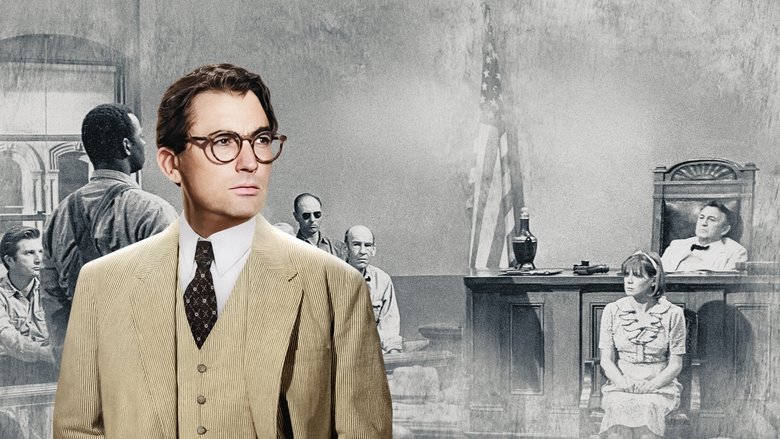
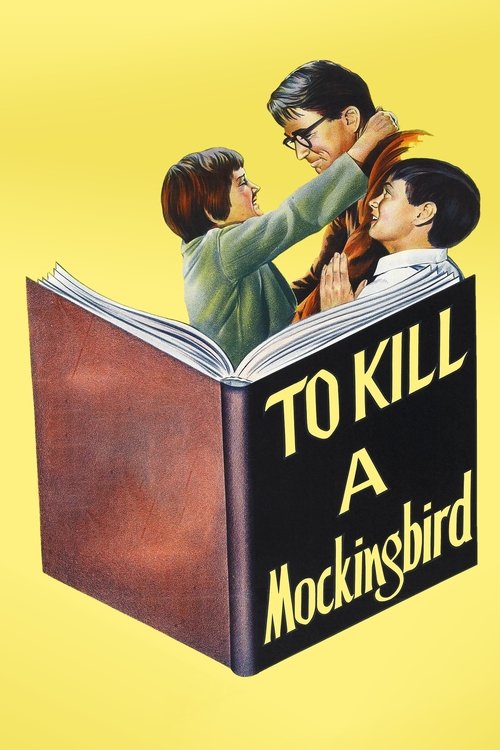
"A father must expose his children to a small town's outraged passions… and can only protect them with his love."
Director: Robert Mulligan
Cast: Mary Badham, Gregory Peck, Phillip Alford, John Megna, Frank Overton
To Kill a Mockingbird — Characters & Cast
Character Analysis
Atticus Finch
Gregory Peck
Motivation
Atticus is driven by a profound sense of justice and a deep-seated belief in doing what is right, regardless of public opinion or personal cost. His primary motivation is to live with a clear conscience and to set a proper example for his children, whom he is raising to be compassionate and just individuals. He defends Tom Robinson because he believes in the principle of equality before the law and his own moral duty.
Character Arc
Atticus is a largely static character, serving as the film's unwavering moral center. He does not undergo a significant personal transformation but instead remains a pillar of integrity and justice from beginning to end. His role is to guide his children's moral development and to challenge the deeply ingrained prejudices of his community. His consistency in the face of adversity is his defining characteristic.
Jean Louise 'Scout' Finch
Mary Badham
Motivation
Scout's motivation is primarily driven by childhood curiosity and a desire to understand the world around her. She is fascinated by the mystery of Boo Radley and perplexed by the adult world's contradictions, particularly the injustice she witnesses during the trial. Her journey is one of seeking answers and trying to reconcile her father's teachings with the harsh realities she observes.
Character Arc
The film is told from Scout's perspective, and her arc is one of classic coming-of-age. She begins as an innocent, curious, and tomboyish six-year-old. Over the course of the film, her experiences—observing the trial, witnessing the town's racism, and finally meeting Boo Radley—strip away her naivete. She learns to see the complexity of human nature and develops a mature understanding of empathy and justice, culminating in her ability to see the world from Boo Radley's point of view.
Jeremy Atticus 'Jem' Finch
Phillip Alford
Motivation
Jem is motivated by a desire to be brave and to emulate his father, Atticus, whom he deeply admires. He has a strong sense of justice and responsibility, particularly in his role as Scout's older brother and protector. His actions are often driven by a need to prove his courage, whether by touching the Radley house or by standing with his father against the lynch mob.
Character Arc
Jem's arc mirrors Scout's but is marked by a more profound and painful disillusionment. As he enters adolescence, he struggles to reconcile his idealistic belief in justice, inherited from his father, with the unfair verdict of the trial. The outcome leaves him deeply shaken and cynical. However, the attack by Bob Ewell and Boo Radley's intervention force him to confront true evil and heroism, ultimately pushing him further along the path to maturity and a more nuanced understanding of courage.
Arthur 'Boo' Radley
Robert Duvall
Motivation
Boo's motivation appears to be a simple, pure-hearted desire for connection and a protective affection for the Finch children. Having been isolated for years, he watches them from his window and reaches out in the only ways he can. His ultimate motivation is to protect the innocent, which he does when he saves Jem and Scout from Bob Ewell, acting as a true guardian angel.
Character Arc
Boo Radley's development happens almost entirely in the perception of the other characters, particularly the children. He transforms from a monstrous legend into a human being. For most of the film, he is an unseen presence, communicating only through gifts left in a tree. His arc culminates in a single, decisive act of heroism where he saves Jem and Scout. In the final scenes, he is revealed to be a shy, gentle, and profoundly kind man, completing his transformation from a figure of fear to a symbol of compassion and protection.
Cast
Explore More About This Movie
Dive deeper into specific aspects of the movie with our detailed analysis pages