東京物語
"As long as life goes on, relationships between parents and children will bring boundless joy and endless grief."
Director: Yasujirō Ozu
Cast: Chishū Ryū, Chieko Higashiyama, Setsuko Hara, Haruko Sugimura, Sō Yamamura
Tokyo Story — Characters & Cast
Character Analysis
Shūkichi Hirayama
Chishū Ryū
Motivation
His primary motivation is to reconnect with his children and see how they are faring in the city. He wants to affirm the family bond that he believes should endure despite time and distance. Later, his motivation shifts to quietly enduring his disappointment and, finally, facing his future alone with stoicism.
Character Arc
Shūkichi begins the journey with quiet optimism. Throughout the visit, he becomes increasingly aware of the emotional distance from his children, which he masks with smiles and polite phrases like "Yes." His drunkenness in Tokyo allows a rare moment of vulnerability where he confesses his disappointment. After Tomi's death, his arc culminates in a state of profound loneliness, but also a quiet, dignified acceptance of his fate and a deep gratitude for Noriko's kindness.
Tomi Hirayama
Chieko Higashiyama
Motivation
Her motivation is rooted in a mother's desire to see her children and grandchildren. She seeks affection and a sense of belonging within the family she raised. She is also concerned for Noriko's future, urging her to remarry and find happiness.
Character Arc
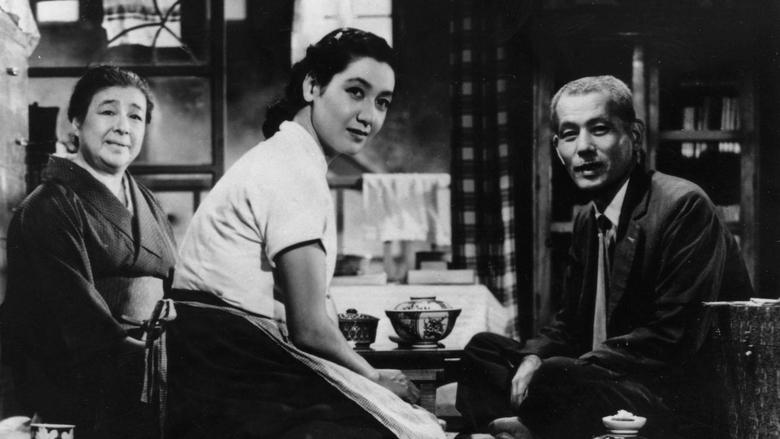
Tomi shares her husband's initial hopefulness but is perhaps more sensitive to the children's indifference. Her arc is one of gentle disillusionment. She finds solace and genuine connection only with Noriko. Her sudden illness and death serve as the film's central tragedy, forcing a brief, obligatory family reunion and exposing the true nature of the family's fractured relationships.
Noriko Hirayama
Setsuko Hara
Motivation
Her motivation stems from a deep-seated sense of duty, respect, and genuine affection for her late husband's parents. She acts out of a kindness that is not obligatory but inherent to her character, even as she privately grapples with her own loneliness eight years after her husband's death.
Character Arc
Noriko's character does not have a dramatic arc in the traditional sense; rather, she is a constant. She represents the ideal of traditional Japanese filial piety and kindness, which contrasts sharply with the biological children's behavior. She begins and ends as the most compassionate character. Her arc is more of a revelation to the audience and to the Hirayama family, culminating in a moment where she tearfully admits her own loneliness and struggles to maintain her cheerful facade.
Shige Kaneko
Haruko Sugimura
Motivation
Her motivations are primarily practical and self-centered. She is driven by the demands of running her business and managing her household. Her actions are dictated by what is convenient and beneficial for her own immediate life, with little room for the sentimentalities of family connection.
Character Arc
Shige's character remains largely static. She is presented as impatient, materialistic, and somewhat callous from the beginning. She is more concerned with the expense and inconvenience of her parents' visit than with their emotional needs. Even her grief at her mother's death is fleeting, quickly replaced by practical concerns like claiming her mother's belongings, an act that horrifies her younger sister, Kyōko.
Kōichi Hirayama
Sō Yamamura
Motivation
Kōichi is motivated by his professional duties and the responsibility of providing for his own family. He feels the weight of his obligations as a doctor in his community, which leaves him with little time or energy for his aging parents. His neglect is portrayed more as a product of circumstance than a lack of love.
Character Arc
Like his sister Shige, Kōichi is too preoccupied with his work as a suburban doctor to pay his parents much attention. He is less overtly selfish than Shige, often appearing more conflicted and guilty about his inability to host his parents properly. His arc is one of passive neglect; he means well, but his professional obligations always take precedence. He shows some remorse after his mother's death, but quickly returns to his busy life in Tokyo.
Cast
Explore More About This Movie
Dive deeper into specific aspects of the movie with our detailed analysis pages