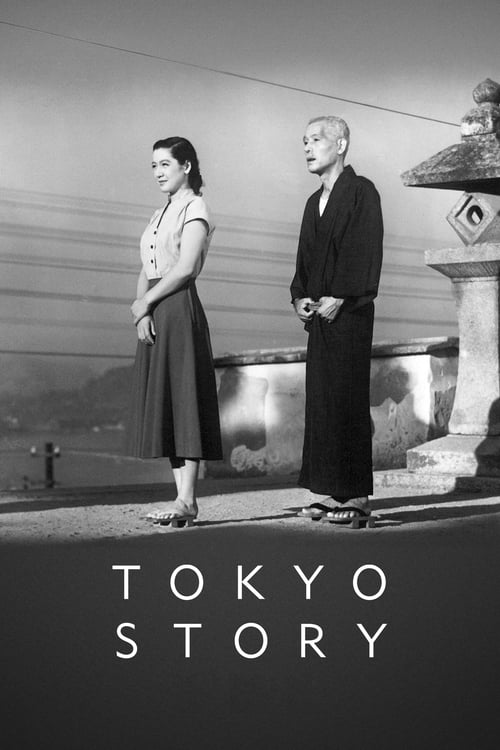
Tokyo Story
東京物語
"As long as life goes on, relationships between parents and children will bring boundless joy and endless grief."
Overview
"Tokyo Story" follows an elderly couple, Shūkichi and Tomi Hirayama, who travel from their provincial seaside town of Onomichi to the bustling metropolis of Tokyo to visit their adult children. Upon arrival, they find that their eldest son, Kōichi, a local doctor, and their eldest daughter, Shige, a beauty salon owner, are preoccupied with their own busy lives and families. The parents' presence becomes a slight inconvenience, disrupting the routines of their children who struggle to find time for them.
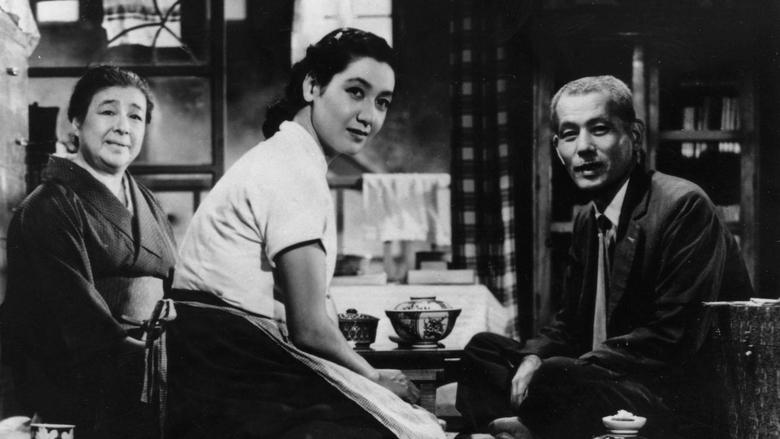
The only person who shows them genuine warmth and kindness is their widowed daughter-in-law, Noriko, the wife of their son who was killed in the war. She takes a day off from her office job to show them the sights of the city. Seeing their children's busyness, Kōichi and Shige decide to send their parents to a hot spring resort in Atami for a break. However, the noisy, modern resort is not to their liking, and they decide to cut their trip short and return to Tokyo, and subsequently, home.
The film delicately observes the subtle interactions and quiet disappointments that arise, painting a poignant picture of the growing chasm between generations in a rapidly modernizing post-war Japan. It is a story told not through dramatic confrontations, but through gentle observation, quiet conversations, and the unspoken emotions that lie beneath the surface of everyday life.
Core Meaning
The core meaning of "Tokyo Story" revolves around the inevitable dissolution of the Japanese family unit in the face of post-war modernization and the universal, poignant truth that children naturally grow apart from their parents. Director Yasujirō Ozu sought to depict the collapse of the traditional family system by showing the lives of the grown-up children. The film serves as a meditation on aging, mortality, and the subtle, often unspoken, disappointments of life. It suggests that the fracturing of family ties is not necessarily born of malice, but from the practicalities and self-centeredness of modern life, where individuals become absorbed in their own immediate concerns. Ultimately, the film carries a sense of gentle sadness and acceptance—what is known in Japanese aesthetics as mono no aware, a wistful awareness of the transience of all things—suggesting that this familial drift, while painful, is an inescapable part of the human condition.
Thematic DNA
Generational Conflict and Disconnect
The central theme is the emotional and physical distance between the aging parents and their adult children. The Hirayama children, caught up in the fast pace of urban Tokyo, view their parents' visit as a disruption to their busy lives. This is not portrayed as outright cruelty, but as a subtle neglect born from their focus on their own careers and families. The film contrasts the traditional values of the parents with the modern, Westernized lifestyles of their children, highlighting how societal changes have eroded the bonds of filial piety. The disappointment is palpable but rarely spoken aloud, conveyed instead through quiet gestures and resigned smiles.
Modernization and the Decline of Tradition
"Tokyo Story" is set in post-war Japan, a period of rapid economic growth and Westernization. The film contrasts the tranquil, traditional life in the parents' hometown of Onomichi with the bustling, industrial landscape of Tokyo, symbolized by trains and smokestacks. This modernization is presented as a primary cause for the breakdown of the traditional family structure. The children's focus on work and material concerns is a direct result of this new, capitalist-influenced society, which leaves little room for the old traditions of honoring one's elders.
Loneliness and Mortality
The film is a profound meditation on the loneliness that accompanies old age. As their children become increasingly distant, Shūkichi and Tomi are left to face their twilight years with a sense of isolation. This is most poignantly illustrated after Tomi's death, when Shūkichi is left completely alone in his quiet house. The narrative explores the acceptance of mortality and the quiet grief that follows loss. The final scenes evoke a deep sense of solitude and the quiet continuation of life in the face of death.
Disappointment and Acceptance
A deep undercurrent of disappointment runs through the film, though it is often masked by politeness and smiles. Shūkichi drunkenly confesses to his old friends that he is disappointed in his children's careers. The parents feel like a burden, and the children feel a sense of obligation rather than genuine affection. However, this disappointment is met with a quiet resignation. Characters like Noriko and, eventually, Shūkichi, embody a sense of acceptance, acknowledging that life is inherently disappointing but must be endured with grace. This is famously captured in the line exchanged between Noriko and Kyōko: "Isn't life disappointing?" "Yes, it is."
Character Analysis
Shūkichi Hirayama
Chishū Ryū
Motivation
His primary motivation is to reconnect with his children and see how they are faring in the city. He wants to affirm the family bond that he believes should endure despite time and distance. Later, his motivation shifts to quietly enduring his disappointment and, finally, facing his future alone with stoicism.
Character Arc
Shūkichi begins the journey with quiet optimism. Throughout the visit, he becomes increasingly aware of the emotional distance from his children, which he masks with smiles and polite phrases like "Yes." His drunkenness in Tokyo allows a rare moment of vulnerability where he confesses his disappointment. After Tomi's death, his arc culminates in a state of profound loneliness, but also a quiet, dignified acceptance of his fate and a deep gratitude for Noriko's kindness.
Tomi Hirayama
Chieko Higashiyama
Motivation
Her motivation is rooted in a mother's desire to see her children and grandchildren. She seeks affection and a sense of belonging within the family she raised. She is also concerned for Noriko's future, urging her to remarry and find happiness.
Character Arc
Tomi shares her husband's initial hopefulness but is perhaps more sensitive to the children's indifference. Her arc is one of gentle disillusionment. She finds solace and genuine connection only with Noriko. Her sudden illness and death serve as the film's central tragedy, forcing a brief, obligatory family reunion and exposing the true nature of the family's fractured relationships.
Noriko Hirayama
Setsuko Hara
Motivation
Her motivation stems from a deep-seated sense of duty, respect, and genuine affection for her late husband's parents. She acts out of a kindness that is not obligatory but inherent to her character, even as she privately grapples with her own loneliness eight years after her husband's death.
Character Arc
Noriko's character does not have a dramatic arc in the traditional sense; rather, she is a constant. She represents the ideal of traditional Japanese filial piety and kindness, which contrasts sharply with the biological children's behavior. She begins and ends as the most compassionate character. Her arc is more of a revelation to the audience and to the Hirayama family, culminating in a moment where she tearfully admits her own loneliness and struggles to maintain her cheerful facade.
Shige Kaneko
Haruko Sugimura
Motivation
Her motivations are primarily practical and self-centered. She is driven by the demands of running her business and managing her household. Her actions are dictated by what is convenient and beneficial for her own immediate life, with little room for the sentimentalities of family connection.
Character Arc
Shige's character remains largely static. She is presented as impatient, materialistic, and somewhat callous from the beginning. She is more concerned with the expense and inconvenience of her parents' visit than with their emotional needs. Even her grief at her mother's death is fleeting, quickly replaced by practical concerns like claiming her mother's belongings, an act that horrifies her younger sister, Kyōko.
Kōichi Hirayama
Sō Yamamura
Motivation
Kōichi is motivated by his professional duties and the responsibility of providing for his own family. He feels the weight of his obligations as a doctor in his community, which leaves him with little time or energy for his aging parents. His neglect is portrayed more as a product of circumstance than a lack of love.
Character Arc
Like his sister Shige, Kōichi is too preoccupied with his work as a suburban doctor to pay his parents much attention. He is less overtly selfish than Shige, often appearing more conflicted and guilty about his inability to host his parents properly. His arc is one of passive neglect; he means well, but his professional obligations always take precedence. He shows some remorse after his mother's death, but quickly returns to his busy life in Tokyo.
Symbols & Motifs
Trains and Boats
Trains and boats are recurring motifs that symbolize the passage of time, the journey of life, and the irreversible changes brought by modernity. They represent both the connection and the distance between the traditional countryside (Onomichi) and the modern city (Tokyo).
The film opens with a boat in the harbor and a train passing through Onomichi. The parents' journey to and from Tokyo is a central element of the plot, although the journeys themselves are not shown, emphasizing the destinations and the emotional distances covered. The final shot of a boat moving slowly across the water reinforces the idea of life continuing its steady, indifferent course.
Clocks and Watches
Clocks and watches are potent symbols of time's relentless, linear progression and the fleeting nature of life. They underscore the theme of mono no aware (the pathos of things) and the limited time the family has together.
At the end of the film, Shūkichi gives Tomi's watch to Noriko, a deeply symbolic gesture. He is passing on his late wife's time to Noriko, encouraging her to move forward and remarry, rather than remaining bound to the past. It signifies a transition and the continuation of life.
The Vase
While more famous in other Ozu films like "Late Spring," the vase in the Hirayama home can be seen as a symbol of stillness, tradition, and the quiet, enduring beauty that exists amidst the turmoil of family life and societal change. It represents a point of contemplation and stasis in a world of constant movement.
Ozu often uses shots of objects, like a vase, as transitional "pillow shots." In the final scene, as Shūkichi sits alone in his home, the quiet presence of the vase in the room contrasts with his profound loneliness, highlighting the enduring nature of objects versus the transience of human life.
Smokestacks
The images of smokestacks that appear in transitional shots symbolize the industrialization and modernization of Tokyo. They represent progress and the new economic reality that consumes the lives of the children, while also suggesting a form of pollution, both environmental and perhaps cultural.
Ozu frequently cuts to shots of smokestacks before scenes set in Tokyo. This visually establishes the urban environment and contrasts it sharply with the natural landscapes of the parents' hometown, Onomichi.
Memorable Quotes
Isn't life disappointing?
— Kyōko Hirayama
Context:
This exchange occurs in Onomichi after their mother's funeral. Kyōko is angry and hurt by her older siblings' selfish and hasty departure. She confronts Noriko, who gently explains that children inevitably drift away, leading to Kyōko's heartbreaking question.
Meaning:
This poignant question, posed by the youngest, most idealistic daughter to the kind Noriko, encapsulates the film's central philosophical sentiment. It is a moment of profound disillusionment, recognizing the gap between how life should be and how it is. Noriko's simple, affirmative response, "Yes, it is," validates this feeling, suggesting that accepting this disappointment is a mark of maturity.
Living alone like this, the days will get very long.
— Shūkichi Hirayama
Context:
Shūkichi says this to Noriko in his home after the funeral, as they reflect on Tomi's life. He prefaces it by saying that if he'd known things would come to this, he would have been kinder to his wife, expressing a universal regret.
Meaning:
This line, spoken by Shūkichi after his wife's death, powerfully conveys his profound sense of loneliness and the emptiness of the future that stretches before him. It is a quiet, understated expression of immense grief and the daunting reality of facing the rest of his life alone.
Children don't live up to their parents' expectations. Let's just be happy that they're better than most.
— Shūkichi Hirayama
Context:
Shūkichi and Tomi are talking alone at the Atami spa. They quietly reflect on how their children have changed, acknowledging their flaws but ultimately choosing to focus on the positive, however faint it may be.
Meaning:
This statement reveals Shūkichi's deep-seated disappointment with his children, but also his pragmatic decision to accept them for who they are. It reflects a common parental experience of adjusting expectations and finding a way to be content, even if dreams for one's children haven't fully materialized.
They're selfish. Demanding things and leaving like this.
— Kyōko Hirayama
Context:
This is said to Noriko after the funeral, as Kyōko vents her frustration about Kōichi and Shige's behavior, particularly Shige asking for their deceased mother's clothes as keepsakes before promptly returning to Tokyo.
Meaning:
Kyōko's angry outburst serves as the film's most direct condemnation of the older siblings' behavior. She voices the audience's feelings of indignation and provides a moral counterpoint to Noriko's more accepting perspective. It highlights the stark difference in values between the youngest daughter, who remains in the traditional hometown, and her urbanized siblings.
Philosophical Questions
Is the drift between parents and children an inevitable part of life?
The film explores this question through the character of Noriko, who tells a distraught Kyōko that children inevitably drift away from their parents as they build their own lives. "Tokyo Story" presents this phenomenon not as a malicious act, but as a slow, gradual, and sorrowful process. It forces the viewer to consider whether this emotional distance is a natural consequence of time and individual growth, or a failure of modern society to value familial bonds.
What is the nature of happiness and disappointment?
The film suggests that life is inherently tinged with disappointment. No character achieves an idealized state of happiness. The parents are disappointed in their children, the children are struggling with their own lives, and the kindest character, Noriko, is deeply lonely. The dialogue "Isn't life disappointing?" "Yes, it is," lies at the film's philosophical heart, proposing that maturity and wisdom come from accepting this reality with grace rather than fighting against it.
How does societal change affect our most personal relationships?
"Tokyo Story" uses the family unit as a microcosm to examine the profound impact of large-scale societal shifts. The transition from a traditional, agrarian-based society to a modern, industrial one is shown to directly alter the fundamental dynamics of family, replacing filial piety with individual ambition. It asks whether our deepest connections can withstand the pressures of economic and cultural change.
What does it mean to be 'family'?
The film raises this question by contrasting the behavior of the biological children with that of the daughter-in-law, Noriko. She, who has no blood relation, demonstrates more care and duty than those who do. This challenges the viewer to consider whether family is defined by blood ties or by actions, kindness, and emotional connection. Shūkichi explicitly acknowledges this when he tells Noriko she has treated them better than their own children.
Alternative Interpretations
While the most common interpretation of "Tokyo Story" is that it's a critique of the younger generation's selfishness due to modernization, some alternative readings offer more nuance:
- A Critique of the Parents: Some analyses suggest the film is not entirely one-sided. There are hints that Shūkichi's past behavior, particularly his drinking, may have contributed to the emotional distance with his older children. Shige and Kōichi remember their father's drinking, an issue the youngest daughter, Kyōko, was spared. This suggests their resentment may be rooted in past grievances, making their behavior a result of unresolved family history rather than just modern selfishness.
- The Children as Victims of Modernity: Another interpretation posits that the children are not inherently bad people, but rather victims of a demanding and unforgiving modern economy. Kōichi's life as a doctor in a poor suburb and Shige's struggle to run her small business show that they are not living in luxury. Their neglect of their parents can be seen as a tragic consequence of their own difficult lives and struggle for survival in the new Japan, making them figures to be pitied as much as condemned.
- A Political Allegory: A more political reading views the film as a commentary on post-occupation Japan. In this interpretation, the parents (especially Shūkichi) represent traditional, pre-war Japan, while the children represent the new, Westernized Japan that has forgotten its history and traditions in its rush to embrace American-influenced values. The children's neglect of their parents thus symbolizes the nation's neglect of its own past.
Cultural Impact
"Tokyo Story" was released in 1953, just a year after the end of the American occupation of Japan. It captures a pivotal moment in Japanese history, reflecting the societal anxieties surrounding rapid industrialization, Westernization, and the consequent erosion of traditional values. The film powerfully depicts the breakdown of the multi-generational family unit, a cornerstone of Japanese (and broader Confucian) culture, as younger generations embraced a more individualistic, urban lifestyle.
Initially, the film was not widely distributed internationally, as Japanese studios deemed it "too Japanese" for Western tastes. However, after screenings in London in 1957 and New York in 1972, its reputation grew exponentially. Today, it is universally regarded as Ozu's masterpiece and one of the greatest achievements in cinematic history. Its influence on global cinema has been profound, with countless filmmakers citing Ozu's patient, observational style, his focus on the subtleties of human relationships, and his ability to evoke deep emotion through minimalist techniques. Directors like Wim Wenders and Hou Hsiao-hsien have expressed deep admiration for his work.
Critically, the film is lauded for its universal themes, which transcend its specific cultural context. The story of children growing apart from their parents resonates with audiences worldwide. The film's gentle pace and quiet emotional depth have become a benchmark for humanist cinema. While not a blockbuster, its impact on film criticism, filmmaking, and cinephile culture is immense, solidifying its place as a timeless work of art that explores the fundamental questions of family, life, and loss.
Audience Reception
While now considered a masterpiece, initial audience reception outside of Japan was delayed because Japanese distributors felt the film was "too Japanese" for foreign audiences. However, upon its eventual international release, it was met with widespread critical acclaim for its universal themes and emotional depth. Modern audiences generally praise the film for its profound emotional impact, its subtle and realistic portrayal of family dynamics, and its timeless relevance. Many viewers describe being deeply moved, often to tears, by the film's quiet tragedy and its honest depiction of aging and loneliness.
The main point of criticism, particularly for first-time viewers, is often the film's deliberately slow pace and minimalist style. Some find the lack of dramatic action and the static camera work to be challenging. However, for most admirers of the film, this meditative pace is seen as essential to its power, allowing the emotional weight to accumulate gradually and authentically. There are no major controversial moments, but the behavior of the children often provokes strong reactions of anger and frustration from viewers, which is a testament to the film's effective characterization.
Interesting Facts
- The film was loosely inspired by the 1937 American film "Make Way for Tomorrow," directed by Leo McCarey. Ozu's co-writer, Kogo Noda, suggested the plot, although Ozu himself had not seen the American film.
- Director Yasujirō Ozu never married and lived with his own mother until her death. This personal experience deeply informs the film's themes of family obligation and the parent-child relationship.
- Chishū Ryū, who plays the elderly father Shūkichi, was only 49 years old at the time of filming.
- The film is famous for Ozu's signature "tatami shot," where the camera is placed at a low height, simulating the eye-level of a person kneeling on a traditional tatami mat.
- Upon its initial release, Japanese film exporters considered "Tokyo Story" to be "too Japanese" to be marketable to international audiences. It only gained widespread global recognition years later.
- In the 2012 Sight & Sound directors' poll, "Tokyo Story" was voted the greatest film of all time, surpassing classics like "Citizen Kane" and "2001: A Space Odyssey."
- Ozu's directing style was famously meticulous, often requiring dozens of retakes to get an actor's gesture or expression exactly right. He rarely moved the camera, believing in the compositional power of the static shot.
- The original negative of the film was lost in a fire shortly after its completion, meaning that existing prints are derived from a duplicate negative.
⚠️ Spoiler Analysis
Click to reveal detailed analysis with spoilers
Frequently Asked Questions
Explore More About This Movie
Dive deeper into specific aspects of the movie with our detailed analysis pages
Comments (0)
No comments yet. Be the first to share your thoughts!