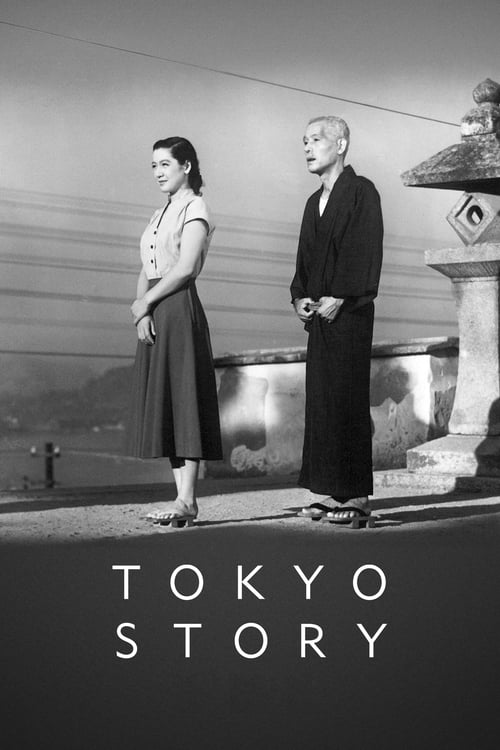
東京物語
"As long as life goes on, relationships between parents and children will bring boundless joy and endless grief."
Tokyo Story - Symbolism & Philosophy
Symbols & Motifs
Trains and Boats
Trains and boats are recurring motifs that symbolize the passage of time, the journey of life, and the irreversible changes brought by modernity. They represent both the connection and the distance between the traditional countryside (Onomichi) and the modern city (Tokyo).
The film opens with a boat in the harbor and a train passing through Onomichi. The parents' journey to and from Tokyo is a central element of the plot, although the journeys themselves are not shown, emphasizing the destinations and the emotional distances covered. The final shot of a boat moving slowly across the water reinforces the idea of life continuing its steady, indifferent course.
Clocks and Watches
Clocks and watches are potent symbols of time's relentless, linear progression and the fleeting nature of life. They underscore the theme of mono no aware (the pathos of things) and the limited time the family has together.
At the end of the film, Shūkichi gives Tomi's watch to Noriko, a deeply symbolic gesture. He is passing on his late wife's time to Noriko, encouraging her to move forward and remarry, rather than remaining bound to the past. It signifies a transition and the continuation of life.
The Vase
While more famous in other Ozu films like "Late Spring," the vase in the Hirayama home can be seen as a symbol of stillness, tradition, and the quiet, enduring beauty that exists amidst the turmoil of family life and societal change. It represents a point of contemplation and stasis in a world of constant movement.
Ozu often uses shots of objects, like a vase, as transitional "pillow shots." In the final scene, as Shūkichi sits alone in his home, the quiet presence of the vase in the room contrasts with his profound loneliness, highlighting the enduring nature of objects versus the transience of human life.
Smokestacks
The images of smokestacks that appear in transitional shots symbolize the industrialization and modernization of Tokyo. They represent progress and the new economic reality that consumes the lives of the children, while also suggesting a form of pollution, both environmental and perhaps cultural.
Ozu frequently cuts to shots of smokestacks before scenes set in Tokyo. This visually establishes the urban environment and contrasts it sharply with the natural landscapes of the parents' hometown, Onomichi.
Philosophical Questions
Is the drift between parents and children an inevitable part of life?
The film explores this question through the character of Noriko, who tells a distraught Kyōko that children inevitably drift away from their parents as they build their own lives. "Tokyo Story" presents this phenomenon not as a malicious act, but as a slow, gradual, and sorrowful process. It forces the viewer to consider whether this emotional distance is a natural consequence of time and individual growth, or a failure of modern society to value familial bonds.
What is the nature of happiness and disappointment?
The film suggests that life is inherently tinged with disappointment. No character achieves an idealized state of happiness. The parents are disappointed in their children, the children are struggling with their own lives, and the kindest character, Noriko, is deeply lonely. The dialogue "Isn't life disappointing?" "Yes, it is," lies at the film's philosophical heart, proposing that maturity and wisdom come from accepting this reality with grace rather than fighting against it.
How does societal change affect our most personal relationships?
"Tokyo Story" uses the family unit as a microcosm to examine the profound impact of large-scale societal shifts. The transition from a traditional, agrarian-based society to a modern, industrial one is shown to directly alter the fundamental dynamics of family, replacing filial piety with individual ambition. It asks whether our deepest connections can withstand the pressures of economic and cultural change.
What does it mean to be 'family'?
The film raises this question by contrasting the behavior of the biological children with that of the daughter-in-law, Noriko. She, who has no blood relation, demonstrates more care and duty than those who do. This challenges the viewer to consider whether family is defined by blood ties or by actions, kindness, and emotional connection. Shūkichi explicitly acknowledges this when he tells Noriko she has treated them better than their own children.
Core Meaning
The core meaning of "Tokyo Story" revolves around the inevitable dissolution of the Japanese family unit in the face of post-war modernization and the universal, poignant truth that children naturally grow apart from their parents. Director Yasujirō Ozu sought to depict the collapse of the traditional family system by showing the lives of the grown-up children. The film serves as a meditation on aging, mortality, and the subtle, often unspoken, disappointments of life. It suggests that the fracturing of family ties is not necessarily born of malice, but from the practicalities and self-centeredness of modern life, where individuals become absorbed in their own immediate concerns. Ultimately, the film carries a sense of gentle sadness and acceptance—what is known in Japanese aesthetics as mono no aware, a wistful awareness of the transience of all things—suggesting that this familial drift, while painful, is an inescapable part of the human condition.