Подземље
"ONCE UPON A TIME THERE WAS A COUNTRY"
Underground - Symbolism & Philosophy
Symbols & Motifs
The Cellar
Symbolizes Plato's Cave and the isolation of the Yugoslav people under communism. It represents a fabricated reality where time and truth are controlled by a central authority.
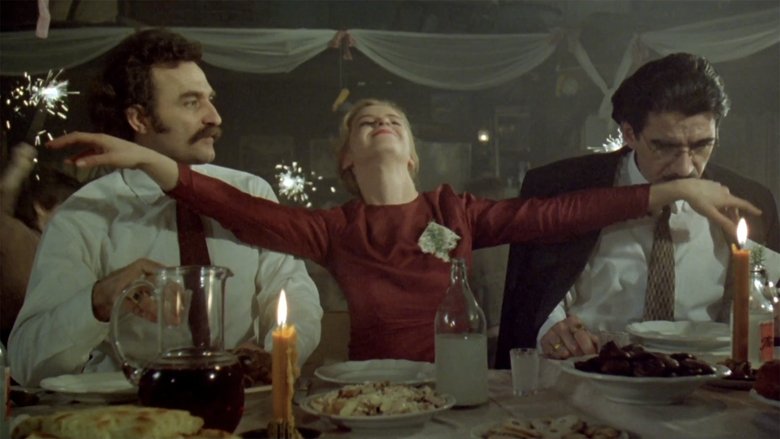
Used throughout the second act where characters live, party, and work for decades, believing WWII is still happening above.
The Brass Band
Represents the relentless, chaotic rhythm of history and life in the Balkans. It accompanies weddings, funerals, and battles alike, indifferent to human suffering or joy.
The band follows Blacky and Marko everywhere, even running alongside their car or playing amidst the ruins of war.
The Floating Island
Symbolizes the disintegration of Yugoslavia and the separation of its memory from reality. It represents a dream-state where the country exists only in a fairy tale.
In the final scene, the land physically cracks, and the characters float away on a chunk of earth while celebrating a wedding.
Soni the Monkey
Represents mimicry and primitive instinct. Soni often imitates the violent actions of humans (like firing a tank), suggesting that war is a learned, primal behavior.
Soni is Ivan's companion in the zoo and later in the cellar; he inadvertently triggers destruction by mimicking human warfare.
Philosophical Questions
Is truth objective or a construction of power?
Through Marko's fabrication of WWII continuing for 20 years, the film explores the idea that 'truth' is defined by those who control information (the cellar). It asks if a lived lie is any less 'real' to the subject than the objective reality outside.
Can a lie protect innocence?
Marko keeps the cellar dwellers underground ostensibly to 'protect' them, but it is actually to exploit them. The film questions the ethics of paternalism—is safety worth the price of freedom and truth? Ivan's character suggests that the 'real' world is so horrific that the lie might have been preferable.
Core Meaning
At its heart, Underground is a biting satire on the construction of history and political myth-making. Kusturica uses the allegory of the cellar to demonstrate how totalitarian regimes (specifically Tito's Yugoslavia) kept their population in a state of suspended animation, fed by propaganda and fear of external enemies.
The film argues that a country built on lies and burying its past is doomed to repeat its violence. It portrays the Balkan conflict not just as political, but as a cyclical, fratricidal tragedy fueled by passion and blindness, suggesting that the "truth" is often just a conviction performed by those in power.