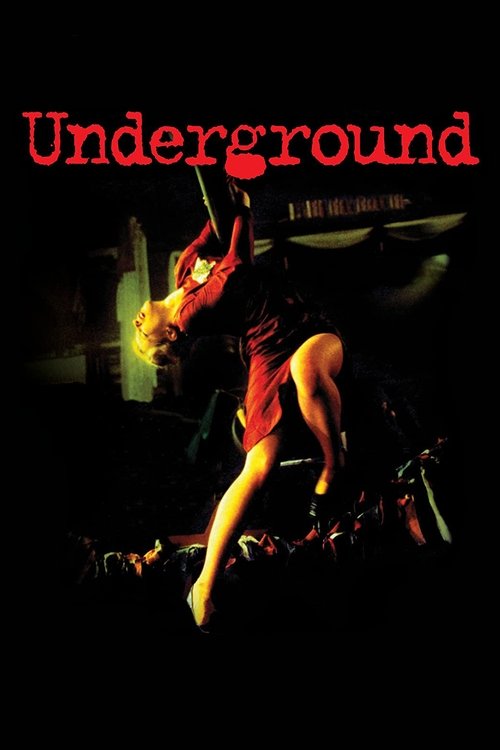
Underground
Подземље
"ONCE UPON A TIME THERE WAS A COUNTRY"
Overview
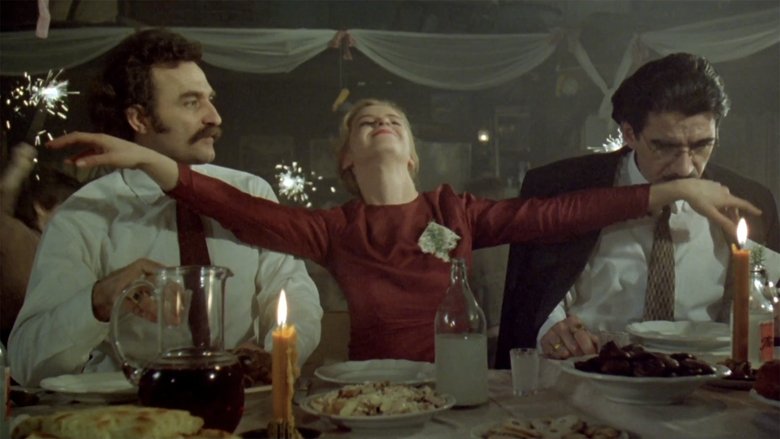
Underground tells the epic, surreal story of two friends, Marko and Blacky, spanning from World War II to the Yugoslav Wars of the 1990s. During the Nazi occupation of Belgrade, Marko hides Blacky and a group of partisans in his grandfather's large cellar to protect them. While they manufacture weapons for the resistance, Marko becomes a high-ranking Communist official in Tito's regime.
The twist lies in Marko's grand deception: for twenty years, he keeps the cellar inhabitants convinced that World War II is still raging above, manipulating time and feeding them fake news broadcasts. He exploits their labor to manufacture arms for his own profit while seducing Natalija, the woman they both love.
When the truth finally breaks and the inhabitants emerge decades later, they find themselves in the middle of a new conflict—the Yugoslav Wars. The film blurs the lines between the staged reality of the cellar, the filming of a propaganda movie about their lives, and the grim reality of the 1990s civil war, culminating in a surreal, dreamlike reunion.
Core Meaning
At its heart, Underground is a biting satire on the construction of history and political myth-making. Kusturica uses the allegory of the cellar to demonstrate how totalitarian regimes (specifically Tito's Yugoslavia) kept their population in a state of suspended animation, fed by propaganda and fear of external enemies.
The film argues that a country built on lies and burying its past is doomed to repeat its violence. It portrays the Balkan conflict not just as political, but as a cyclical, fratricidal tragedy fueled by passion and blindness, suggesting that the "truth" is often just a conviction performed by those in power.
Thematic DNA
The Manipulation of History and Truth
Marko's character embodies the state power that rewrites history. By keeping the partisans underground and feeding them false narratives, the film critiques how Communist Yugoslavia constructed its own heroic mythology while keeping the populace in the dark about reality.
Plato's Cave and Isolation
The cellar is a direct reference to Plato's Allegory of the Cave. The inhabitants see only the 'shadows' (fake news, air raid sirens) created by Marko and believe them to be the whole truth. Their emergence into the 'real' world is disorienting and leads to tragedy, questioning the nature of reality itself.
Fratricide and Civil War
The relationship between Marko and Blacky represents the fracturing of Yugoslavia. The quote "A war is not a war until a brother kills his brother" underscores the film's view of the conflict as an internal, self-destructive tragedy rather than just foreign aggression.
Dionysian Vitality vs. Destruction
The film is characterized by an unstoppable, chaotic energy—constant music, eating, drinking, and celebrating even amidst bombing and death. This reflects a specific 'Balkan' spirit where the drive for life and the drive for destruction are dangerously intertwined.
Character Analysis
Marko Dren
Miki Manojlović
Motivation
Power, survival, and possession of Natalija. He represents the political elite who profit from the suffering of the people.
Character Arc
Starts as a charming rogue and resistance fighter, evolves into a cold, calculating Communist leader who imprisons his friends to maintain his power and lies. Ends as a war profiteer lost in his own web of deceit.
Petar 'Blacky' Popara
Lazar Ristovski
Motivation
Patriotism, loyalty to Marko, and love for Natalija. He represents the raw, unguided energy of the people.
Character Arc
A brave but reckless patriot who is easily manipulated. He spends decades underground believing he is a hero, only to emerge into a world he doesn't understand, ultimately becoming a tragic figure of war.
Natalija
Mirjana Joković
Motivation
Survival and comfort. She is often seen as a metaphor for the country itself, torn between different powers.
Character Arc
An actress who switches allegiances between the German occupier Franz, the hero Blacky, and the powerful Marko to survive. She is the object of desire that drives the conflict between the men.
Ivan Dren
Slavko Štimac
Motivation
Love for animals and a desire for simple truth. He is the only one who sees the absurdity of the war.
Character Arc
Marko's stuttering brother who cares for the animals. He is the moral conscience of the film, devastated by the cruelty of the world. His suicide is a rejection of the madness around him.
Symbols & Motifs
The Cellar
Symbolizes Plato's Cave and the isolation of the Yugoslav people under communism. It represents a fabricated reality where time and truth are controlled by a central authority.
Used throughout the second act where characters live, party, and work for decades, believing WWII is still happening above.
The Brass Band
Represents the relentless, chaotic rhythm of history and life in the Balkans. It accompanies weddings, funerals, and battles alike, indifferent to human suffering or joy.
The band follows Blacky and Marko everywhere, even running alongside their car or playing amidst the ruins of war.
The Floating Island
Symbolizes the disintegration of Yugoslavia and the separation of its memory from reality. It represents a dream-state where the country exists only in a fairy tale.
In the final scene, the land physically cracks, and the characters float away on a chunk of earth while celebrating a wedding.
Soni the Monkey
Represents mimicry and primitive instinct. Soni often imitates the violent actions of humans (like firing a tank), suggesting that war is a learned, primal behavior.
Soni is Ivan's companion in the zoo and later in the cellar; he inadvertently triggers destruction by mimicking human warfare.
Memorable Quotes
A war is no war until the brother kills his brother.
— Marko Dren
Context:
Spoken by Marko, highlighting the fratricidal nature of the conflict that destroys the country.
Meaning:
Encapsulates the film's tragic view of the Yugoslav conflict as a civil war where intimate bonds are severed by political hatred.
Bila jednom jedna zemlja. (Once upon a time, there was a country.)
— Ivan Dren
Context:
The closing narration delivered directly to the camera as the island floats away.
Meaning:
Frames the entire film as a fairy tale or a myth, suggesting that Yugoslavia has ceased to exist in reality and now lives only in memory and story.
There is no truth, only your conviction that what you say is the truth.
— Marko Dren
Context:
Marko explaining his philosophy, justifying his manipulation of the people in the cellar.
Meaning:
Summarizes the film's postmodern take on history—that history is written by the victors and those who can maintain the most convincing lie.
Philosophical Questions
Is truth objective or a construction of power?
Through Marko's fabrication of WWII continuing for 20 years, the film explores the idea that 'truth' is defined by those who control information (the cellar). It asks if a lived lie is any less 'real' to the subject than the objective reality outside.
Can a lie protect innocence?
Marko keeps the cellar dwellers underground ostensibly to 'protect' them, but it is actually to exploit them. The film questions the ethics of paternalism—is safety worth the price of freedom and truth? Ivan's character suggests that the 'real' world is so horrific that the lie might have been preferable.
Alternative Interpretations
The 'Yugo-nostalgia' Reading: Many see the film as a mournful love letter to a unified Yugoslavia that was destroyed by fratricide, with the final floating island representing the memory of a multi-ethnic ideal that can no longer exist on earth.
The Propaganda Critique: Detractors argue that by portraying all sides as equally crazy and violent, and by focusing on a 'third party' (the Nazis/foreigners) or internal betrayal, the film whitewashes the specific crimes of the Milošević regime during the 1990s wars.
The Meta-Historical Satire: A more cerebral interpretation suggests the film isn't about the war itself, but about how the war is sold. Marko represents the state propaganda machine that invents enemies to stay in power, making the film a universal critique of totalitarian manipulation rather than a specific comment on the Bosnian war.
Cultural Impact
Underground is one of the most controversial Palme d'Or winners in history. Upon release in 1995, it was polarized: film critics praised its visual energy and Fellini-esque scope, while political commentators (especially in France and Bosnia) condemned it as pro-Serbian propaganda. Critics like Slavoj Žižek argued that by portraying the Balkans as a place of 'primal' chaotic violence, Kusturica exoticized the war and depoliticized the Serbian aggression.
Culturally, the film cemented the 'Balkan' aesthetic in world cinema—brass bands, wild weddings, and tragic comedy—largely thanks to Goran Bregović's iconic score. It remains a definitive cinematic text on the Yugoslav experience, viewed by some as a nostalgic elegy for a lost country and by others as a dangerous distortion of historical responsibility.
Audience Reception
Audience reactions are typically polarized but generally lean towards high praise for the artistic achievement. Common points of praise include the unmatched energy, the musical score, and the surreal humor. Viewers often describe it as an 'exhausting masterpiece' due to its length and sensory overload.
Critics (especially from the region) often find the symbolism heavy-handed and the politics problematic, with some finding the portrayal of the war as a 'natural disaster' offensive. However, for international audiences, it is often rated as one of the best non-English language films of the 90s.
Interesting Facts
- The film exists in two versions: the theatrical cut (approx. 2h 47m) and a 5-hour TV miniseries version that aired on Serbian television.
- It won the Palme d'Or at the 1995 Cannes Film Festival, making Emir Kusturica one of the few directors to win the top prize twice (the first was for 'When Father Was Away on Business').
- The production used actual equipment rented from the Yugoslav Army (VJ), which fueled controversy that the film was supported by the Milošević regime.
- Shooting was incredibly arduous and lasted on-and-off from late 1993 to early 1995, mirroring the chaos of the war happening nearby.
- Kusturica was so hurt by the accusations of propaganda from French intellectuals like Alain Finkielkraut (who hadn't seen the film when he criticized it) that he announced his retirement from filmmaking, though he later returned.
- The monkey, Soni, was a difficult 'actor' to work with but provided some of the film's most poignant unscripted moments.
Easter Eggs
Kusturica's Cameo
Director Emir Kusturica appears in a cameo as an arms dealer negotiating with Marko during the 1990s war segment, blurring the line between creator and his creation's chaos.
Film-within-a-film
In the third act, a film crew is shooting a propaganda movie based on Marko's memoirs titled 'Spring Comes On A White Horse'. The actors playing 'Blacky' and 'Marko' in the fake movie wear costumes identical to the real characters' outfits from Part 1, creating a meta-commentary on how history is turned into kitsch.
Reference to Fassbinder
The scene where Kusturica (as the arms dealer) interacts with Marko is a visual homage to Rainer Werner Fassbinder's role in his own film The Marriage of Maria Braun, another film about a country (Germany) rebuilding itself after war.
⚠️ Spoiler Analysis
Click to reveal detailed analysis with spoilers
Frequently Asked Questions
Explore More About This Movie
Dive deeper into specific aspects of the movie with our detailed analysis pages
Comments (0)
No comments yet. Be the first to share your thoughts!