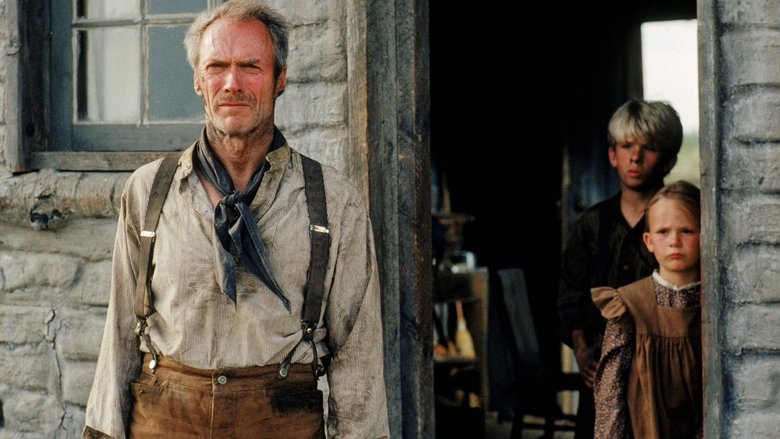
"Some legends will never be forgotten. Some wrongs can never be forgiven."
Unforgiven - Symbolism & Philosophy
Symbols & Motifs
Little Bill's House
The poorly constructed house that Sheriff Little Bill Daggett is building symbolizes the fragility of the civilization and order he is trying to impose on the West. Its leaky roof and flawed design mirror his own flawed and hypocritical character—a man who claims to bring law and order through violence and cruelty, yet is ultimately an incompetent builder of both houses and societies.
Little Bill is frequently seen working on his house by the river, complaining about the rain and the poor craftsmanship. In his final moments after being shot by Munny, his last words are, "I don't deserve this. To die like this. I was building a house." Munny's cold reply, "Deserve's got nothin' to do with it," underscores the collapse of Bill's world and his failed attempt to build a lasting, civilized legacy.
Weather (Rain and Storms)
The recurring rain and stormy weather throughout the film symbolize the bleak, unforgiving nature of the world and the inner turmoil of the characters. It reflects the moral gloom and the cleansing, yet destructive, force of the violence that unfolds. The final shootout in Big Whiskey happens during a torrential downpour, amplifying the chaos and grim finality of Munny's actions.
The film opens on a stormy night when Delilah is attacked. Will Munny suffers from a fever during a rainstorm, haunted by visions of his past. The climax of the film, where Munny rides into town for revenge, is set during a relentless storm, visually representing the storm of violence he unleashes.
The Schofield Kid's Glasses
The Schofield Kid's severe near-sightedness and his need for glasses symbolize his blindness to the reality of killing. He sees the myth of the gunslinger but not the ugly truth. His vision is metaphorical as well as literal; he can't see the true nature of the life he aspires to until he has taken a life himself, at which point he is emotionally shattered and can finally "see" clearly.
The Kid's poor eyesight is revealed early on, and it makes his boasts of being a killer seem ridiculous. After he kills his first man (in a panicked, clumsy scene in an outhouse), the reality of his actions hits him. He gives up his gun and his share of the money, telling Munny, "I guess I'd rather be blind and ragged than dead."
Philosophical Questions
Can a person truly change their fundamental nature?
The film's central conflict revolves around William Munny's struggle with his past. He has spent a decade as a peaceful farmer, reformed by his late wife. However, the pull of violence and the need for money draw him back in. The film meticulously charts his slow regression, culminating in the explosive final act where he fully embraces his former identity as a cold-blooded killer. This raises the question of whether his decade of peace was a true transformation or merely a temporary suppression of his innate character. The story suggests that while people can strive for redemption, their core nature may be inescapable when provoked by extreme circumstances.
What is the relationship between myth and reality in the creation of heroes?
"Unforgiven" constantly juxtaposes the romanticized legends of the West with its brutal reality. The character of W.W. Beauchamp, a writer of dime novels, seeks out heroes like English Bob and Little Bill, only to find their legends are built on lies, exaggeration, and cruelty. The film demonstrates how myths are constructed to sanitize violence and create heroes out of killers. William Munny himself is a subject of these myths, but the film shows the pathetic, unheroic reality of the man for most of the runtime, only to have him embody the terrifying truth of the legend at the very end.
Does violence ever lead to justice?
The film begins with an act of violence and an official form of justice (a fine of horses) that feels inadequate, prompting a quest for vigilante justice (the bounty). This ignites a cycle of escalating violence. Sheriff Little Bill uses brutal violence to maintain "peace," but his actions are unjust and self-serving. Munny's final rampage is an act of revenge, not justice, and while it eliminates a tyrant, it does so through a horrific massacre that leaves the town in fear. The film offers no easy answers, suggesting that violence begets more violence, and the line between justice and revenge is often nonexistent.
Core Meaning
At its core, "Unforgiven" is a profound deconstruction of the Western genre and the myths of American heroism. Clint Eastwood, both as director and star, aimed to strip away the romanticism associated with the gunslinger, revealing the grim reality and moral corrosion of a life defined by violence. The film posits that violence is not a clean or righteous solution but a destructive force that leaves an indelible mark on the soul. It questions the very nature of heroism and villainy, presenting characters who are deeply flawed and morally ambiguous. The central message is that the past is inescapable, and the ghosts of one's actions, particularly violent ones, can never be fully exorcised. The title itself suggests a central theme: the characters are unforgiven for their past sins, and perhaps more importantly, they are unable to forgive themselves.