"People should not be afraid of their governments. Governments should be afraid of their people."
V for Vendetta - Symbolism & Philosophy
Symbols & Motifs
The Guy Fawkes Mask
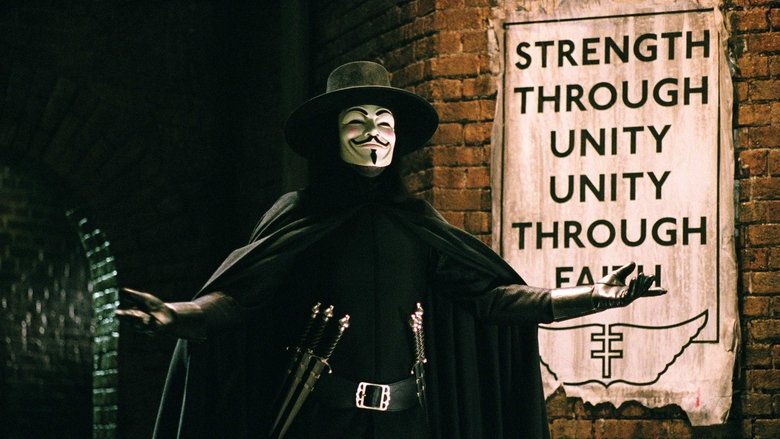
The Guy Fawkes mask is the most prominent symbol in the film, representing rebellion, anonymity, and the power of ideas. Historically associated with the failed Gunpowder Plot of 1605, the film recontextualizes it as a symbol of resistance against tyranny. The mask allows V to become an idea rather than a man, and when the populace dons the mask, they become a unified force for change.
V wears the mask throughout the film to hide his disfigurement and his identity. He also sends masks to the public, and in the film's climax, thousands of citizens wearing the mask march on Parliament, demonstrating the widespread adoption of the idea of resistance.
The Letter 'V'
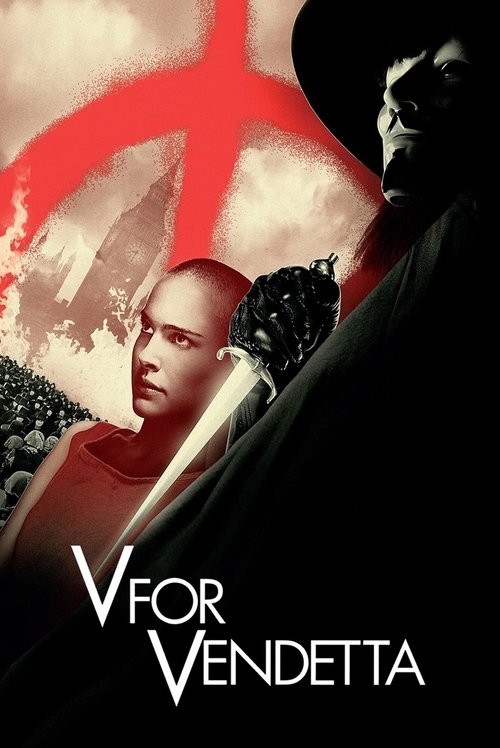
The letter 'V' is a recurring motif representing V himself, his vendetta, and the Roman numeral for five, referencing his cell number at Larkhill. It is also an inverted symbol for anarchy. It is a symbol of his identity and his revolutionary cause, which he leaves as a calling card.
V introduces himself with a monologue of words beginning with 'V'. He carves the 'V' symbol at the sites of his actions. The dominoes he arranges form a giant 'V'.
Dominoes
The falling dominoes are a powerful visual metaphor for the chain reaction of V's actions. They symbolize how a single act of defiance can trigger a cascade of events leading to the downfall of an oppressive regime. It represents the interconnectedness of events and the unstoppable momentum of a revolution once it has begun.
V sets up a large and intricate pattern of black and red dominoes that, when toppled, form his 'V' symbol. This scene is intercut with news reports of growing unrest and defiance among the population, visually linking V's plan to the people's awakening.
Valerie's Letter
Valerie's autobiography, written on toilet paper, symbolizes hope, integrity, and the endurance of the human spirit in the face of horrific oppression. It represents the importance of holding onto one's true self and values, even in the darkest of times. For Evey, it is a catalyst for her transformation, giving her the strength to overcome her fear.
Evey reads Valerie's letter while she is being held and tortured by V in a simulated prison. The letter, from a former Larkhill inmate, inspires her to find her own courage and integrity, ultimately leading to her rebirth as a fearless individual.
Philosophical Questions
Do the ends justify the means?
The film constantly forces the audience to question the morality of V's actions. He murders government officials, destroys property, and manipulates Evey through psychological torture. While his ultimate goal is the liberation of the people, the film asks whether such noble ends can justify his violent and often brutal means. The debate over whether V is a hero or a terrorist is central to this question.
What is the nature of freedom?
"V for Vendetta" explores the idea that true freedom is not just the absence of physical restraint but also freedom from fear. V's 're-education' of Evey is designed to strip her of her fear, which he sees as the ultimate prison. The film questions whether a society that has traded its freedom for security is truly safe, and what individuals must be willing to sacrifice to reclaim their liberty.
Can violence be a legitimate tool for political change?
The film presents a scenario where all democratic avenues for change have been eliminated, and the government itself is a terrorist entity. In this context, it asks whether violence becomes a necessary and legitimate tool for revolution. V's actions, which would be classified as terrorism in a democratic society, are portrayed as a justifiable response to a fascist regime.
Core Meaning
The central message of "V for Vendetta" is that ideas are indestructible and have the power to change the world. The film posits that governments should fear their people, not the other way around. It explores the concept that a single individual's actions, when fueled by a powerful idea, can inspire a mass movement capable of toppling even the most oppressive regimes. The narrative champions the importance of individual liberty and the necessity of resisting tyranny, even in the face of overwhelming odds. Ultimately, the film suggests that while a person can be killed, the ideals they represent can live on and inspire future generations to continue the fight for freedom and justice.