
Vincent - Symbolism & Philosophy
Symbols & Motifs
Shadows and Light
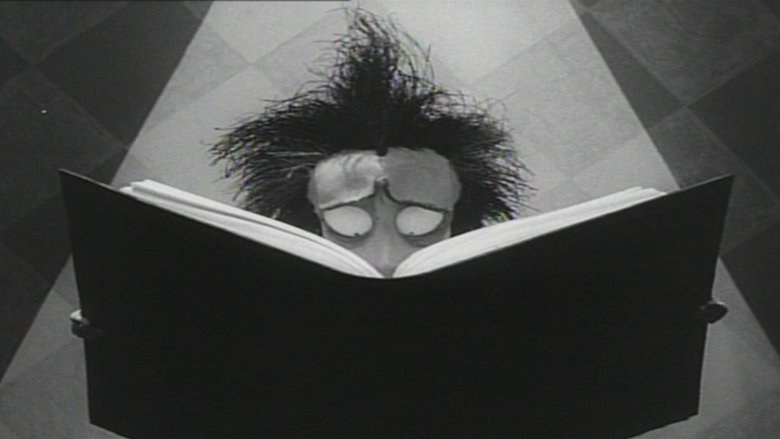
Symbolizes the two conflicting worlds Vincent inhabits. Light represents the ordinary, mundane reality his mother tries to enforce, while deep, distorted shadows represent his rich, dramatic, and preferred inner world of gothic fantasy. The high-contrast, black-and-white cinematography is essential to this symbolism.
Throughout the film, scenes transition from high-key lighting, when his mother interacts with him, to low-key, expressionistic lighting when he is lost in his daydreams. The final shot shows him collapsing into a patch of shadow, symbolizing his ultimate consumption by his fantasy world.
The Dog, Abercrombie
Abercrombie represents the innocent victim of Vincent's creative, yet morbid, ambitions. His transformation into a "horrible zombie dog" is a manifestation of Vincent's desire to bring his dark fantasies to life, using the elements of his real world as props. He is also a direct precursor to the reanimated dog in Burton's later film, "Frankenweenie."
In one of his fantasies, Vincent is shown with a contraption, gleefully performing an experiment on Abercrombie. Later, the spectral, shadowy figure of the zombie dog haunts him during the film's chaotic climax.
Faceless Adults
The recurring visual motif of adults whose faces are kept out of frame, particularly his mother and aunt, symbolizes the disconnect and lack of understanding between Vincent's world and the adult world. From his perspective as a child, adults are towering, authoritarian figures who cannot comprehend his imagination.
When Vincent's aunt visits, he leans against her, but we only see her from the torso down. Similarly, his mother is often just a voice or a pair of hands entering the frame, representing the intrusion of an outside reality he doesn't feel a part of.
The Raven
The raven symbolizes Vincent's complete immersion into the world of Edgar Allan Poe and his embrace of tragic, romantic despair. The final quote from Poe's poem signifies his ultimate surrender to his tortured artist persona, choosing the finality of "Nevermore" over a return to reality.
The film ends with Vincent collapsing, weak and overwhelmed by his terrifying fantasies, and softly quoting the final lines of "The Raven": "And my soul from out that shadow that lies floating on the floor, shall be lifted... nevermore."
Philosophical Questions
Where is the line between a healthy imagination and a dangerous delusion?
The film constantly blurs this line. Vincent's fantasies are creative and serve as an escape from a boring reality. However, they lead him to a state of genuine terror and isolation, culminating in a belief that he is dying. The film doesn't offer a clear answer but explores the tension between the enriching power of imagination and its potential to completely detach an individual from reality, especially when that individual feels misunderstood by the world around them.
Is it better to conform to societal norms of happiness or to embrace one's unique, even if melancholic, nature?
"Vincent" presents this choice through the conflict with his mother. She advocates for a conventional form of happiness: playing outside on a sunny day. Vincent, however, finds his identity and a deeper sense of self in the "tormented" and "insane" persona he adopts. The film is a clear endorsement of the latter, portraying Vincent's world, for all its darkness, as richer and more compelling than the bland alternative offered by his mother, thus celebrating individuality over conformity.
Core Meaning
The core meaning of "Vincent" is a celebration of individuality and the power of imagination as both a sanctuary and a potential prison. Director Tim Burton explores the mind of a creative, solitary child who feels like an outsider. The film champions the idea of embracing one's unique, even macabre, interests in a world that often pushes for conformity. It serves as a semi-autobiographical piece, reflecting Burton's own childhood and feelings of alienation, while also being a tribute to his idols, Vincent Price and Edgar Allan Poe. The film delves into the delicate balance between a rich inner life and the encroaching demands of reality, suggesting that while imagination is a vital escape, it can also lead to profound isolation if not reconciled with the outside world.