Vincent
A gothic stop-motion poem where a young boy's macabre imagination, fueled by Poe and Price, blossoms into a shadowy, surreal world that threatens to consume his reality.
Vincent

Vincent

01 October 1982 United States of America 6 min ⭐ 7.9 (891)
Director: Tim Burton
Cast: Vincent Price
Animation Fantasy
Imagination vs. Reality The Outsider and Alienation Homage to Gothic Horror Childhood Creativity and Melancholy
Budget: $60,000

Overview

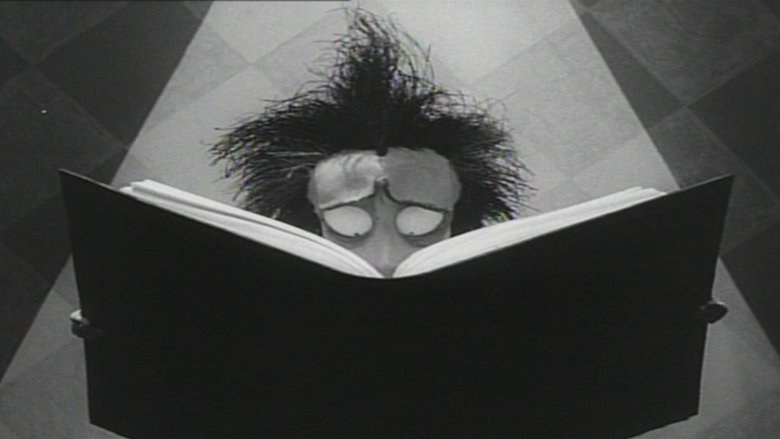
"Vincent" is a six-minute, black-and-white, stop-motion animated short film that tells the story of a seven-year-old boy named Vincent Malloy. While outwardly a polite and considerate child, Vincent harbors a deep desire to be just like his idol, the iconic horror actor Vincent Price, who also narrates the film. His days are spent in elaborate fantasies, where he sees himself as a tormented artist and mad scientist.

Vincent's imagination transforms his suburban life into a gothic landscape. He imagines conducting experiments on his dog, Abercrombie, to turn him into a zombie, and pictures dipping his visiting aunt in wax for his personal museum. His obsession with the tales of Edgar Allan Poe leads him to believe his wife has been buried alive, and he becomes lost in a world of self-imposed, sorrowful delusion. Throughout the film, his mother's attempts to pull him back to the bright, sunny reality of childhood only serve to deepen his retreat into his dark, imagined world.
Core Meaning

The core meaning of "Vincent" is a celebration of individuality and the power of imagination as both a sanctuary and a potential prison. Director Tim Burton explores the mind of a creative, solitary child who feels like an outsider. The film champions the idea of embracing one's unique, even macabre, interests in a world that often pushes for conformity. It serves as a semi-autobiographical piece, reflecting Burton's own childhood and feelings of alienation, while also being a tribute to his idols, Vincent Price and Edgar Allan Poe. The film delves into the delicate balance between a rich inner life and the encroaching demands of reality, suggesting that while imagination is a vital escape, it can also lead to profound isolation if not reconciled with the outside world.

Thematic DNA

Imagination vs. Reality 35%
The Outsider and Alienation 30%
Homage to Gothic Horror 25%
Childhood Creativity and Melancholy 10%

Imagination vs. Reality

The central conflict of the film is the stark contrast between Vincent's mundane suburban reality and his vivid, gothic imagination. This is visualized through shifts in lighting and set design; his 'real' life is often brightly lit, while his fantasies plunge him into a dark, shadowy world of German Expressionist angles. His mother's dialogue constantly tries to pull him back, reminding him, "You're not Vincent Price, you're Vincent Malloy... you're just a young boy," but he increasingly prefers the melodrama of his self-created torment.

The Outsider and Alienation

Vincent is the archetypal Burton protagonist: a sensitive, misunderstood outcast. He doesn't connect with typical childhood activities, preferring the solitary company of Poe's tales and his dark inventions. His family, particularly his mother, doesn't understand his unique perspective, viewing his creative expressions as mere "games... all in your head." This lack of understanding fuels his alienation and pushes him deeper into his fantasy world, a common theme in Burton's later works featuring characters like Edward Scissorhands and Victor Frankenstein.

Homage to Gothic Horror

The film is a direct tribute to the gothic horror genre. It is steeped in references to the works of Edgar Allan Poe, particularly "The Raven," which Vincent quotes at the film's climax. The narration by Vincent Price, a horror icon famous for his roles in Roger Corman's Poe adaptations, solidifies this connection. The entire aesthetic—the stop-motion animation, the distorted perspectives, and the dramatic use of shadow—is a pastiche of 1920s German Expressionist films like "The Cabinet of Dr. Caligari."

Childhood Creativity and Melancholy

"Vincent" explores the darker side of childhood creativity, where imagination is not just about fun but also a way to process feelings of loneliness and melancholy. Vincent's fantasies are not just playful; they are steeped in a "luxury of sorrow," a desire to feel the profound emotions he reads about in Poe's work. The film portrays him as a young, romantic artist who finds beauty and identity in the tragic and the macabre, a stark contrast to the simple happiness his mother wishes for him.

Character Analysis

Vincent Malloy

Vincent Price (Narrator)

Archetype: The Outcast/Antihero
Key Trait: Imaginative

Motivation

Vincent is motivated by a desire to escape the mundanity of his suburban childhood and inhabit the dark, dramatic, and emotionally rich world of his heroes, Vincent Price and Edgar Allan Poe. He seeks to feel the profound torment and sorrow of the gothic characters he reads about, finding it more exciting and authentic than the "real fun" his mother prescribes.

Character Arc

Vincent doesn't have a traditional character arc of growth, but rather a descent. He begins as a boy who enjoys pretending to be Vincent Price but is still grounded in reality. As the film progresses, the line between his fantasy and reality blurs. His mother's attempts to correct him only push him further into his delusions. By the end, he is completely consumed by his tragic, self-created narrative, collapsing under the weight of his own imagination and believing himself to be dead.

Vincent's Mother

N/A

Archetype: The Obstacle/Voice of Reality
Key Trait: Conventional

Motivation

Her motivation is simple and maternal: she wants her son to be a happy, normal seven-year-old. She is concerned by his morbid fantasies and wants him to engage with the real world and "have some real fun."

Character Arc

Vincent's Mother represents the well-meaning but uncomprehending voice of the conventional world. She tries to guide Vincent toward what she perceives as a normal, healthy childhood—playing outside in the sun. Her arc is static; she never comes to understand her son's inner world and her frustration grows, culminating in her angry outburst that he is "just a young boy."

Symbols & Motifs

Shadows and Light

Meaning:

Symbolizes the two conflicting worlds Vincent inhabits. Light represents the ordinary, mundane reality his mother tries to enforce, while deep, distorted shadows represent his rich, dramatic, and preferred inner world of gothic fantasy. The high-contrast, black-and-white cinematography is essential to this symbolism.

Context:

Throughout the film, scenes transition from high-key lighting, when his mother interacts with him, to low-key, expressionistic lighting when he is lost in his daydreams. The final shot shows him collapsing into a patch of shadow, symbolizing his ultimate consumption by his fantasy world.

The Dog, Abercrombie

Meaning:

Abercrombie represents the innocent victim of Vincent's creative, yet morbid, ambitions. His transformation into a "horrible zombie dog" is a manifestation of Vincent's desire to bring his dark fantasies to life, using the elements of his real world as props. He is also a direct precursor to the reanimated dog in Burton's later film, "Frankenweenie."

Context:

In one of his fantasies, Vincent is shown with a contraption, gleefully performing an experiment on Abercrombie. Later, the spectral, shadowy figure of the zombie dog haunts him during the film's chaotic climax.

Faceless Adults

Meaning:

The recurring visual motif of adults whose faces are kept out of frame, particularly his mother and aunt, symbolizes the disconnect and lack of understanding between Vincent's world and the adult world. From his perspective as a child, adults are towering, authoritarian figures who cannot comprehend his imagination.

Context:

When Vincent's aunt visits, he leans against her, but we only see her from the torso down. Similarly, his mother is often just a voice or a pair of hands entering the frame, representing the intrusion of an outside reality he doesn't feel a part of.

The Raven

Meaning:

The raven symbolizes Vincent's complete immersion into the world of Edgar Allan Poe and his embrace of tragic, romantic despair. The final quote from Poe's poem signifies his ultimate surrender to his tortured artist persona, choosing the finality of "Nevermore" over a return to reality.

Context:

The film ends with Vincent collapsing, weak and overwhelmed by his terrifying fantasies, and softly quoting the final lines of "The Raven": "And my soul from out that shadow that lies floating on the floor, shall be lifted... nevermore."

Memorable Quotes

He wants to be just like Vincent Price.

— Narrator (Vincent Price)

Context:

This is the fourth line of the opening narration, immediately following the description of Vincent Malloy as a polite seven-year-old boy. It creates the central irony and charm of the film.

Meaning:

This line, delivered by Vincent Price himself, establishes the film's central premise and its meta-textual nature. It introduces the core desire of the protagonist, which is not just a childish fantasy but a deep identification with a specific icon of horror, setting the stage for the film's exploration of identity and hero worship.

You're not Vincent Price, you're Vincent Malloy. You're not tormented or insane, you're just a young boy.

— Vincent's Mother (Voiced by Narrator)

Context:

Vincent's mother says this to him in his room after he refuses to go outside, claiming he is possessed. It is her most direct attempt to break his delusion.

Meaning:

This quote represents the film's central conflict between imagination and reality. It's the voice of the adult world attempting to dismantle Vincent's fantasy and impose a 'normal' identity upon him. It highlights her lack of understanding that for Vincent, this imagined world is his true reality.

And my soul from out that shadow that lies floating on the floor, shall be lifted... nevermore.

— Vincent Malloy (Quoting Poe, Voiced by Narrator)

Context:

This is the last line of the film. After being overwhelmed by horrific visions, Vincent collapses onto the floor and recites this quote in a soft, weak voice, implying he believes he has died.

Meaning:

This final line signifies Vincent's complete surrender to his tragic fantasy. By quoting Edgar Allan Poe's "The Raven," he fully adopts the persona of the tormented protagonist, choosing the permanent despair of his imagined world over the possibility of returning to reality. It's an ambiguous and haunting end to his psychological journey.

Philosophical Questions

Where is the line between a healthy imagination and a dangerous delusion?

The film constantly blurs this line. Vincent's fantasies are creative and serve as an escape from a boring reality. However, they lead him to a state of genuine terror and isolation, culminating in a belief that he is dying. The film doesn't offer a clear answer but explores the tension between the enriching power of imagination and its potential to completely detach an individual from reality, especially when that individual feels misunderstood by the world around them.

Is it better to conform to societal norms of happiness or to embrace one's unique, even if melancholic, nature?

"Vincent" presents this choice through the conflict with his mother. She advocates for a conventional form of happiness: playing outside on a sunny day. Vincent, however, finds his identity and a deeper sense of self in the "tormented" and "insane" persona he adopts. The film is a clear endorsement of the latter, portraying Vincent's world, for all its darkness, as richer and more compelling than the bland alternative offered by his mother, thus celebrating individuality over conformity.

Alternative Interpretations

While the film is largely seen as a whimsical, albeit dark, exploration of a child's imagination, there are alternative readings. One perspective is that the film is a more serious allegory for mental illness. Vincent's detachment from reality, his paranoid fantasies, and his final collapse could be interpreted not as playful make-believe, but as a depiction of a child's descent into a psychological crisis. His mother's dismissal of his state as just "games in your head" takes on a darker tone in this light, representing a failure to recognize a genuine cry for help.

Another interpretation focuses on the ending. Does Vincent actually believe he is dead, or is he simply being dramatic? A more optimistic reading suggests the final collapse is the ultimate performance of his tragic character—he is not succumbing to madness but completing his theatrical game before getting up and being a normal boy again. However, the dominant interpretation leans toward ambiguity, suggesting that for a child like Vincent, the line between performance and genuine psychological torment is blurred, and the ending represents his imaginative world becoming frighteningly real and overwhelming.

Cultural Impact

Though not widely seen upon its initial, limited release, "Vincent" is a seminal work in Tim Burton's filmography and a cornerstone of his aesthetic. It was the first project where he had significant creative control, and it established all the key thematic and visual elements that would define his career: gothic sensibilities, stop-motion animation, the celebration of the misunderstood outcast, and a blend of the macabre with heartfelt emotion. The film was made at Disney, but its dark tone was so antithetical to the studio's brand at the time that it was shelved, an event that foreshadowed Burton's eventual firing after he made the similarly "too scary" short "Frankenweenie." Despite its initial obscurity, "Vincent" garnered critical acclaim at film festivals. Over the years, as Burton became a major filmmaker, the short film achieved cult status. It is now seen as the purest distillation of the "Burtonesque" style and is studied as the origin point of his unique vision. Its influence is most directly seen in Burton's own later stop-motion features, but its broader impact lies in how it helped to legitimize a darker, more personal, and artistically ambitious style within mainstream American animation.

Audience Reception

Audience reception for "Vincent" is overwhelmingly positive, with many viewers regarding it as a masterpiece of short filmmaking and a perfect encapsulation of Tim Burton's style. Fans praise the clever, Dr. Seuss-esque rhyming narration delivered perfectly by the legendary Vincent Price. The unique stop-motion animation and the German Expressionist-inspired visuals are consistently highlighted as beautiful and iconic. What resonates most with audiences is the film's heartfelt and relatable theme of being a misunderstood outsider who finds solace in art and imagination. Many who grew up feeling different see themselves in Vincent Malloy. The primary, minor criticism is simply its brevity; at only six minutes, some viewers are left wanting more of its enchanting world. Overall, it is considered a gothic gem and a must-see for any Tim Burton fan.

Interesting Facts

  • The film was produced by Walt Disney Productions while Tim Burton was working there as an animator. The studio found the film too dark and scary for its target audience and consigned it to the vaults, rarely showing it.
  • Impressed by Burton's unique talent, Disney's Head of Creative Development, Tom Wilhite, gave him a budget of $60,000 to produce the short film, which was adapted from a poem Burton himself had written.
  • Tim Burton's idol, Vincent Price, narrated the film. Burton sent Price the poem, and Price was so impressed he agreed to participate. They became good friends, and Price would later call the experience "the most gratifying thing that ever happened."
  • The character of Vincent Malloy is a semi-autobiographical representation of Tim Burton himself, reflecting his own childhood feelings of alienation and his love for Vincent Price and Edgar Allan Poe.
  • The film's narration is written entirely in rhyming couplets, in a style Burton intended as an homage to his other childhood hero, Dr. Seuss.
  • This was Tim Burton's first stop-motion film, a technique that would become a signature element of his filmmaking style in later works like "The Nightmare Before Christmas" and "Corpse Bride."
  • The film won the Critics' Prize at the prestigious Annecy Film Festival in France.

Easter Eggs

An early version of Jack Skellington from "The Nightmare Before Christmas" makes a cameo.

A small, skeletal figure with a round head, closely resembling Jack Skellington, appears as a detail on a toy/machine in Vincent's room. This cameo occurred years before "The Nightmare Before Christmas" was made, showing that Burton had been developing the character for a long time.

The film contains visual references to Vincent Price's movies.

Vincent's fantasy of dipping his aunt in wax is a direct nod to Vincent Price's iconic role in the 1953 horror film "House of Wax." This serves as a deeper homage to the actor whose persona the entire film is built around.

The character design of Vincent resembles Tim Burton.

Vincent Malloy's physical appearance, with his pale face and wild, dark hair, is a deliberate caricature of a young Tim Burton, reinforcing the autobiographical nature of the film.

⚠️ Spoiler Analysis

Click to reveal detailed analysis with spoilers

Frequently Asked Questions

Explore More About This Movie

Dive deeper into specific aspects of the movie with our detailed analysis pages

Comments (0)

Leave a comment

No comments yet. Be the first to share your thoughts!