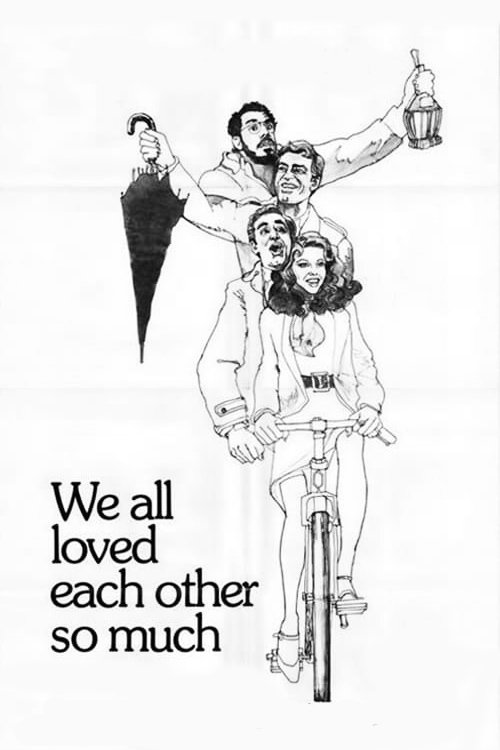
We All Loved Each Other So Much
A bittersweet Commedia all'italiana capturing the fading embers of youthful idealism, painting a poignant fresco of friendship and disillusionment against the backdrop of a changing Italy.
We All Loved Each Other So Much

C'eravamo tanto amati

"A many splendored thing."

21 December 1974 Italy 124 min ⭐ 8.3 (621)
Director: Ettore Scola
Cast: Nino Manfredi, Vittorio Gassman, Stefania Sandrelli, Stefano Satta Flores, Giovanna Ralli
Drama Comedy
Disillusionment and Lost Ideals Friendship and Betrayal The Passage of Time and Memory Cinema as a Reflection of Life

We All Loved Each Other So Much - Ending Explained

⚠️ Spoiler Analysis

The film's non-linear structure opens with a scene from the end: Antonio, Nicola, and Luciana arriving at a lavish villa, having found the owner's driver's license. They see the owner, Gianni, about to dive into his pool, and the frame freezes. The film then spends two hours explaining how they reached this moment of reunion and discovery. Throughout the narrative, we see Gianni's rise to wealth is built on betraying his leftist ideals, culminating in his marriage to Elide Catenacci, the daughter of his corrupt developer client. A key hidden element is that while his friends assume he has struggled like them, Gianni has become immensely wealthy, a fact he actively hides during a reunion dinner that ends in a fight.

A tragic turn is the suicide of Gianni's wife, Elide, who feels unloved and identifies with the alienated women in Antonioni's films. Her death frees Gianni but leaves him emotionally hollow. In another key twist, Nicola, the intellectual purist, participates in a TV quiz show about cinema to win money. He answers every question correctly but loses everything on the final question about "Bicycle Thieves" because his detailed, academic answer is deemed incorrect by the show's simplistic standards, a bitter irony that seals his fate as a noble failure.

The ending reveals the full weight of Gianni's choices. After a chance meeting where Gianni pretends to be a simple traffic warden, his friends find his lost wallet and go to return it to the address on his license. When they arrive at the villa, they realize the depth of his deception. They leave the license at the gate without a word, understanding that their friend is lost to them, his wealth having created an unbridgeable chasm. Gianni secretly watches them leave, filled with regret but unable to face them. The final line, "We wanted to change the world, but the world changed us," becomes Gianni's tragic epitaph, underscoring that his success is his greatest failure.

Alternative Interpretations

While the dominant interpretation of the film is one of bittersweet melancholy over lost ideals, some alternative readings exist. One perspective is that the film is not just a lament but also a harsh critique of the Left's failure. Nicola, the intellectual, is portrayed as ineffectual, lost in the romance of cinema rather than engaging in tangible political action. Gianni's betrayal is not just a personal failing but represents the Left's seduction by capitalism. From this viewpoint, the film is less about nostalgia and more a satirical indictment of a generation's inability to translate its ideals into lasting change.

Another interpretation focuses more on the personal than the political. The film can be seen as a universal story about the nature of friendship and the inevitable changes wrought by time, ambition, and love, with the political backdrop serving more as a setting than the central message. It's a deeply human drama about how three distinct personalities react differently to the challenges of life, and how their bond, despite everything, never completely vanishes. The ending, where Gianni watches his friends from afar, can be read not just as a moment of alienation, but also as one of profound, enduring regret and a flicker of the love that still remains, however distant.