Werckmeister harmóniák
Werckmeister Harmonies - Symbolism & Philosophy
Symbols & Motifs
The Whale
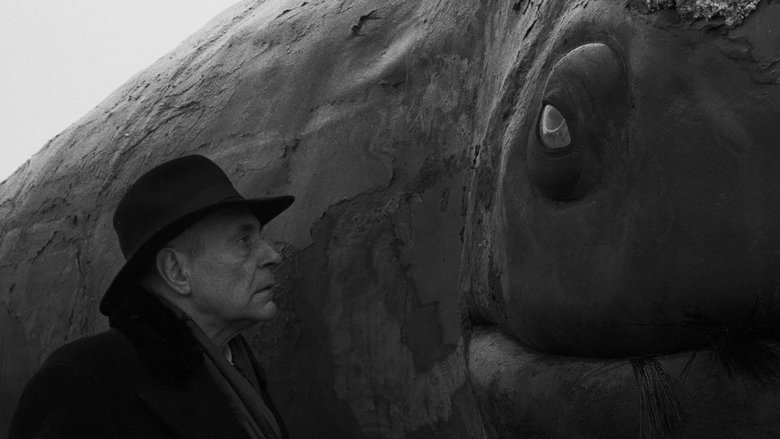
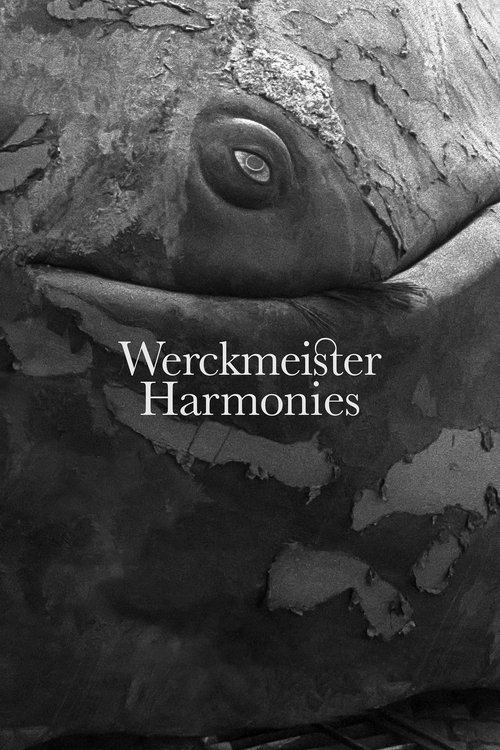
The massive, decaying whale is the film's central and most potent symbol, open to multiple interpretations. It can represent the death of God, the decay of a natural or cosmic order, or a defunct political ideology like communism. As a monstrous, otherworldly creature displayed in the town square, it embodies the sublime and the terrifying—a reflection of omnipotence that has been rendered inert and silent. Its physical decay mirrors the moral and social decay of the town. For some, it is an apocalyptic beast, a harbinger of the chaos to come.
The whale is the main attraction of the mysterious circus that arrives in the town. János is fascinated by it, seeing in its immense, dead form a profound mystery of creation. The townspeople gather around its container, their feelings a mixture of awe, fear, and morbid curiosity. The final shot of the film shows the whale abandoned and desecrated in the square, a stark image of the destruction that has swept through the community.
The Eclipse
The solar eclipse, enacted by János with drunken bar patrons, symbolizes the temporary descent into darkness and the fragility of cosmic order. It represents a moment when the natural laws are suspended, foreshadowing the societal breakdown and moral darkness that will soon engulf the town. The pantomime itself is a fleeting attempt to grasp and control the grand, indifferent mechanics of the universe, a moment of fragile harmony before the plunge into chaos.
The film's opening scene features János in a tavern, choreographing three regulars to represent the Sun, Earth, and Moon to demonstrate a total solar eclipse. The camera circles the participants in a mesmerizing long take, creating a cosmic ballet that sets the film's philosophical and somber tone.
Werckmeister's Harmonies
The musical theory of Andreas Werckmeister, which established the well-tempered tuning system, symbolizes the artificial and compromised nature of man-made order. György Eszter argues that this system abandoned a more "natural" harmony for a standardized, rationalized one, introducing a fundamental falsehood into Western culture. This musical "deception" serves as a metaphor for the flawed social and political systems that govern humanity, suggesting that their inherent imperfections will inevitably lead to discord and collapse.
The concept is explained in a monologue by György Eszter to János. He laments that the pursuit of a flawless, artificial system has destroyed the divine, natural harmony of music. At the end of the film, after the riot, a defeated György tells János he has re-tuned his piano back to the standard Werckmeister system, signifying his capitulation to the flawed order he once resisted.
The Prince
The Prince is an unseen, demagogic figure who represents the seductive and destructive power of nihilistic ideology. He is a voice of chaos, inciting the townspeople's latent frustrations and fears into a violent uprising. Never shown, his power is purely rhetorical and psychological, highlighting how easily a crowd can be swayed by promises of destruction disguised as revolution. He is the invisible force that gives the mob its direction and purpose, embodying the terrifying appeal of pure negativity.
The Prince is the second attraction of the circus, though he is only ever heard as a shadowy figure giving inflammatory speeches that are rumored to have caused riots in other towns. The restless crowd gathers in the square to hear him, and his unseen presence is the direct catalyst for the violent march on the hospital.
Philosophical Questions
Are order and harmony in human society natural states or artificial constructs destined for collapse?
The film relentlessly explores this question through the central metaphor of Werckmeister's musical harmonies. György Eszter posits that the standardized musical scale is a 'lie'—an artificial order imposed upon the natural dissonance of sound. This mirrors the fragile social order of the town, which appears stable on the surface but is rife with underlying tension and despair. The arrival of the circus and the Prince's rhetoric easily shatters this veneer, unleashing a chaos that feels more primal and, perhaps, more 'natural' than the preceding quiet desperation. The film seems to pessimistically conclude that human attempts to create lasting order are doomed to fail because they are built on compromises that ignore the inherently chaotic and irrational aspects of human nature.
What is the nature of evil and does it arise from ideology or from a void of meaning?
Werckmeister Harmonies presents the eruption of evil as an ambiguous phenomenon. The violence is catalyzed by the unseen Prince, a demagogue who gives the mob its destructive purpose, suggesting an ideological root. However, the rioters themselves seem to lack any clear goal or ideology beyond pure destruction, as a found diary reveals they were angry at everything because they didn't know what they were angry with. This suggests that the evil stems not from a coherent belief system but from a profound existential vacuum. In a world stripped of faith and meaning (symbolized by the dead whale), the townspeople are left with a festering resentment that can be easily ignited into nihilistic rage. The evil, then, is less a product of a specific doctrine and more a terrifying consequence of spiritual and social decay.
Can innocence and observation exist untainted in a world of violence?
János Valuska embodies this question. He is the film's moral center, a character of pure observation and gentle innocence. He is fascinated by the world but does not actively participate in its power struggles; he is a perpetual witness. The film charts his journey from a state of cosmic wonder to one of catatonic shock. By placing him directly in the path of the mob's brutal rampage, the film tests whether his passive innocence can endure. The conclusion is stark: it cannot. His eventual breakdown in a mental asylum signifies the destruction of the contemplative spirit in the face of incomprehensible brutality. The film argues that in a world overcome by chaos, to simply watch is not enough, and the act of witnessing such horror will inevitably destroy the witness.
Core Meaning
At its core, Werckmeister Harmonies is a profound meditation on the perpetual and fragile struggle between order and chaos. Director Béla Tarr explores the idea that societal structures, much like the compromised musical harmonies of Werckmeister, are artificial constructs that suppress a natural, more volatile state of being. The film suggests that when faith in these structures collapses—whether they be political, social, or cosmic—humanity is prone to surrendering to its most destructive impulses. It serves as a bleak allegory for the rise of totalitarianism and the ease with which a populace, steeped in fear and uncertainty, can be manipulated into committing acts of senseless violence. The film doesn't offer easy answers but instead presents a haunting vision of how quickly civilization can crumble, leaving behind only the cold, silent wreckage of its ideals.