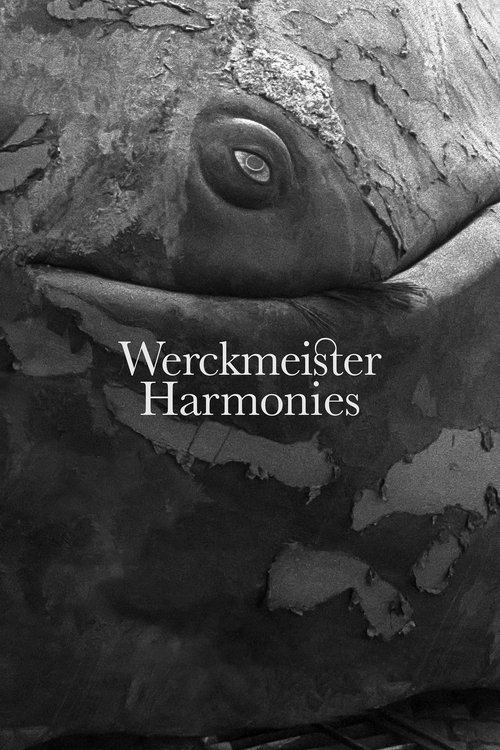
Werckmeister Harmonies
Werckmeister harmóniák
Overview
In a desolate, unnamed Hungarian town gripped by an unnerving winter, a mysterious circus arrives, bringing with it two main attractions: the enormous, taxidermied carcass of a whale and a shadowy, unseen figure known as "The Prince." The arrival of these strange entities acts as a catalyst, slowly unraveling the fragile social fabric of the community. The film follows János Valuska, a naive and gentle young man who acts as a local paper carrier and cares for his reclusive 'uncle,' György Eszter, a musicologist obsessed with the theoretical imperfections of the well-tempered musical scale developed by Andreas Werckmeister.
As an ominous tension builds, the townspeople gather in the main square, drawn by the unsettling presence of the whale and the inflammatory rhetoric rumored to come from the Prince. This simmering discontent, manipulated by János's ambitious and estranged aunt, Tünde, boils over into a terrifying explosion of mob violence. János becomes a silent, horrified witness to the town's descent into a brutal, nihilistic chaos, a journey captured in a mere thirty-nine long, continuous shots that immerse the viewer in the unfolding apocalypse.
Core Meaning
At its core, Werckmeister Harmonies is a profound meditation on the perpetual and fragile struggle between order and chaos. Director Béla Tarr explores the idea that societal structures, much like the compromised musical harmonies of Werckmeister, are artificial constructs that suppress a natural, more volatile state of being. The film suggests that when faith in these structures collapses—whether they be political, social, or cosmic—humanity is prone to surrendering to its most destructive impulses. It serves as a bleak allegory for the rise of totalitarianism and the ease with which a populace, steeped in fear and uncertainty, can be manipulated into committing acts of senseless violence. The film doesn't offer easy answers but instead presents a haunting vision of how quickly civilization can crumble, leaving behind only the cold, silent wreckage of its ideals.
Thematic DNA
The Collapse of Order and the Rise of Chaos
The film meticulously documents the disintegration of a small town's social order. This theme is central, illustrated by the arrival of the circus which acts as a catalyst for the simmering unrest. The townspeople, initially just idle and discontented, are gradually incited to violence by the unseen "Prince," a demagogue who preaches a message of destruction. The ensuing riot, a brutal and silent rampage through a hospital, represents the complete breakdown of morality and reason. This chaos is contrasted with the intellectual pursuit of order by György Eszter, whose theories on musical harmony reflect a yearning for a lost, natural coherence in the universe—a coherence that the film's events brutally negate.
Power, Manipulation, and Political Opportunism
The film serves as a powerful allegory for how political power is seized in times of crisis. Tünde Eszter, György's estranged wife, epitomizes this theme. She sees the growing chaos not as a threat, but as an opportunity. In league with the police chief, she manipulates the situation, intending to use the fear and violence to establish a new, stricter order under her control. She attempts to co-opt her husband's intellectual authority to legitimize her movement, demonstrating how ideology and prestige can be twisted for authoritarian ends. The mob itself is a tool, an amorphous force of anger harnessed by those with clear political ambitions.
Loss of Faith and Existential Despair
A profound sense of millenarian dread and spiritual emptiness pervades the film. The setting is a bleak, post-communist Hungarian landscape where ideologies have failed, leaving a vacuum of meaning. The giant, dead whale can be seen as a symbol of a dead God or a decaying natural order, its silent presence mocking the townspeople's search for meaning. János, the innocent observer, begins the film with a sense of cosmic wonder, but his journey through the heart of the town's darkness ultimately crushes his spirit, leaving him in a catatonic state. This reflects a broader societal loss of faith and the terrifying silence that follows.
The Fragility of Reason and Innocence
János Valuska embodies the perspective of innocence and pure-hearted reason in a world descending into madness. He is a gentle soul who sees cosmic beauty in an eclipse and marvels at the whale as a creation of God. However, his sensitivity and passivity make him powerless against the tide of irrational violence. He is a witness, not an actor, and his journey culminates in his own mental breakdown, suggesting that pure reason and innocence cannot survive in the face of such brutal, collective hysteria. The film posits that in times of social collapse, the forces of unreason will inevitably overwhelm and destroy the contemplative and the gentle.
Character Analysis
János Valuska
Lars Rudolph
Motivation
János is motivated by a simple, almost childlike curiosity about the world and a deep-seated sense of duty and compassion. He wants to understand the mysteries of the universe, like the eclipse and the whale, and he feels a responsibility to care for his 'uncle' György. He is not driven by ambition or ideology, but by a gentle desire to observe, learn, and help.
Character Arc
János begins the film as a wide-eyed innocent, a pure and curious soul who finds wonder in the cosmos and seeks to care for those around him. He is a passive observer, drifting through the escalating tensions of the town. His arc is one of tragic disillusionment. As he witnesses the brutal, senseless violence of the mob—a force he is powerless to stop—his spirit is broken. The horrors he sees strip him of his innocence, culminating in his commitment to a mental institution where he is left in a catatonic state, staring blankly, his connection to the world severed.
György Eszter
Peter Fitz
Motivation
His primary motivation is the intellectual and philosophical pursuit of a 'purer,' more natural truth, which he seeks through music theory. He is driven by a conviction that modern society is built on a fundamental 'lie' or compromise, and he resists this by retreating into his studies, hoping to rediscover a lost, authentic harmony.
Character Arc
György Eszter starts as a principled recluse, an intellectual who has withdrawn from a society he sees as fundamentally flawed, symbolized by his rejection of Werckmeister's musical harmonies. He is dedicated to his theoretical work, representing a belief in a higher, natural order. However, the tide of real-world chaos, instigated in part by his estranged wife, forces him out of his isolation. By the end, the violence and the subsequent imposition of a new, brutal order leave him defeated. His final act of re-tuning his piano to the conventional system is a gesture of complete capitulation, an abandonment of his ideals in the face of overwhelming force.
Tünde Eszter
Hanna Schygulla
Motivation
Tünde is motivated by a naked hunger for power and control. She is pragmatic and cynical, viewing people and events as instruments to be used for her own advancement. Her goal is to dismantle the old, stagnant order and replace it with a new one that she can lead, under the guise of bringing 'cleanliness' and 'order' to the town.
Character Arc
Tünde is a ruthless and ambitious woman who appears at the outset as merely estranged from her husband. Her arc is one of ascending power. She sees the growing social unrest not as a disaster but as a perfect opportunity to seize control. She manipulates János, pressures her husband, and collaborates with the police chief to form a committee that will restore 'order' after the chaos she helps to orchestrate. By the end of the film, she has successfully exploited the violence to install herself and her allies in a position of authority, demonstrating a chillingly effective path from manipulation to authoritarian rule.
Symbols & Motifs
The Whale
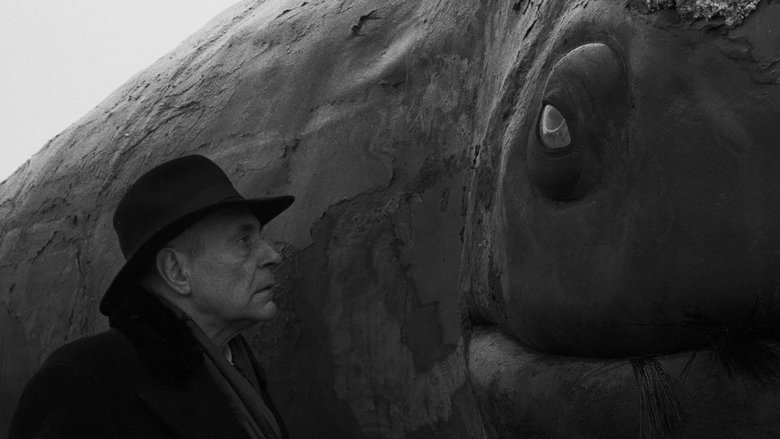
The massive, decaying whale is the film's central and most potent symbol, open to multiple interpretations. It can represent the death of God, the decay of a natural or cosmic order, or a defunct political ideology like communism. As a monstrous, otherworldly creature displayed in the town square, it embodies the sublime and the terrifying—a reflection of omnipotence that has been rendered inert and silent. Its physical decay mirrors the moral and social decay of the town. For some, it is an apocalyptic beast, a harbinger of the chaos to come.
The whale is the main attraction of the mysterious circus that arrives in the town. János is fascinated by it, seeing in its immense, dead form a profound mystery of creation. The townspeople gather around its container, their feelings a mixture of awe, fear, and morbid curiosity. The final shot of the film shows the whale abandoned and desecrated in the square, a stark image of the destruction that has swept through the community.
The Eclipse
The solar eclipse, enacted by János with drunken bar patrons, symbolizes the temporary descent into darkness and the fragility of cosmic order. It represents a moment when the natural laws are suspended, foreshadowing the societal breakdown and moral darkness that will soon engulf the town. The pantomime itself is a fleeting attempt to grasp and control the grand, indifferent mechanics of the universe, a moment of fragile harmony before the plunge into chaos.
The film's opening scene features János in a tavern, choreographing three regulars to represent the Sun, Earth, and Moon to demonstrate a total solar eclipse. The camera circles the participants in a mesmerizing long take, creating a cosmic ballet that sets the film's philosophical and somber tone.
Werckmeister's Harmonies
The musical theory of Andreas Werckmeister, which established the well-tempered tuning system, symbolizes the artificial and compromised nature of man-made order. György Eszter argues that this system abandoned a more "natural" harmony for a standardized, rationalized one, introducing a fundamental falsehood into Western culture. This musical "deception" serves as a metaphor for the flawed social and political systems that govern humanity, suggesting that their inherent imperfections will inevitably lead to discord and collapse.
The concept is explained in a monologue by György Eszter to János. He laments that the pursuit of a flawless, artificial system has destroyed the divine, natural harmony of music. At the end of the film, after the riot, a defeated György tells János he has re-tuned his piano back to the standard Werckmeister system, signifying his capitulation to the flawed order he once resisted.
The Prince
The Prince is an unseen, demagogic figure who represents the seductive and destructive power of nihilistic ideology. He is a voice of chaos, inciting the townspeople's latent frustrations and fears into a violent uprising. Never shown, his power is purely rhetorical and psychological, highlighting how easily a crowd can be swayed by promises of destruction disguised as revolution. He is the invisible force that gives the mob its direction and purpose, embodying the terrifying appeal of pure negativity.
The Prince is the second attraction of the circus, though he is only ever heard as a shadowy figure giving inflammatory speeches that are rumored to have caused riots in other towns. The restless crowd gathers in the square to hear him, and his unseen presence is the direct catalyst for the violent march on the hospital.
Memorable Quotes
How mysterious is the Lord that he amuses Himself with such strange creatures.
— János Valuska
Context:
János has just seen the taxidermied whale for the first time, displayed inside a large truck container as part of the travelling circus. He is mesmerized by the creature's scale and strange beauty, and his words are a quiet reflection on the profound mysteries of nature and existence, spoken to György Eszter.
Meaning:
This quote, whispered by János as he gazes at the enormous, dead whale, captures his sense of awe and wonder in the face of the sublime and the inexplicable. It reflects his innocent, almost religious perspective, where even a decaying carcass is a testament to the mysterious grandeur of creation. The line underscores the film's central tension between a search for meaning and the cold, silent indifference of the universe.
They think because they are afraid. To be afraid is to understand nothing.
— Unidentified character (in some analyses)
Context:
The precise context for this quote within the film is not consistently documented in critical analyses, but it reflects the general atmosphere of existential dread and the irrational behavior of the crowds gathering in the town square, influenced by the rumors surrounding the Prince.
Meaning:
This quote encapsulates a core philosophical idea of the film: that the descent into mob mentality and violence is rooted in fear, not understanding. It suggests that the townspeople's destructive actions are a reaction to a profound anxiety and confusion they cannot articulate. Their violence is a desperate attempt to impose a brutal, simplistic meaning on a world they no longer comprehend. The statement critiques the illusion of control that comes from fear-based thinking.
I have to make it clear that not even for a moment is there doubt that it is not a technical but a philosophical question.
— György Eszter
Context:
György says this during his monologue to János, explaining his obsession with the imperfections of the well-tempered scale. He is trying to impress upon János that his research is not just about music, but about a foundational error in how humanity perceives and structures the world.
Meaning:
With this statement, György elevates his critique of musical tuning from a mere technical debate to a profound philosophical problem concerning the very nature of order and truth. He argues that Werckmeister's standardized system represents a fundamental 'lie' that has shaped all of Western culture, prioritizing artificial tidiness over natural, complex harmony. It frames the entire film's conflict as a struggle between authentic, chaotic reality and the flawed, oppressive systems created to contain it.
Philosophical Questions
Are order and harmony in human society natural states or artificial constructs destined for collapse?
The film relentlessly explores this question through the central metaphor of Werckmeister's musical harmonies. György Eszter posits that the standardized musical scale is a 'lie'—an artificial order imposed upon the natural dissonance of sound. This mirrors the fragile social order of the town, which appears stable on the surface but is rife with underlying tension and despair. The arrival of the circus and the Prince's rhetoric easily shatters this veneer, unleashing a chaos that feels more primal and, perhaps, more 'natural' than the preceding quiet desperation. The film seems to pessimistically conclude that human attempts to create lasting order are doomed to fail because they are built on compromises that ignore the inherently chaotic and irrational aspects of human nature.
What is the nature of evil and does it arise from ideology or from a void of meaning?
Werckmeister Harmonies presents the eruption of evil as an ambiguous phenomenon. The violence is catalyzed by the unseen Prince, a demagogue who gives the mob its destructive purpose, suggesting an ideological root. However, the rioters themselves seem to lack any clear goal or ideology beyond pure destruction, as a found diary reveals they were angry at everything because they didn't know what they were angry with. This suggests that the evil stems not from a coherent belief system but from a profound existential vacuum. In a world stripped of faith and meaning (symbolized by the dead whale), the townspeople are left with a festering resentment that can be easily ignited into nihilistic rage. The evil, then, is less a product of a specific doctrine and more a terrifying consequence of spiritual and social decay.
Can innocence and observation exist untainted in a world of violence?
János Valuska embodies this question. He is the film's moral center, a character of pure observation and gentle innocence. He is fascinated by the world but does not actively participate in its power struggles; he is a perpetual witness. The film charts his journey from a state of cosmic wonder to one of catatonic shock. By placing him directly in the path of the mob's brutal rampage, the film tests whether his passive innocence can endure. The conclusion is stark: it cannot. His eventual breakdown in a mental asylum signifies the destruction of the contemplative spirit in the face of incomprehensible brutality. The film argues that in a world overcome by chaos, to simply watch is not enough, and the act of witnessing such horror will inevitably destroy the witness.
Alternative Interpretations
While often read as a political allegory about the failure of ideologies and the rise of fascism, Werckmeister Harmonies invites several alternative interpretations due to its ambiguous and symbolic nature.
A Metaphysical and Religious Parable: One interpretation views the film through a religious or metaphysical lens. The giant, dead whale can be seen as the carcass of God or a fallen idol, its arrival signifying a spiritual apocalypse. The townspeople, lost without a divine order, descend into nihilistic chaos. János, in this reading, is a Christ-like figure of innocence whose purity is ultimately sacrificed in a world that has lost its faith. The final shot of the ruined whale in the empty square becomes a symbol of this spiritual void.
A Psychological Drama: The film can also be interpreted as an exploration of collective psychology. The town is a closed system, and the arrival of the circus acts as an external stimulus that triggers a mass hysteria. The "Prince" is not a political leader but a projection of the crowd's latent anger and desire for destruction. The violence is not ideologically motivated but is a primal, irrational outburst against the perceived constraints of civilization itself. The riot in the hospital, which halts abruptly at the sight of a frail, naked old man, suggests a sudden, shocking confrontation with humanity's own vulnerability, momentarily breaking the spell of collective rage.
An Artistic Manifesto: On a meta-level, the film can be seen as Tarr's commentary on art and representation. György Eszter's quest to reject the "false" harmonies of Werckmeister for a more "natural" tuning reflects the filmmaker's own rejection of conventional cinematic storytelling (e.g., fast editing, clear plot points) in favor of a more immersive, temporal reality. The film's long takes force the viewer to experience time and space in a way that conventional cinema does not, attempting to create a "purer" or more authentic cinematic experience, much like the musical harmony Eszter seeks. The bleak ending could symbolize the ultimate failure or impossibility of achieving such pure artistic expression in a compromised world.
Cultural Impact
Werckmeister Harmonies arrived in 2000 as a stark embodiment of millennial anxiety and a profound commentary on the political and spiritual vacuum of post-Communist Eastern Europe. Rooted in the dense, apocalyptic prose of László Krasznahorkai's novel The Melancholy of Resistance, the film reflects a deep pessimism about history and progress, resonating with the political disillusionment prevalent in Hungary and beyond at the turn of the century. Its allegorical depiction of societal collapse has been interpreted as a critique of both failed communist states and the rise of new forms of authoritarianism and fascism, making its themes increasingly relevant in the 21st century.
Critically, the film was hailed as a masterpiece of "slow cinema" and solidified Béla Tarr's reputation as one of the most uncompromising auteurs in world cinema. Its aesthetic—characterized by mesmerizing black-and-white cinematography, a ceaselessly roving camera, and exceptionally long takes—has had a significant influence on a generation of filmmakers, including Gus Van Sant, who paid direct homage to a scene from the film in his 2002 movie Gerry. The film is frequently cited in polls of the best films of the 21st century and is considered a cornerstone of modern art-house cinema. Despite its challenging nature, it has garnered a dedicated following and is celebrated for its philosophical depth and hypnotic, immersive power, cementing its place as a prophetic and enduring work of art.
Audience Reception
Audience reception for Werckmeister Harmonies is typically polarized, reflecting its challenging and unconventional nature. Viewers who praise the film often describe it as a mesmerizing, hypnotic, and deeply profound work of art. They laud its stunning black-and-white cinematography, the technical brilliance of its incredibly long takes, and the haunting, atmospheric score by Mihály Víg. Many find it to be a powerful and thought-provoking philosophical statement on the human condition, societal collapse, and the nature of order. It is frequently described as a film that stays with the viewer long after watching, demanding reflection and interpretation.
Conversely, the main points of criticism center on its deliberate and exceptionally slow pace. Some viewers find the film to be impenetrable, pretentious, or simply boring, feeling that the long, languid shots are self-indulgent and serve little narrative purpose. The bleak, pessimistic tone and lack of conventional character development can also be alienating, with some audience members reporting that they felt no emotional connection to the characters. The ambiguity of the plot and symbolism is a source of frustration for some, who feel the film is deliberately obscure. The overall verdict from audiences tends to be that it is either a cinematic masterpiece for the patient viewer or an endurance test for others.
Interesting Facts
- The film is composed of only 39 shots over its 145-minute runtime, resulting in an average shot length of nearly four minutes.
- *Werckmeister Harmonies* is based on the 1989 novel *The Melancholy of Resistance* by Hungarian writer László Krasznahorkai, who also co-wrote the screenplay.
- The film was shot over a long period, between 1997 and 2000, due to difficulties in securing financing. Director Béla Tarr would shoot when he had money and then stop until more funding was found.
- Director Béla Tarr has stated that he and his collaborators, particularly his wife and co-director Ágnes Hranitzky, feel like they are always making the same movie, just trying to make it a little better each time.
- The lead actor, Lars Rudolph (János), was not a professional actor at the time but a street musician. Béla Tarr was inspired to make the film after seeing him, believing he had found the perfect person to embody the main character.
- The mournful, minimalist score by composer Mihály Víg was often written before shooting began, and its rhythm would influence the pacing of the scenes and camera movements.
- Several key actors, including Lars Rudolph, Peter Fitz, and Hanna Schygulla, are German and their dialogue was dubbed into Hungarian.
⚠️ Spoiler Analysis
Click to reveal detailed analysis with spoilers
Frequently Asked Questions
Explore More About This Movie
Dive deeper into specific aspects of the movie with our detailed analysis pages
Comments (0)
No comments yet. Be the first to share your thoughts!