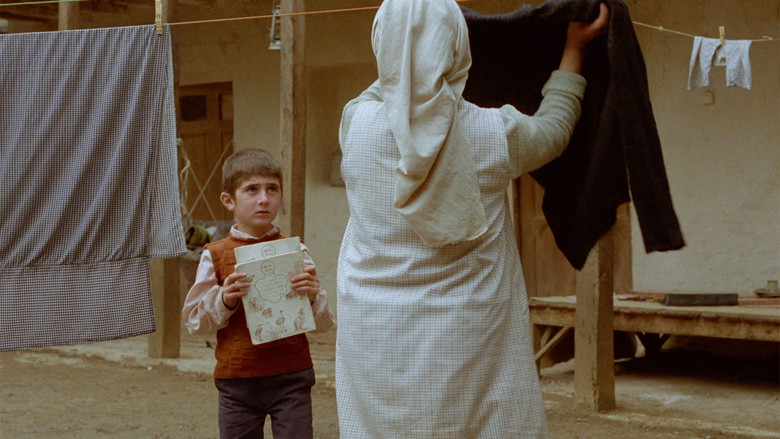
Where Is The Friend's House?
A neorealistic fable of childhood duty, where a young boy's desperate odyssey through winding rural landscapes mirrors a profound quest for moral integrity.
Where Is The Friend's House?

خانه‌ی دوست کجاست؟

01 July 1987 Iran 83 min ⭐ 7.9 (408)
Director: Abbas Kiarostami
Cast: Babek Ahmed Poor, Ahmed Ahmed Poor, Kheda Barech Defai, Iran Outari, Ait Ansari
Drama Family Adventure
Childhood Morality vs. Adult Authority The Quest and The Journey Communication and Misunderstanding Friendship and Responsibility

Where Is The Friend's House? - Ending Explained

⚠️ Spoiler Analysis

After an exhausting and fruitless day-long search for his friend Mohammad Reza's house, Ahmad returns home defeated as night falls. He is unable to find the house, and every lead has resulted in a dead end or a case of mistaken identity. Faced with the certainty that his friend will be expelled the next day, Ahmad makes a crucial decision. Instead of giving up, he sits down and diligently completes all of his friend's homework in the notebook for him.

The final scene takes place in the classroom the following morning. The teacher begins his stern inspection of the homework notebooks. Mohammad Reza is visibly anxious, but Ahmad arrives just in time and hands him the completed notebook. The teacher checks the work, declares it "Excellent," and moves on. He remains completely oblivious to the incredible journey and the profound act of friendship that occurred. As the teacher flips a page, the camera briefly reveals the small, pressed flower that the old carpenter had given to Ahmad, a silent testament to the boy's humanity and kindness, hidden from the eyes of authority. The ending is a quiet triumph of a child's moral ingenuity and compassion over an indifferent and rigid adult system. Ahmad found his own solution, protecting his friend not by following the rules, but by an act of selfless solidarity.

Alternative Interpretations

While the film is widely seen as a critique of rigid authority, some interpretations view it through a more political lens, suggesting Ahmad's struggle is a microcosm of an individual's struggle for self-determination against an oppressive state or theocratic regime. The relentless, illogical obstacles he faces can be read as a metaphor for bureaucratic absurdity in post-revolutionary Iran.

Another interpretation, advanced by critic Robin Wood, sees the film as a "naturalistic 'Alice in Wonderland'". In this view, Ahmad's journey is not just social commentary but a descent into a strange and bewildering world where the logic of adults is as nonsensical as that of the characters in Lewis Carroll's novel. His quest is an exploration of this confusing landscape, a journey of discovery through a world that operates on mysterious and arbitrary principles.

A more philosophical reading suggests the film is less about society and more about an innate, almost spiritual, quest for ethical truth. Ahmad's journey is a pilgrimage, and his determination is a reflection of a pure, internal moral compass that transcends social conditioning. The film becomes a parable about the origins of human kindness and the struggle to maintain it.