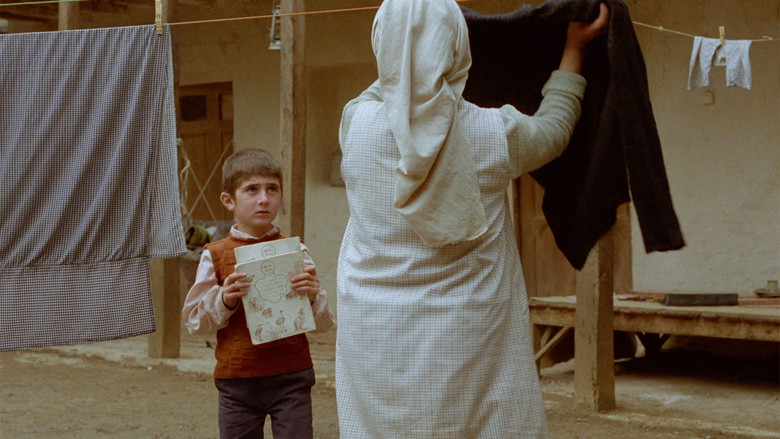
Where Is The Friend's House?
A neorealistic fable of childhood duty, where a young boy's desperate odyssey through winding rural landscapes mirrors a profound quest for moral integrity.
Where Is The Friend's House?

Where Is The Friend's House?

خانه‌ی دوست کجاست؟

01 July 1987 Iran 83 min ⭐ 7.9 (408)
Director: Abbas Kiarostami
Cast: Babek Ahmed Poor, Ahmed Ahmed Poor, Kheda Barech Defai, Iran Outari, Ait Ansari
Drama Family Adventure
Childhood Morality vs. Adult Authority The Quest and The Journey Communication and Misunderstanding Friendship and Responsibility

Overview

"Where Is the Friend's House?" follows the simple yet profound journey of a young schoolboy named Ahmad. After realizing he has accidentally taken his friend Mohammad Reza's notebook, Ahmad is consumed with anxiety. Their teacher has repeatedly threatened to expel Mohammad for failing to do his homework in the correct notebook. Driven by a strong sense of responsibility, Ahmad defies his mother's orders and embarks on a quest to the neighboring village to return the notebook.

His journey is fraught with obstacles and the indifference of the adult world. The adults he encounters are often preoccupied with their own concerns and dismiss his urgent pleas for help. He navigates the labyrinthine alleyways and identical-looking houses, getting lost and receiving misleading directions. Ahmad's simple mission transforms into a suspenseful odyssey, highlighting the vast gap between the moral clarity of a child and the complex, often illogical, rules of adult society.


Core Meaning

"Where Is the Friend's House?" is a powerful allegory about moral responsibility, empathy, and the integrity of a child's conscience in a world governed by rigid, and often nonsensical, adult rules. Director Abbas Kiarostami explores the idea that true morality stems from an innate sense of duty and compassion rather than from fear of punishment or adherence to authority. The film critiques a social structure where the voices and concerns of children are undervalued and ignored. Ahmad's relentless journey, despite facing constant frustration and dismissal from elders, champions the profound and unwavering nature of childhood friendship and the determination to do what is right, even when it means breaking the rules.

Thematic DNA

Childhood Morality vs. Adult Authority 35%
The Quest and The Journey 30%
Communication and Misunderstanding 20%
Friendship and Responsibility 15%

Childhood Morality vs. Adult Authority

The film starkly contrasts Ahmad's clear-eyed sense of right and wrong with the rigid, often unhelpful, world of adults. The teacher's threat of expulsion over a notebook is presented as an overly harsh punishment, setting the stage for Ahmad's moral dilemma. While adults like his mother and grandfather enforce rules without understanding his urgent cause, Ahmad operates on a higher plane of empathy and loyalty to his friend. His quest becomes an act of quiet rebellion against an authoritarian system that prioritizes arbitrary discipline over genuine understanding and compassion.

The Quest and The Journey

Ahmad's physical journey to find his friend's house serves as a powerful metaphor for a moral and existential quest. The repetitive, zigzagging path he travels up the hill symbolizes the arduous and often confusing path of life. His search is not merely for a physical location but for understanding, empathy, and a way to navigate the frustrating logic of the adult world. The journey itself, filled with dead ends and small encounters, becomes a formative experience, teaching him resilience and reinforcing his commitment to his friend.

Communication and Misunderstanding

A recurring element is the failure of communication between generations. Ahmad repeatedly and politely asks for directions, but the adults he meets either ignore him, misunderstand him, or provide useless information. This communication breakdown highlights the isolation of children within their own society and the tendency of adults to dismiss their concerns as trivial. The film uses this repetitive, almost absurd, lack of effective dialogue to create a sense of frustration and to underscore the cultural and generational gap.

Friendship and Responsibility

At its heart, the film is a celebration of friendship and the profound sense of responsibility a child feels towards a peer. Ahmad's unwavering determination is fueled solely by the desire to protect his friend from punishment. He is willing to face his mother's anger, get lost in the dark, and exhaust himself, all for the sake of his classmate. This theme elevates a simple childhood promise into a powerful statement on loyalty and ethical commitment.

Character Analysis

Ahmad

Babek Ahmed Poor

Archetype: The Innocent Hero
Key Trait: Conscientious

Motivation

Ahmad is driven by a powerful sense of empathy and responsibility. Having witnessed his friend Mohammad Reza being brutally berated by their teacher, his primary motivation is to prevent his friend from being expelled. His fear for his friend's well-being outweighs his fear of being punished by his own family.

Character Arc

Ahmad begins as a timid, conscientious schoolboy, fearful of authority. His journey to return the notebook forces him to become courageous and defiant, challenging his mother's orders and navigating an unfamiliar, intimidating world on his own. He doesn't change his core moral values but grows in his resolve to act upon them, culminating in a mature and selfless decision to do his friend's homework, thus finding his own solution when the adult world fails him.

Mohammad Reza Nematzadeh

Ahmed Ahmed Poor

Archetype: The Victim
Key Trait: Fearful

Motivation

His motivation is simple: to avoid punishment and expulsion from school. He is a passive figure whose fate rests in Ahmad's hands, representing the helplessness of a child within a rigid authoritarian system.

Character Arc

Mohammad Reza's character does not have a significant arc; he primarily serves as the catalyst for Ahmad's journey. He is portrayed as a vulnerable and fearful student, consistently terrorized by the teacher. His tearful anxiety in the opening scene establishes the high stakes of Ahmad's mission.

The Teacher

Kheda Barech Defai

Archetype: The Antagonist/Authority Figure
Key Trait: Authoritarian

Motivation

The teacher is motivated by a rigid adherence to rules and a belief in discipline through humiliation and fear. He aims to enforce order and conformity in his classroom, seeing the notebook as a critical tool for this purpose.

Character Arc

The teacher is a static character who represents the oppressive and inflexible nature of adult authority. From his first appearance, he is stern, unforgiving, and seemingly incapable of empathy, valuing rules above the well-being of his students. His final approval of the homework, delivered with the same sternness, shows he has learned nothing and remains oblivious to the moral drama that has unfolded.

The Old Carpenter

Ait Ansari

Archetype: The Mentor/Wise Old Man
Key Trait: Benevolent

Motivation

He appears motivated by a simple desire to help the lost boy. He is nostalgic for a past where craftsmanship and human connection were valued, and he sees an opportunity to share his wisdom and offer assistance to Ahmad.

Character Arc

The old carpenter is one of the few adults who treats Ahmad with kindness and respect. He represents a bridge to a more traditional, humane, and empathetic world. Although he ultimately fails to lead Ahmad to the correct house, he provides momentary companionship, wisdom, and a symbolic gift (the flower) that reinforces the film's theme of hidden beauty and kindness.

Symbols & Motifs

The Zigzag Path

Meaning:

The iconic zigzag path on the hill that Ahmad repeatedly traverses symbolizes the arduous, indirect, and challenging nature of his quest. It represents the obstacles and the frustrating, non-linear journey one must often take to do the right thing. Visually, it breaks the natural landscape, emphasizing the difficult path the small boy must conquer alone.

Context:

The path is shown multiple times as Ahmad travels between his village of Koker and the neighboring village of Poshteh. His ascents and descents on this path mark the different stages of his increasingly desperate search, becoming a visual leitmotif for his struggle and perseverance.

Doors and Windows

Meaning:

Doors and windows function as recurring motifs representing obstacles, opportunities, and the threshold between different worlds (childhood and adulthood, knowledge and ignorance). Closed doors symbolize the unhelpfulness of the adults and the barriers Ahmad faces. The old carpenter, a maker of beautiful, traditional doors, represents a fading world of craftsmanship and wisdom, offering a brief opening of hope for Ahmad.

Context:

The film opens with the classroom door closing and features numerous scenes where Ahmad confronts closed doors in his search. He meets two door vendors: one selling modern, practical iron doors who ignores him, and an elderly artisan who crafts ornate wooden doors and tries to help him, symbolizing a clash between new and old values.

The Notebook

Meaning:

The notebook is the film's central MacGuffin, but it symbolizes much more than a simple school item. It represents the rigid, authoritarian rules of the education system and the adult world. The threat of expulsion tied to it highlights the disproportionate weight given to procedure over intention. For Ahmad, however, the notebook becomes a symbol of his responsibility and his unwavering loyalty to his friend.

Context:

The entire plot is driven by Ahmad's accidental possession of Mohammad Reza's notebook. His desperate journey is entirely focused on returning this object to prevent his friend from being punished by their strict teacher.

The Pressed Flower

Meaning:

The single dried flower, placed in the notebook by Ahmad at the end, symbolizes an act of friendship, humanity, and quiet defiance. It is a small gesture of beauty and care hidden within the symbol of rigid authority (the notebook). It represents the triumph of compassion and personal morality over the cold, impersonal rules that have dominated the narrative.

Context:

After failing to find his friend's house, an elderly carpenter gives Ahmad a flower. Ahmad presses it into the notebook after completing his friend's homework for him. In the final scene, the teacher is checking the homework and flips past the flower, acknowledging the work as excellent but oblivious to the flower's true significance.

Philosophical Questions

Does true morality come from following rules or from personal conscience?

The film constantly places societal rules in opposition to Ahmad's inner sense of duty. The teacher's rigid rule about the notebook is the catalyst for the entire conflict. Ahmad's mother and grandfather also impose rules that obstruct his moral quest. Ahmad ultimately chooses to follow his conscience, first by defying his mother to search for his friend, and finally by creating his own solution—doing the homework for him. This suggests that genuine ethical action often requires questioning or even breaking established rules when they conflict with a higher duty of compassion.

To what extent do adults see and value the inner lives of children?

The film powerfully argues that the adult world is largely oblivious and indifferent to the rich, urgent moral lives of children. Ahmad's quest is of monumental importance to him, but to the adults he encounters, it is an inconvenient interruption or a childish whim. They fail to recognize the profound ethical dilemma he faces. Kiarostami uses the camera to align the audience with Ahmad's perspective, forcing us to experience his frustration and to question the wisdom and empathy of the adult characters.

Can a small act of kindness create significant meaning?

Ahmad's entire journey is a small act—returning a notebook—but the film imbues it with epic significance. His perseverance demonstrates how a seemingly minor act of responsibility can reflect one's entire moral character. The film concludes with another small act: placing a flower in the notebook. This gesture, unseen or unappreciated by the authority figure, becomes the film's ultimate statement on the power of quiet, personal acts of friendship and beauty to create meaning in a harsh, rule-bound world.

Alternative Interpretations

While the film is widely seen as a critique of rigid authority, some interpretations view it through a more political lens, suggesting Ahmad's struggle is a microcosm of an individual's struggle for self-determination against an oppressive state or theocratic regime. The relentless, illogical obstacles he faces can be read as a metaphor for bureaucratic absurdity in post-revolutionary Iran.

Another interpretation, advanced by critic Robin Wood, sees the film as a "naturalistic 'Alice in Wonderland'". In this view, Ahmad's journey is not just social commentary but a descent into a strange and bewildering world where the logic of adults is as nonsensical as that of the characters in Lewis Carroll's novel. His quest is an exploration of this confusing landscape, a journey of discovery through a world that operates on mysterious and arbitrary principles.

A more philosophical reading suggests the film is less about society and more about an innate, almost spiritual, quest for ethical truth. Ahmad's journey is a pilgrimage, and his determination is a reflection of a pure, internal moral compass that transcends social conditioning. The film becomes a parable about the origins of human kindness and the struggle to maintain it.

Cultural Impact

"Where Is the Friend's House?" was a landmark film that brought the Iranian New Wave to global prominence in the late 1980s. Made in the post-revolutionary context of Iran, the film artfully navigated state censorship by using a child's story to offer a subtle but powerful critique of authoritarianism, bureaucracy, and the disconnect between generations. Its style, deeply rooted in Italian neorealism, blended documentary-like authenticity with a poetic and metaphorical narrative, influencing a generation of filmmakers both in Iran and internationally.

The film was widely praised by critics for its deceptive simplicity, emotional depth, and profound humanism. It demonstrated that a compelling, suspenseful drama could be created from the most minimal of plots. For international audiences, it provided a nuanced and relatable window into rural Iranian life, challenging prevalent stereotypes. The Koker Trilogy, which this film initiated, became a touchstone of 1990s art-house cinema, solidifying Kiarostami's reputation as one of the world's greatest living directors. Its influence can be seen in later films that focus on the authentic experiences of children and the use of minimalist storytelling to explore complex social and philosophical themes.

Audience Reception

Audiences have generally praised "Where Is the Friend's House?" for its emotional power, authenticity, and the captivating performance of its young protagonist, Babek Ahmed Poor. Many viewers find the simple story incredibly suspenseful and moving, identifying deeply with Ahmad's frustrating and heroic quest. The film is often described as a heartwarming and life-affirming experience that celebrates the innocence and moral clarity of childhood.

Points of criticism are rare but sometimes focus on the film's slow pace, which can be challenging for viewers accustomed to more conventional narrative structures. Some have found the repetitive nature of Ahmad's encounters with unhelpful adults to be frustrating to the point of tedium, although most critics and audiences recognize this repetition as a deliberate and effective stylistic choice to convey the boy's struggle. Overall, the film is overwhelmingly regarded as a masterpiece of humanist cinema, cherished for its simplicity and profound emotional resonance.

Interesting Facts

  • The film's title is derived from a poem by the famous Iranian poet and painter Sohrab Sepehri.
  • This was the first film by Abbas Kiarostami to gain significant international attention and acclaim, winning the Bronze Leopard at the 1989 Locarno Film Festival.
  • "Where Is the Friend's House?" is the first installment of Kiarostami's renowned "Koker Trilogy," which also includes "And Life Goes On" (1992) and "Through the Olive Trees" (1994). The name was coined by critics, as the films are linked by their location in the Koker region of Iran.
  • Kiarostami used non-professional actors from the local villages to achieve a high degree of realism, a hallmark of his style.
  • To elicit a genuine crying performance from the child actor playing Mohammad Reza, Kiarostami reportedly shredded a beloved photograph of the boy's just off-camera.
  • The legendary Japanese director Akira Kurosawa cited "Where Is the Friend's House?" as one of his favorite films.
  • The film is included on the British Film Institute's list of 50 films you should see by the age of 15.
  • After a devastating earthquake hit the Koker region in 1990, Kiarostami was so concerned for the well-being of his young actors that he drove to the area to find them. This journey inspired the second film in the trilogy, "And Life Goes On".

⚠️ Spoiler Analysis

Click to reveal detailed analysis with spoilers

Frequently Asked Questions

Explore More About This Movie

Dive deeper into specific aspects of the movie with our detailed analysis pages

Comments (0)

Leave a comment

No comments yet. Be the first to share your thoughts!