
خانهی دوست کجاست؟
Where Is The Friend's House? - Symbolism & Philosophy
Symbols & Motifs
The Zigzag Path
The iconic zigzag path on the hill that Ahmad repeatedly traverses symbolizes the arduous, indirect, and challenging nature of his quest. It represents the obstacles and the frustrating, non-linear journey one must often take to do the right thing. Visually, it breaks the natural landscape, emphasizing the difficult path the small boy must conquer alone.
The path is shown multiple times as Ahmad travels between his village of Koker and the neighboring village of Poshteh. His ascents and descents on this path mark the different stages of his increasingly desperate search, becoming a visual leitmotif for his struggle and perseverance.
Doors and Windows
Doors and windows function as recurring motifs representing obstacles, opportunities, and the threshold between different worlds (childhood and adulthood, knowledge and ignorance). Closed doors symbolize the unhelpfulness of the adults and the barriers Ahmad faces. The old carpenter, a maker of beautiful, traditional doors, represents a fading world of craftsmanship and wisdom, offering a brief opening of hope for Ahmad.
The film opens with the classroom door closing and features numerous scenes where Ahmad confronts closed doors in his search. He meets two door vendors: one selling modern, practical iron doors who ignores him, and an elderly artisan who crafts ornate wooden doors and tries to help him, symbolizing a clash between new and old values.
The Notebook
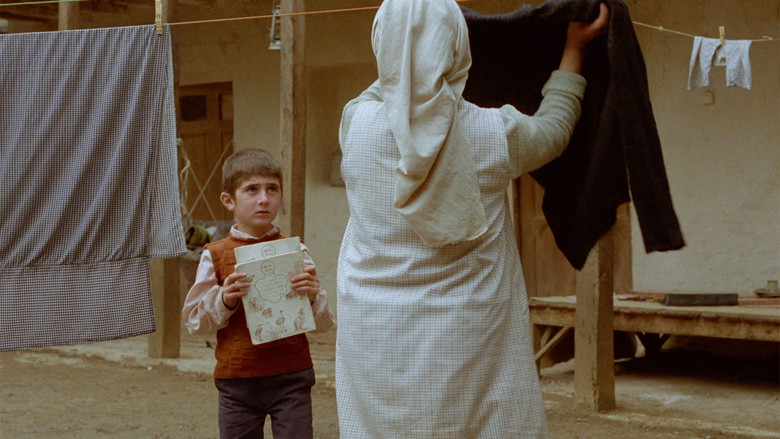
The notebook is the film's central MacGuffin, but it symbolizes much more than a simple school item. It represents the rigid, authoritarian rules of the education system and the adult world. The threat of expulsion tied to it highlights the disproportionate weight given to procedure over intention. For Ahmad, however, the notebook becomes a symbol of his responsibility and his unwavering loyalty to his friend.
The entire plot is driven by Ahmad's accidental possession of Mohammad Reza's notebook. His desperate journey is entirely focused on returning this object to prevent his friend from being punished by their strict teacher.
The Pressed Flower
The single dried flower, placed in the notebook by Ahmad at the end, symbolizes an act of friendship, humanity, and quiet defiance. It is a small gesture of beauty and care hidden within the symbol of rigid authority (the notebook). It represents the triumph of compassion and personal morality over the cold, impersonal rules that have dominated the narrative.
After failing to find his friend's house, an elderly carpenter gives Ahmad a flower. Ahmad presses it into the notebook after completing his friend's homework for him. In the final scene, the teacher is checking the homework and flips past the flower, acknowledging the work as excellent but oblivious to the flower's true significance.
Philosophical Questions
Does true morality come from following rules or from personal conscience?
The film constantly places societal rules in opposition to Ahmad's inner sense of duty. The teacher's rigid rule about the notebook is the catalyst for the entire conflict. Ahmad's mother and grandfather also impose rules that obstruct his moral quest. Ahmad ultimately chooses to follow his conscience, first by defying his mother to search for his friend, and finally by creating his own solution—doing the homework for him. This suggests that genuine ethical action often requires questioning or even breaking established rules when they conflict with a higher duty of compassion.
To what extent do adults see and value the inner lives of children?
The film powerfully argues that the adult world is largely oblivious and indifferent to the rich, urgent moral lives of children. Ahmad's quest is of monumental importance to him, but to the adults he encounters, it is an inconvenient interruption or a childish whim. They fail to recognize the profound ethical dilemma he faces. Kiarostami uses the camera to align the audience with Ahmad's perspective, forcing us to experience his frustration and to question the wisdom and empathy of the adult characters.
Can a small act of kindness create significant meaning?
Ahmad's entire journey is a small act—returning a notebook—but the film imbues it with epic significance. His perseverance demonstrates how a seemingly minor act of responsibility can reflect one's entire moral character. The film concludes with another small act: placing a flower in the notebook. This gesture, unseen or unappreciated by the authority figure, becomes the film's ultimate statement on the power of quiet, personal acts of friendship and beauty to create meaning in a harsh, rule-bound world.
Core Meaning
"Where Is the Friend's House?" is a powerful allegory about moral responsibility, empathy, and the integrity of a child's conscience in a world governed by rigid, and often nonsensical, adult rules. Director Abbas Kiarostami explores the idea that true morality stems from an innate sense of duty and compassion rather than from fear of punishment or adherence to authority. The film critiques a social structure where the voices and concerns of children are undervalued and ignored. Ahmad's relentless journey, despite facing constant frustration and dismissal from elders, champions the profound and unwavering nature of childhood friendship and the determination to do what is right, even when it means breaking the rules.