Smultronstället
"All along the line, there's nothing but cold and death and loneliness"
Wild Strawberries - Symbolism & Philosophy
Symbols & Motifs
Wild Strawberries
The wild strawberries symbolize youth, nostalgia, and lost innocence. The Swedish title, Smultronstället, literally means "the wild strawberry patch" and idiomatically refers to a cherished, idyllic place from one's past. For Isak, they represent a time of youthful love and happiness, but also of betrayal and regret, as he remembers his first love, Sara, picking strawberries with his brother.
The symbol appears in Isak's idyllic memories of his childhood home. He recalls Sara picking wild strawberries, a memory that is both sweet and painful. The title itself frames the entire film as a journey back to this symbolic place of memory and lost time.
Clocks and Watches Without Hands
The clocks and watches without hands symbolize the irrelevance of time in the face of death and memory. In Isak's dream, the handless clock signifies his anxiety about his life ending and time running out. His mother also possesses a watch without hands, suggesting that for the emotionally detached, time has, in a sense, stood still. It also represents the timeless nature of dreams and memories, which do not adhere to linear time.
This symbol appears prominently in Isak's opening nightmare, where he sees a large clock with no hands on a deserted street. Later, when visiting his mother, she shows him an old watch, also without hands.
The Coffin
The coffin is a direct and terrifying symbol of Isak's impending death and his confrontation with his own mortality. The dream forces him to literally face himself as a corpse, a powerful motivator for his subsequent journey of self-reflection. The fact that he is both the observer and the deceased in the dream highlights his internal division and self-alienation.
In his first nightmare, a horse-drawn hearse crashes, and a coffin falls out. When Isak approaches, the corpse inside comes to life and pulls him down; the corpse is himself.
The Car Journey
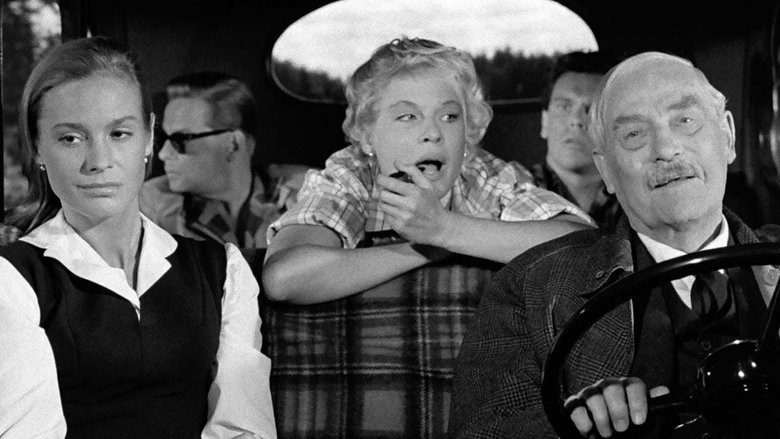
The car journey serves as a powerful metaphor for Isak's journey through his own life and memories. The car becomes a vessel that transports him not only physically to Lund but also psychologically into his past. The various passengers he picks up represent different facets of his life and personality, and the journey itself provides the temporal and spatial structure for his introspection.
The entire film is structured around the car journey from Stockholm to Lund. The confined space of the car forces interactions and conversations that propel Isak's self-examination.
Philosophical Questions
Can a person truly change and find redemption at the end of their life?
The film's central narrative arc is built around this question. Isak's journey suggests that profound self-awareness and change are possible, even for someone who has lived a long life of emotional detachment. His final dream of a peaceful childhood scene indicates that he has found a measure of redemption and inner peace. However, the film leaves it somewhat ambiguous as to whether this is a complete transformation or a fleeting moment of grace before death.
What is the meaning of a life if it is lived without genuine human connection?
Isak Borg is a man who has achieved great professional success, yet his life is portrayed as empty and unfulfilled due to his lack of close relationships. The film posits that a life dedicated solely to intellectual pursuits and ego is ultimately a lonely and meaningless one. The "extraordinary logic" that Isak discerns at the end is the realization that love, family, and forgiveness are the true measures of a life well-lived.
How does the past shape our present identity?
"Wild Strawberries" is a deep dive into the workings of memory and its influence on the present. Isak is literally haunted by his past, and the film demonstrates that we are all composed of our memories, both joyous and painful. His inability to move past the betrayals and emotional wounds of his youth has defined his entire adult life. The film suggests that only by confronting and accepting the past can one find peace in the present.
Core Meaning
The core meaning of "Wild Strawberries" revolves around the themes of self-discovery, reconciliation, and the possibility of redemption, even at the end of one's life. Ingmar Bergman explores the profound regret that can accompany a life lived with emotional detachment and the importance of human connection. The film suggests that it is never too late to confront one's past, understand one's failings, and find a measure of peace. Isak Borg's journey is a testament to the idea that a life of professional success is meaningless without love, warmth, and meaningful relationships. Through his introspective journey, he learns to accept his past and open himself up to the people around him in the present, ultimately finding a sense of tranquility and acceptance of his own mortality.