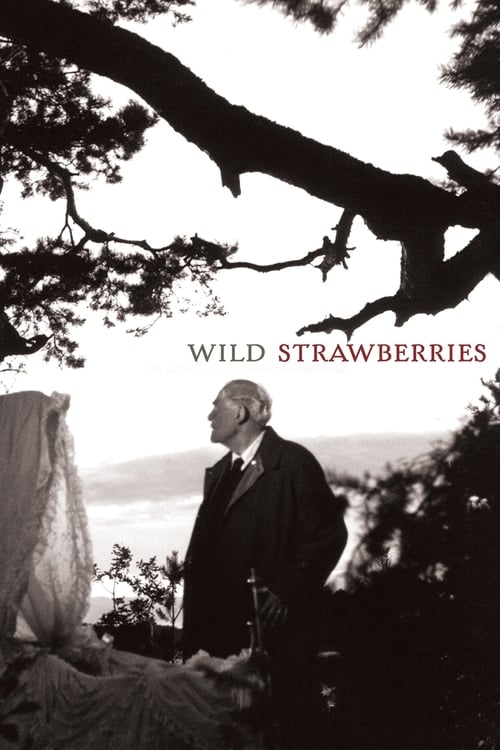
Wild Strawberries
Smultronstället
"All along the line, there's nothing but cold and death and loneliness"
Overview
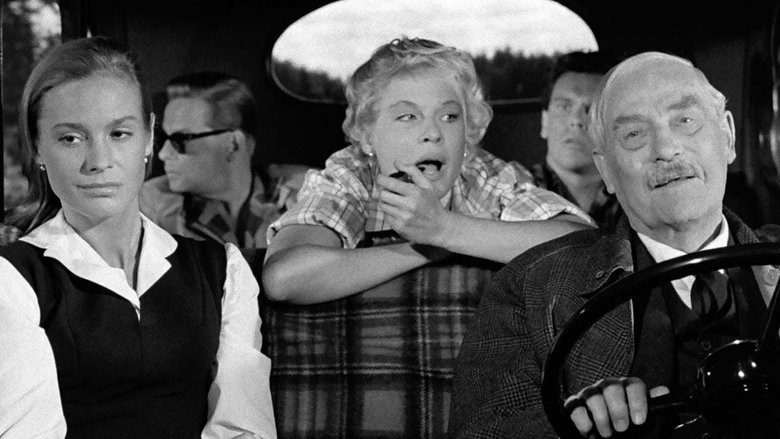
"Wild Strawberries" (Smultronstället) is a 1957 Swedish film directed by the legendary Ingmar Bergman. The film follows Dr. Isak Borg, an elderly, widowed, and emotionally distant professor of medicine, as he travels by car from Stockholm to Lund to receive an honorary degree. He is accompanied by his daughter-in-law, Marianne, who is estranged from his son, Evald. What begins as a simple journey evolves into a profound pilgrimage into Isak's past.
Along the way, Isak is confronted by a series of vivid dreams, nightmares, and nostalgic daydreams, forcing him to re-evaluate his life, his coldness, and the relationships he has damaged. Encounters with a group of youthful hitchhikers, including a girl named Sara who bears a striking resemblance to his first love, and a bickering married couple, further trigger his introspection. The film masterfully weaves between the past and present, creating a deeply moving and psychologically rich portrait of a man grappling with his impending mortality and the emptiness of his existence.

Core Meaning
The core meaning of "Wild Strawberries" revolves around the themes of self-discovery, reconciliation, and the possibility of redemption, even at the end of one's life. Ingmar Bergman explores the profound regret that can accompany a life lived with emotional detachment and the importance of human connection. The film suggests that it is never too late to confront one's past, understand one's failings, and find a measure of peace. Isak Borg's journey is a testament to the idea that a life of professional success is meaningless without love, warmth, and meaningful relationships. Through his introspective journey, he learns to accept his past and open himself up to the people around him in the present, ultimately finding a sense of tranquility and acceptance of his own mortality.
Thematic DNA
The Journey of Self-Discovery and Redemption
Isak Borg's physical road trip to Lund mirrors his internal journey into his own psyche. The film is structured around this dual journey, where encounters on the road trigger flashbacks and dreams that force him to confront the man he has become: cold, selfish, and lonely. This theme is central to the film, as Isak gradually sheds his crusty exterior and begins to feel a sense of warmth and connection, suggesting that redemption is possible even in the twilight of life.
Memory, Nostalgia, and the Past
The film constantly blurs the lines between past and present, memory and reality. Bergman masterfully uses flashbacks and dream sequences to show how the past continually informs and haunts the present. The "wild strawberry patch" itself is a potent symbol of a cherished, idyllic past. However, the film also cautions against a purely romanticized view of nostalgia, as Isak's memories are often tinged with regret and pain, revealing the source of his current emotional state.
Alienation and Loneliness
A profound sense of loneliness pervades Isak's life. His intellectual achievements have come at the cost of emotional intimacy, leaving him isolated from his family and society. This theme is explored through his strained relationship with his son, his deceased wife, and even his elderly mother, who is portrayed as equally cold and detached. The film suggests that this emotional coldness is a legacy passed down through generations.
Life, Death, and Existentialism
At 78, Isak is acutely aware of his impending death, a fear that is starkly visualized in his opening nightmare. The film grapples with existential questions about the meaning of life in the face of mortality. Isak's journey becomes a quest to find meaning not in his professional accolades, but in genuine human connection and self-acceptance before his time runs out. The presence of the young hitchhikers, full of life and vigor, provides a stark contrast to Isak's age and introspective melancholy.
Character Analysis
Professor Isak Borg
Victor Sjöström
Motivation
Initially, his motivation is simply to travel to Lund to receive an honorary degree. However, a disturbing nightmare about his own death instigates a deeper, subconscious motivation: to understand the emptiness of his life and find meaning before he dies. His journey becomes a quest for redemption and reconciliation with his past.
Character Arc
Isak begins the film as a cold, egotistical, and lonely old man, respected in his profession but emotionally detached from his family. Through his journey of dreams and memories, he is forced to confront his past failures: his lost love, his unhappy marriage, and his strained relationship with his son. By the end of the film, he has undergone a significant transformation, finding a degree of warmth, humility, and connection with others. He moves from a state of denial and emotional numbness to one of acceptance and peace.
Marianne Borg
Ingrid Thulin
Motivation
Her initial motivation is to get a ride to Lund to meet her estranged husband. However, she is also grappling with her own difficult marriage and pregnancy. Her interactions with Isak become a way for her to process her own feelings about the Borg family's emotional legacy and her future.
Character Arc
Marianne starts the journey with a palpable dislike for her father-in-law, seeing him as a selfish and cold man. As his travel companion, she becomes a crucial figure in his transformation, acting as a compassionate but honest observer of his character. Her own marital problems with Evald, which she reveals to Isak, mirror the emotional coldness of the Borg family. Through their shared journey, she develops a sense of empathy and understanding for Isak, and her presence helps him to open up.
Evald Borg
Gunnar Björnstrand
Motivation
Evald is motivated by a desire to avoid emotional pain and responsibility, which he sees as inherent to life and family. He embodies a nihilistic worldview, likely stemming from his upbringing in a loveless home.
Character Arc
Evald is a minor but pivotal character who represents the continuation of Isak's emotional coldness. He is cynical, bitter, and desires to be "stone dead" emotionally. His refusal to have a child with Marianne stems from a deep-seated pessimism and a feeling of being an unwanted child himself. While his arc within the film is minimal, the possibility of his reconciliation with Marianne at the end offers a glimmer of hope that the cycle of emotional detachment might be broken.
Sara
Bibi Andersson
Motivation
The Sara of the past is motivated by youthful desires, ultimately choosing Isak's more spontaneous brother over the serious Isak. The present-day Sara is motivated by a spirit of adventure and a genuine curiosity and affection for the elderly professor.
Character Arc
Bibi Andersson plays two characters named Sara. The first is Isak's youthful cousin and first love, who appears in his memories as a symbol of lost love and idealism. The second is a modern, free-spirited hitchhiker who reminds Isak of his past love. The contemporary Sara is vibrant and optimistic, and her presence, along with her two male companions, injects a youthful energy into Isak's journey. She acts as a catalyst for his reminiscences and ultimately offers him a sense of youthful affection and acceptance that he has long been missing.
Symbols & Motifs
Wild Strawberries
The wild strawberries symbolize youth, nostalgia, and lost innocence. The Swedish title, Smultronstället, literally means "the wild strawberry patch" and idiomatically refers to a cherished, idyllic place from one's past. For Isak, they represent a time of youthful love and happiness, but also of betrayal and regret, as he remembers his first love, Sara, picking strawberries with his brother.
The symbol appears in Isak's idyllic memories of his childhood home. He recalls Sara picking wild strawberries, a memory that is both sweet and painful. The title itself frames the entire film as a journey back to this symbolic place of memory and lost time.
Clocks and Watches Without Hands
The clocks and watches without hands symbolize the irrelevance of time in the face of death and memory. In Isak's dream, the handless clock signifies his anxiety about his life ending and time running out. His mother also possesses a watch without hands, suggesting that for the emotionally detached, time has, in a sense, stood still. It also represents the timeless nature of dreams and memories, which do not adhere to linear time.
This symbol appears prominently in Isak's opening nightmare, where he sees a large clock with no hands on a deserted street. Later, when visiting his mother, she shows him an old watch, also without hands.
The Coffin
The coffin is a direct and terrifying symbol of Isak's impending death and his confrontation with his own mortality. The dream forces him to literally face himself as a corpse, a powerful motivator for his subsequent journey of self-reflection. The fact that he is both the observer and the deceased in the dream highlights his internal division and self-alienation.
In his first nightmare, a horse-drawn hearse crashes, and a coffin falls out. When Isak approaches, the corpse inside comes to life and pulls him down; the corpse is himself.
The Car Journey
The car journey serves as a powerful metaphor for Isak's journey through his own life and memories. The car becomes a vessel that transports him not only physically to Lund but also psychologically into his past. The various passengers he picks up represent different facets of his life and personality, and the journey itself provides the temporal and spatial structure for his introspection.
The entire film is structured around the car journey from Stockholm to Lund. The confined space of the car forces interactions and conversations that propel Isak's self-examination.
Memorable Quotes
Var är den vän som jag söker i dagens början? När natten faller har jag ännu inte funnit Honom.
— Isak Borg (reciting a poem)
Context:
Isak recites this poem with the help of the young hitchhikers during a stop on their journey. The moment highlights the contrast between his somber introspection and their youthful vitality.
Meaning:
"Where is the friend I seek at break of day? When night falls I still have not found Him." This quote encapsulates Isak's profound sense of loneliness and his lifelong, unfulfilled search for connection and meaning. It has religious undertones, suggesting a search for God or a higher purpose, but also speaks to his personal isolation.
En läkares första plikt är att be om förlåtelse.
— Sten Alman (as the examiner in a dream)
Context:
This line is spoken during Isak's second nightmare, where he is subjected to a surreal examination. He is found guilty of "guilt," and this statement is presented as a fundamental principle he has failed to grasp.
Meaning:
"A doctor's first duty is to ask for forgiveness." In the surreal logic of the dream, this line transcends its literal meaning. It suggests that Isak, a man of science who has healed physical ailments, has neglected the emotional and spiritual well-being of himself and others. He is being judged not for his professional competence but for his human failings.
Jag är död, fast jag lever.
— Evald Borg
Context:
Evald says this to Marianne in a flashback she recounts to Isak. He is explaining his refusal to have a child, expressing his bleak and nihilistic view of life.
Meaning:
"I am dead, although I live." This powerful statement from Isak's son, Evald, reveals the depth of his despair and emotional numbness. It also directly reflects Isak's own state of being a "living corpse," highlighting the painful legacy of emotional coldness passed from father to son.
Om jag har varit bekymrad eller ledsen under dagen, så roar det mig ofta att framkalla minnesbilder från min barndom.
— Isak Borg
Context:
These are Isak's final thoughts as he peacefully drifts off to sleep at the end of the film, dreaming of a happy childhood memory of his parents by a lake.
Meaning:
"If I have been worried or sad during the day, I am often calmed by recalling memories of my childhood." This closing line of the film reveals Isak's ultimate reconciliation with his past. He is no longer haunted by his memories but can now find comfort and peace in them. It signifies his final acceptance and the serenity he has achieved through his journey.
Philosophical Questions
Can a person truly change and find redemption at the end of their life?
The film's central narrative arc is built around this question. Isak's journey suggests that profound self-awareness and change are possible, even for someone who has lived a long life of emotional detachment. His final dream of a peaceful childhood scene indicates that he has found a measure of redemption and inner peace. However, the film leaves it somewhat ambiguous as to whether this is a complete transformation or a fleeting moment of grace before death.
What is the meaning of a life if it is lived without genuine human connection?
Isak Borg is a man who has achieved great professional success, yet his life is portrayed as empty and unfulfilled due to his lack of close relationships. The film posits that a life dedicated solely to intellectual pursuits and ego is ultimately a lonely and meaningless one. The "extraordinary logic" that Isak discerns at the end is the realization that love, family, and forgiveness are the true measures of a life well-lived.
How does the past shape our present identity?
"Wild Strawberries" is a deep dive into the workings of memory and its influence on the present. Isak is literally haunted by his past, and the film demonstrates that we are all composed of our memories, both joyous and painful. His inability to move past the betrayals and emotional wounds of his youth has defined his entire adult life. The film suggests that only by confronting and accepting the past can one find peace in the present.
Alternative Interpretations
While the dominant interpretation of "Wild Strawberries" is a story of late-life redemption, some critics and viewers have offered alternative readings. One perspective is that the entire journey is a dream or a deathbed hallucination. This is supported by the surreal quality of many of the encounters and the seamless transitions between past and present. The fact that the film begins and ends with Isak in bed lends some credence to this interpretation. Another reading focuses on the film as a critique of modern, secular society. Isak's emotional sterility can be seen as a product of a world that values scientific rationalism over faith and emotional connection. The debates about the existence of God between the young hitchhikers can be seen as a central, unresolved question of the film. Finally, some interpretations view the ending not as a complete redemption, but as a more modest and realistic finding of momentary peace. Isak's transformation may not be a total reversal of his character, but rather a final, quiet acceptance of his life's joys and sorrows.
Cultural Impact
"Wild Strawberries" is widely regarded as one of Ingmar Bergman's masterpieces and a landmark of world cinema. Released in 1957, it came at a high point in Bergman's career, following the success of "The Seventh Seal." The film's exploration of memory, dreams, and existential angst was groundbreaking and has had a profound influence on countless filmmakers. Its narrative structure, which seamlessly blends reality, dreams, and flashbacks, has been emulated in many subsequent films. Notably, Woody Allen has cited Bergman as a major influence and has made direct references to "Wild Strawberries" in his films "Crimes and Misdemeanors" and "Deconstructing Harry." The film won the Golden Bear for Best Film at the 8th Berlin International Film Festival, solidifying Bergman's status as a leading figure in international cinema. Critically acclaimed upon its release and enduring in its appeal, "Wild Strawberries" continues to be studied and celebrated for its profound humanism, its psychological depth, and its innovative cinematic language.
Audience Reception
"Wild Strawberries" was met with widespread critical acclaim upon its release and continues to be revered by audiences and critics alike. It is often cited as one of the greatest films ever made. Audiences generally praise the film for its profound emotional depth, its masterful storytelling, and the powerful central performance by Victor Sjöström. The dream sequences are frequently highlighted as examples of Bergman's cinematic genius. Points of praise often include the film's universal themes of aging, regret, and the search for meaning, which resonate with viewers of all generations. While there is little in the way of strong criticism, some viewers may find the film's pacing slow or its tone overly melancholic. However, the overwhelming consensus is that "Wild Strawberries" is a deeply moving and thought-provoking work of art.
Interesting Facts
- The film's original Swedish title, "Smultronstället," literally translates to "the wild strawberry patch," but it is also an idiom for a hidden gem of a place with personal or sentimental value.
- Director Ingmar Bergman wrote the screenplay for "Wild Strawberries" while he was hospitalized.
- The lead actor, Victor Sjöström, was a celebrated Swedish film director from the silent era and one of Bergman's idols. This was his final film performance.
- During filming, the 78-year-old Victor Sjöström had trouble remembering his lines, which caused him great frustration. To ease his burden, Bergman made a pact with actress Ingrid Thulin that she would take the blame for any mistakes in their scenes together.
- The stark, high-contrast look of the opening nightmare sequence was a deliberate choice by Bergman and cinematographer Gunnar Fischer to visually represent the harshness of the dream.
- The idea for the film came to Bergman during a drive to his hometown of Uppsala, where he imagined being able to enter his grandmother's house and find it exactly as it was in his childhood.
- The character of Isak Borg's initials (I.B.) are the same as Ingmar Bergman's, hinting at the autobiographical nature of the film.
- The scenes in the car were filmed using back projection, a technique cinematographer Gunnar Fischer disliked but was necessary due to Victor Sjöström's health.
Easter Eggs
The hearse in Isak's opening nightmare is a direct visual reference to Victor Sjöström's own classic silent film, "The Phantom Carriage" (1921).
This is a deliberate homage from Bergman to his lead actor and cinematic mentor, Victor Sjöström. "The Phantom Carriage" was a highly influential film for Bergman, and including this reference adds a layer of intertextuality and acknowledges the passing of a cinematic era, embodied by Sjöström himself.
⚠️ Spoiler Analysis
Click to reveal detailed analysis with spoilers
Frequently Asked Questions
Explore More About This Movie
Dive deeper into specific aspects of the movie with our detailed analysis pages
Comments (0)
No comments yet. Be the first to share your thoughts!