Nattvardsgästerna
Director: Ingmar Bergman
Cast: Ingrid Thulin, Gunnar Björnstrand, Gunnel Lindblom, Max von Sydow, Allan Edwall
Winter Light — Characters & Cast
Character Analysis
Tomas Ericsson
Gunnar Björnstrand
Motivation
Initially, Tomas is motivated by a sense of duty and the lingering memory of a comfortable, self-serving faith he once had. As his crisis unfolds, his primary motivation becomes a desperate search for meaning, or at least an escape from the pain of God's silence. He is driven by his grief for his wife and his inability to reconcile his religious ideals with the harsh realities of the world.
Character Arc
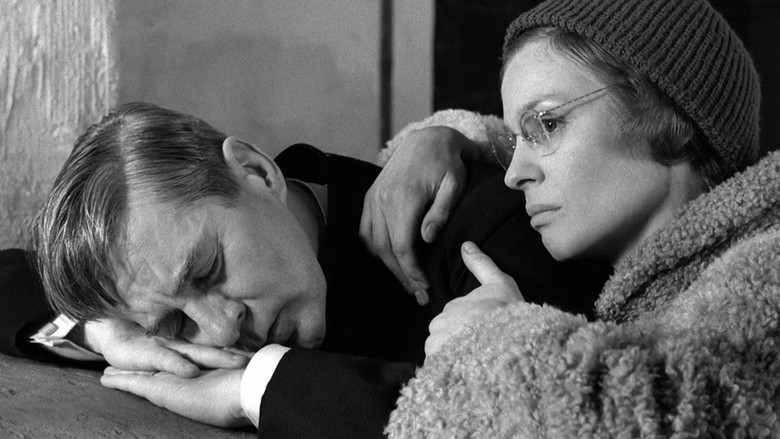
Tomas begins the film as a hollowed-out man, performing his pastoral duties without belief. His crisis deepens when confronted by Jonas's desperate need for faith, a need he cannot meet. He confesses his own atheism, leading to tragic consequences. Throughout the film, he is cruel to Märta, rejecting her love. His arc is not one of triumphant redemption. Instead, he moves from a quiet, internal crisis to an open admission of his emptiness. The final scene, where he chooses to hold a service for an audience of one, suggests a subtle shift. It's an ambiguous ending, but it can be interpreted as him finding a new, more honest foundation for his role: to continue the ritual for its own sake, as an act of will against the void, rather than out of a comforting but false belief.
Märta Lundberg
Ingrid Thulin
Motivation
Märta is motivated by a deep, persistent, and perhaps self-punishing love for Tomas. She seeks connection and companionship, a warmth that was present in her own non-religious upbringing. She endures his cruelty in the hope that he will eventually accept her love and find a way to live in the world without his crumbling faith.
Character Arc
Märta's arc is less about transformation and more about steadfast endurance. She starts as Tomas's devoted but rejected mistress and remains so. However, her character is deepened significantly through the reading of her letter, where she reveals the depth of her emotional pain and her clear-eyed assessment of Tomas's failings. Despite being an atheist, she shows more compassion and unconditional love than the pastor. Her decision to stay for the final service, despite being brutally rejected, represents a powerful, secular form of faith—a faith in another person, however flawed. She remains a symbol of worldly love challenging the relevance of divine love.
Jonas Persson
Max von Sydow
Motivation
Jonas is motivated by a desperate need for meaning and reassurance in a world that seems poised on the brink of meaningless destruction. He wants to believe in something that can stand against the absurdity of human cruelty and the threat of annihilation.
Character Arc
Jonas has a short but pivotal arc. He enters the story seeking spiritual guidance for his crippling fear of nuclear war. He looks to the church for answers but finds only a reflection of his own despair in the pastor. After Tomas confesses his own lack of faith and offers no hope, Jonas's despair is solidified. His arc concludes tragically with his suicide, serving as the catalyst that forces Tomas to confront the real-world consequences of his spiritual emptiness.
Algot Frövik
Allan Edwall
Motivation
Algot is motivated by a desire to understand and share his insights on the nature of suffering and faith. He has clearly spent a long time wrestling with these questions and seeks to connect with the pastor on this deeper level.
Character Arc
Algot is a minor character who appears late in the film but delivers a crucial perspective. As the church sexton, he is a physically deformed man who has contemplated scripture deeply. His arc is contained within a single, powerful conversation with Tomas. He reframes the entire film's spiritual debate by focusing on Christ's suffering, suggesting the most profound pain was not physical but the spiritual agony of feeling abandoned by God. He doesn't change, but he offers a new lens through which to view Tomas's struggle.
Cast
Explore More About This Movie
Dive deeper into specific aspects of the movie with our detailed analysis pages