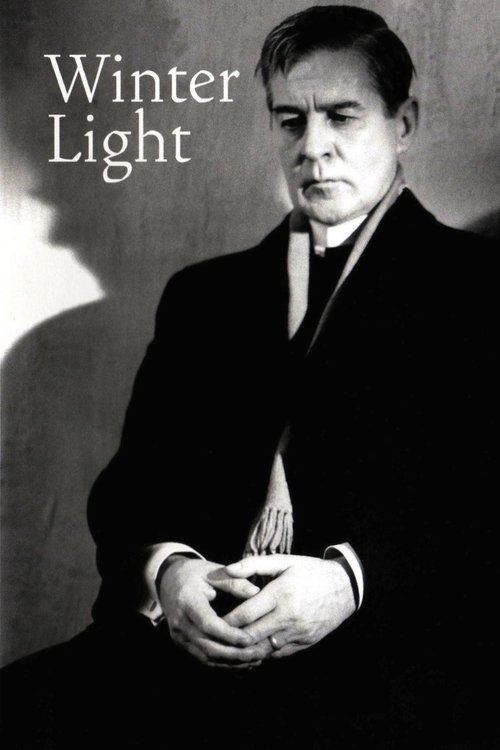
Winter Light
Nattvardsgästerna
Overview
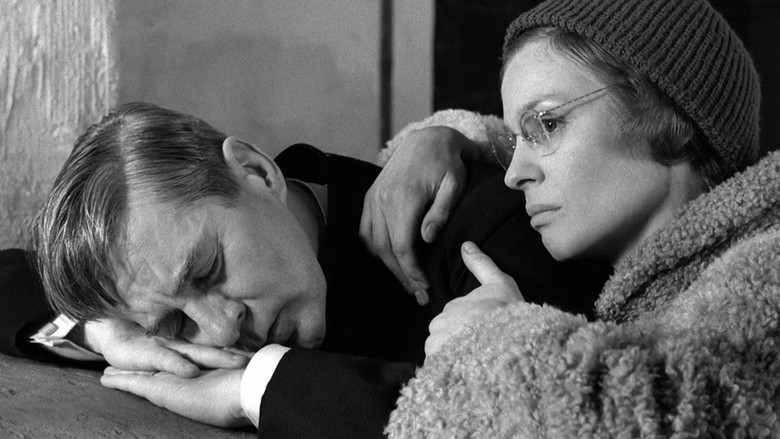
"Winter Light" (original title: "Nattvardsgästerna") chronicles a few stark hours in the life of Tomas Ericsson, a pastor in a small, rural Swedish village. Tomas is grappling with a profound crisis of faith, exacerbated by the recent death of his wife and his inability to connect with his parishioners or his devoted mistress, Märta Lundberg. The film opens with a sparsely attended church service, highlighting the dwindling relevance of religion in the community. His spiritual emptiness is put to the test when a local fisherman, Jonas Persson, seeks his counsel, terrified by the prospect of nuclear annihilation after reading about China's atomic bomb.
Unable to offer any genuine comfort, Tomas instead confesses his own doubt and the silence of God, pushing Jonas further into despair. He also cruelly rebuffs the persistent, loving advances of Märta, an atheist schoolteacher who sees his hypocrisy but loves him nonetheless. The narrative follows Tomas as he confronts the devastating consequences of his spiritual failure and navigates the cold indifference of the world around him, culminating in a decision to proceed with another service in an almost empty church, leaving his ultimate spiritual state ambiguous.
Core Meaning
"Winter Light" is a profound and deeply personal exploration of faith, doubt, and the perceived silence of God in a world filled with suffering. Director Ingmar Bergman uses the spiritual crisis of a single pastor to ask larger existential questions about the relevance of religion in the modern age, a time marked by anxieties like the Cold War. The film suggests that a faith based on egotism and a demand for a personal, loving God is bound to crumble in the face of human cruelty and indifference. Ultimately, the core meaning revolves around the struggle to find meaning and purpose in a seemingly godless universe. The film doesn't offer easy answers but instead explores the idea that perhaps the act of continuing one's duties, of performing the ritual even without certainty, is a form of courage and a potential path through despair. It's a meditation on whether human love and connection can fill the void left by God's absence.
Thematic DNA
The Silence of God
This is the central theme of the film, which is part of Bergman's informal "Silence of God" trilogy. Pastor Tomas is tormented by God's unresponsiveness to his prayers and the world's suffering. This silence is not just a lack of divine communication but a profound emptiness that mirrors Tomas's own emotional and spiritual desolation. He confesses to Jonas that God's silence makes the world's cruelty inexplicable under the premise of a loving deity, but sensible if God doesn't exist. The theme is further explored through Algot, the sexton, who posits that Christ's greatest suffering on the cross was not physical pain but the moment he felt abandoned by God, asking, "My God, my God, why have you forsaken me?"
Crisis of Faith
Tomas Ericsson's personal crisis of faith is the narrative's driving force. His belief system, once a source of comfort, has become a hollow ritual he performs mechanically. The crisis is triggered by his wife's death and compounded by his inability to offer solace to Jonas. He admits his faith was selfish, built on the idea that God loved him most of all. The film meticulously dissects the anatomy of doubt, showing how it can be fueled by personal loss, intellectual reasoning, and the overwhelming reality of global anxieties like nuclear war. Bergman uses Tomas's struggle to represent a broader societal shift away from unquestioning belief.
The Inability to Love
The film contrasts the concept of divine love with the complexities and failures of human love. Tomas is incapable of accepting the unconditional love offered by Märta, whom he treats with cruelty and emotional distance. His love for his late wife seems more an attachment to an idealized past than a present reality. For Tomas, the absence of God's love is mirrored in his own inability to love others. Märta, an atheist, ironically embodies a more Christ-like, persistent love, which Tomas rejects. The film questions the premise of its predecessor, "Through a Glass Darkly," that "God is love," suggesting that human relationships are just as fraught with silence and doubt as the divine one.
Existential Dread and Modern Anxiety
The character of Jonas Persson introduces the theme of modern existential dread. His despair is not caused by personal sin or misfortune, but by the abstract, overwhelming threat of nuclear war, specifically China's development of the atomic bomb. This grounds the film in a specific historical context—the height of the Cold War—and broadens the spiritual crisis from a purely theological debate to a confrontation with the anxieties of the modern world. Tomas's inability to counter this dread with faith highlights religion's struggle to provide meaningful answers to contemporary fears.
Character Analysis
Tomas Ericsson
Gunnar Björnstrand
Motivation
Initially, Tomas is motivated by a sense of duty and the lingering memory of a comfortable, self-serving faith he once had. As his crisis unfolds, his primary motivation becomes a desperate search for meaning, or at least an escape from the pain of God's silence. He is driven by his grief for his wife and his inability to reconcile his religious ideals with the harsh realities of the world.
Character Arc
Tomas begins the film as a hollowed-out man, performing his pastoral duties without belief. His crisis deepens when confronted by Jonas's desperate need for faith, a need he cannot meet. He confesses his own atheism, leading to tragic consequences. Throughout the film, he is cruel to Märta, rejecting her love. His arc is not one of triumphant redemption. Instead, he moves from a quiet, internal crisis to an open admission of his emptiness. The final scene, where he chooses to hold a service for an audience of one, suggests a subtle shift. It's an ambiguous ending, but it can be interpreted as him finding a new, more honest foundation for his role: to continue the ritual for its own sake, as an act of will against the void, rather than out of a comforting but false belief.
Märta Lundberg
Ingrid Thulin
Motivation
Märta is motivated by a deep, persistent, and perhaps self-punishing love for Tomas. She seeks connection and companionship, a warmth that was present in her own non-religious upbringing. She endures his cruelty in the hope that he will eventually accept her love and find a way to live in the world without his crumbling faith.
Character Arc
Märta's arc is less about transformation and more about steadfast endurance. She starts as Tomas's devoted but rejected mistress and remains so. However, her character is deepened significantly through the reading of her letter, where she reveals the depth of her emotional pain and her clear-eyed assessment of Tomas's failings. Despite being an atheist, she shows more compassion and unconditional love than the pastor. Her decision to stay for the final service, despite being brutally rejected, represents a powerful, secular form of faith—a faith in another person, however flawed. She remains a symbol of worldly love challenging the relevance of divine love.
Jonas Persson
Max von Sydow
Motivation
Jonas is motivated by a desperate need for meaning and reassurance in a world that seems poised on the brink of meaningless destruction. He wants to believe in something that can stand against the absurdity of human cruelty and the threat of annihilation.
Character Arc
Jonas has a short but pivotal arc. He enters the story seeking spiritual guidance for his crippling fear of nuclear war. He looks to the church for answers but finds only a reflection of his own despair in the pastor. After Tomas confesses his own lack of faith and offers no hope, Jonas's despair is solidified. His arc concludes tragically with his suicide, serving as the catalyst that forces Tomas to confront the real-world consequences of his spiritual emptiness.
Algot Frövik
Allan Edwall
Motivation
Algot is motivated by a desire to understand and share his insights on the nature of suffering and faith. He has clearly spent a long time wrestling with these questions and seeks to connect with the pastor on this deeper level.
Character Arc
Algot is a minor character who appears late in the film but delivers a crucial perspective. As the church sexton, he is a physically deformed man who has contemplated scripture deeply. His arc is contained within a single, powerful conversation with Tomas. He reframes the entire film's spiritual debate by focusing on Christ's suffering, suggesting the most profound pain was not physical but the spiritual agony of feeling abandoned by God. He doesn't change, but he offers a new lens through which to view Tomas's struggle.
Symbols & Motifs
The Winter Landscape
The cold, bleak, and sparse winter landscape serves as a powerful external reflection of Pastor Tomas's internal spiritual state: his emotional numbness, his dying faith, and the desolation of his soul. The 'winter light' itself is harsh, clear, and unforgiving, stripping away illusions and revealing a stark reality, much like the crisis Tomas undergoes.
The entire film is set against this backdrop. The shots of the snow-covered countryside, the bare trees, and the austere churches create a pervasive atmosphere of coldness and emptiness that mirrors the characters' inner lives.
The Empty Church
The nearly empty churches where Tomas holds his services symbolize the decline of faith and the waning influence of religion in the modern world. They represent a spiritual vacuum and the mechanical, ritualistic performance of belief without genuine conviction or community.
The film opens and closes with services attended by only a handful of people. In the final scene, Tomas resolves to hold the service even though only Märta is there to hear it, turning the empty space into a stage for a profound, albeit ambiguous, personal decision.
Physical Ailments
The various physical afflictions of the characters symbolize their spiritual and emotional suffering. Each ailment reflects a deeper-seated issue. Tomas's flu represents his soul-sickness and crisis of faith. Märta's eczema and poor eyesight relate to her emotional pain and her struggle to be truly 'seen' by Tomas. Algot's crippled body contrasts with his spiritual insight. Jonas's crippling anxiety manifests as a form of paralysis.
Throughout the film, characters are shown suffering from these ailments. Tomas is constantly coughing. Märta's letter details her struggle with a disfiguring rash and her glasses are a prominent feature. These physical details ground their abstract spiritual struggles in tangible, bodily suffering.
The 'Spider God'
The concept of a 'Spider God' represents a terrifying, monstrous, and silent deity that is born from suffering and doubt. It is the antithesis of the loving, comforting God Tomas once believed in. This image embodies the horror of a faith that, when confronted with the world's cruelty, transforms into a grotesque and malevolent force.
Tomas describes this vision, which directly references a similar concept in Bergman's previous film, "Through a Glass Darkly." He explains that when he tried to reconcile his faith with the atrocities he witnessed (like the Spanish Civil War), his God became this revolting spider-like monster.
Memorable Quotes
God, why have you forsaken me?
— Algot Frövik (quoting Jesus)
Context:
Towards the end of the film, just before the final service, Algot asks to speak with Tomas. He humbly offers his interpretation of the Passion, focusing on this line from the cross. It is a moment of unexpected clarity and insight that deeply affects Tomas and the audience.
Meaning:
This quote, delivered by the church sexton Algot, is the theological and emotional core of the film. He suggests that Christ's true suffering on the cross was not the physical pain, but the spiritual agony of God's silence—the feeling of being utterly abandoned. This re-frames Tomas's own crisis not as a failure of faith, but as a participation in the most profound moment of Christ's own suffering, thus humanizing both Jesus and the pastor's doubt.
Every time I confronted God with the realities I witnessed, he turned into something ugly and revolting. A spider God, a monster.
— Tomas Ericsson
Context:
Tomas says this to Jonas Persson during his failed attempt to offer the fisherman counsel. He is explaining the origins of his own doubt, tracing it back to his experiences as a chaplain during the Spanish Civil War and his inability to reconcile faith with reality.
Meaning:
This line encapsulates Tomas's loss of a comforting faith. It describes the horrifying transformation of a loving God into a grotesque, monstrous figure when faced with the undeniable suffering and cruelty of the world. It directly links "Winter Light" to "Through a Glass Darkly," which also uses the spider-god metaphor, and highlights the film's bleaker, more cynical response to the problem of evil.
I sought to shield Him from life, clutching my image of Him to myself in the dark.
— Tomas Ericsson
Context:
This line is part of Tomas's confession to Jonas, immediately following his description of the 'spider God.' He is admitting that his faith was an act of hiding from the world, rather than a way of understanding it, which ultimately led to its collapse.
Meaning:
This is a moment of profound self-realization for Tomas. He admits that his faith was not a robust engagement with the world but a fragile, private illusion that he had to protect from the harshness of reality. It shows his awareness that his belief was based on denial and egotism, rather than truth.
Philosophical Questions
What is the role of faith in a world of profound suffering and apparent divine silence?
The film relentlessly explores this question through Pastor Tomas's crisis. He cannot reconcile the concept of a loving God with the atrocities of war, personal loss, and the looming threat of nuclear annihilation. The 'silence of God' is the film's central motif, questioning whether faith is a meaningful response to suffering or simply a self-serving illusion. The film contrasts Tomas's failing faith with Märta's secular humanism, implicitly asking if human love and connection are a more viable alternative in a godless world.
Can one live a meaningful life without belief in God?
"Winter Light" presents this question through its main characters. Tomas, having lost his faith, feels his life has become meaningless. Conversely, Märta, an atheist, lives a life defined by her love for Tomas and her connection to her community, suggesting that meaning can be found in human relationships. The film doesn't provide a definitive answer but leaves the audience to ponder whether Tomas's final decision to continue his duties is a step towards finding a new, secular meaning in his rituals or a retreat into empty habit.
Is doubt an integral part of faith, or its negation?
Initially, Tomas views his doubt as a total failure and a sign of God's non-existence. However, the sexton Algot's monologue offers a different perspective. By suggesting that Jesus's greatest trial was feeling forsaken by God, the film posits that doubt and a sense of divine abandonment are not the opposites of faith, but perhaps its most profound and difficult expression. This challenges the viewer to consider whether a faith that has not been tested by doubt is any faith at all.
Alternative Interpretations
The ending of "Winter Light" is famously ambiguous and open to several interpretations. After Jonas's suicide and his cruel rejection of Märta, Tomas decides to proceed with the afternoon service, even though only Märta and the organist are present. The central question is what this final act signifies.
One interpretation is one of complete nihilism and defeat. In this view, Tomas has lost his faith entirely and is now just an empty shell, continuing his duties mechanically because it is all he knows how to do. His decision is an act of despair, a surrender to the meaninglessness he has discovered.
A second, more hopeful interpretation suggests that Tomas's decision is an act of existential courage. Stripped of his old, selfish faith, he chooses to perform his duty for the sake of humanity—for Märta, the one person who has remained. In this reading, he finds a new, secular purpose: the ritual itself becomes an act of love and service, not to a silent God, but to the person before him. Bergman himself alluded to this, stating a rule he followed: "Irrespective of everything, you will hold your Communion. It is important to the churchgoer, but even more important to you."
A third perspective synthesizes the two, suggesting that Tomas has not found new faith, but has accepted doubt as an intrinsic part of belief. By embracing the struggle, as Algot suggested Christ did on the cross, he can continue his work with a newfound, tragic honesty. His final act is not a solution to his crisis, but a decision to live within it.
Cultural Impact
"Winter Light" is regarded as one of Ingmar Bergman's most significant and austere works, a masterclass in minimalist, existential filmmaking. Created during the height of the Cold War, its depiction of existential dread resonated with a world anxious about nuclear annihilation. The film's direct and unflinching examination of a crisis of faith was groundbreaking and cemented Bergman's reputation as a foremost cinematic philosopher.
Its influence on cinema is profound, particularly on filmmakers exploring themes of faith and doubt. Paul Schrader's 2017 film "First Reformed" is widely seen as a direct homage to "Winter Light," borrowing its central premise of a troubled pastor, its austere visual style, and its engagement with contemporary anxieties. The film's stark black-and-white cinematography by Sven Nykvist became highly influential, demonstrating how visual austerity could powerfully convey psychological and spiritual states. Though not a commercial success upon release, its critical standing has grown immensely over the decades. It is now considered a cornerstone of art-house cinema, praised for its intellectual rigor, powerful performances, and Bergman's courage in confronting life's most difficult questions without offering easy answers.
Audience Reception
Upon its release, "Winter Light" was met with a mixed but generally respectful reception, with many finding its tone relentlessly bleak and challenging. However, its reputation has grown significantly over time, and it is now widely regarded by critics as a masterpiece and one of Bergman's most powerful and personal films. Audiences and critics alike praise the film's intellectual honesty, its stark and beautiful cinematography by Sven Nykvist, and the commanding performances, particularly by Gunnar Björnstrand and Ingrid Thulin. The long, unbroken close-up of Thulin reading Märta's letter is frequently cited as a legendary and emotionally shattering moment in cinema. The main points of criticism often revolve around its slow pace and unrelentingly grim subject matter, which some viewers find difficult to watch. Nevertheless, for those who connect with its themes of spiritual crisis and existential doubt, it is considered a profound, moving, and deeply rewarding cinematic experience.
Interesting Facts
- The film is considered the second in an unofficial trilogy by Ingmar Bergman, following "Through a Glass Darkly" (1961) and preceding "The Silence" (1963), all dealing with spiritual themes.
- Bergman was inspired to write the story after a conversation with a clergyman who had counseled a parishioner who later committed suicide.
- The film was shot by legendary cinematographer Sven Nykvist, whose work emphasizes the stark, natural light of the Swedish winter, contributing significantly to the film's bleak and austere atmosphere.
- Actor Gunnar Björnstrand, who played Pastor Tomas, was primarily known for comedic roles and found the dark, unlikable character challenging to portray. He reportedly fell ill during the shoot, which perhaps added to the authenticity of his performance.
- Vilgot Sjöman's documentary "Ingmar Bergman Makes a Movie" (L136) was filmed concurrently and documents the production of "Winter Light".
- Bergman considered "Winter Light" one of his most personal films, reflecting his own lifelong struggles with faith and his relationship with his Lutheran pastor father.
- The film is notable for its deliberate lack of a musical score, a choice that enhances the oppressive atmosphere and thematic silence.
- The idea for Jonas Persson's anxiety over China developing an atomic bomb came from an article Bergman himself had read, reflecting his own fears during the Cold War.
⚠️ Spoiler Analysis
Click to reveal detailed analysis with spoilers
Frequently Asked Questions
Explore More About This Movie
Dive deeper into specific aspects of the movie with our detailed analysis pages
Comments (0)
No comments yet. Be the first to share your thoughts!