"The most electrifying entertainment of our time!"
Witness for the Prosecution - Symbolism & Philosophy
Symbols & Motifs
Sir Wilfrid's Monocle
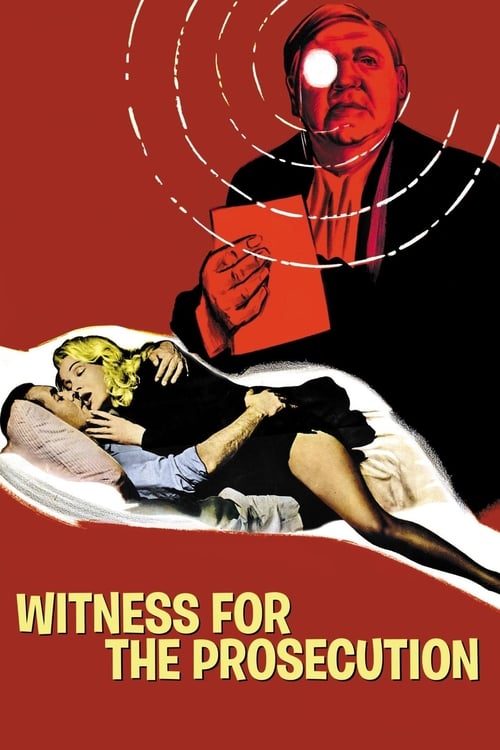
The monocle symbolizes Sir Wilfrid's attempt to achieve clarity, insight, and judgment. He uses it to scrutinize witnesses, believing it helps him see through deception. However, it also represents a flawed, single-lensed perspective. In the end, despite his 'monocle test,' he is completely deceived by Christine and Leonard, showing that his trusted tool for perception can be fooled, symbolizing the limitations of his and the justice system's ability to see the whole truth.
Sir Wilfrid uses the monocle throughout the film, most notably during his initial assessment of Leonard Vole and during intense cross-examinations in the courtroom. He holds it up to catch the light, creating a glint that he believes reveals a person's honesty or dishonesty. Charles Laughton based this mannerism on his own lawyer, who used a monocle to intimidate witnesses.
Cigars and Brandy
The cigars and brandy, forbidden by his nurse, symbolize Sir Wilfrid's defiance, his intellect, and his indulgence in the vices that accompany his high-stakes profession. They are his small acts of rebellion against the restrictive, 'healthy' life Miss Plimsoll tries to enforce. Sneaking a cigar or a sip of brandy is akin to him taking on a dangerous case against medical advice; it is a necessary risk that fuels his brilliance and ultimately keeps him engaged with life.
Sir Wilfrid is constantly trying to outwit his nurse, Miss Plimsoll, to get his hands on his cigars. He hides them in his cane and has his staff help him procure them. His thermos, which is supposed to contain cocoa, is often secretly filled with brandy, a fact Miss Plimsoll is keenly aware of.
Christine's Disguise
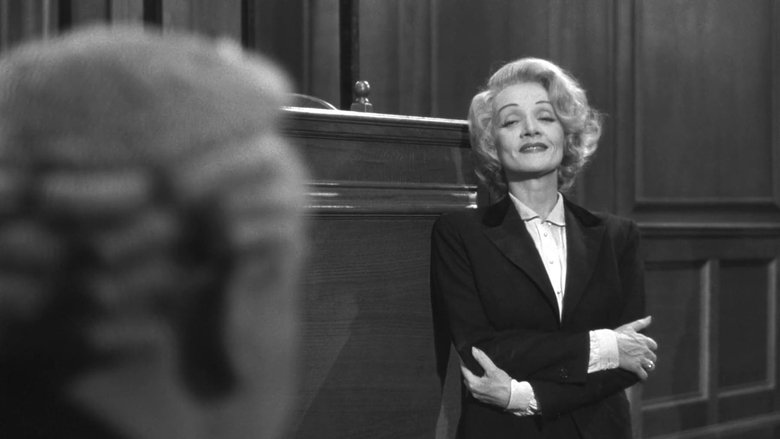
Christine's physical transformation into a coarse, Cockney woman symbolizes the multifaceted nature of her identity and the theme of deception. The disguise is not just a costume; it's a complete performance that allows her to manipulate the justice system from the inside. It proves that identity and truth are fluid and can be fabricated to achieve a desired outcome, completely fooling the discerning Sir Wilfrid and the entire court.
Towards the end of the trial, Sir Wilfrid receives a mysterious phone call from a woman claiming to have letters written by Christine. He meets her at the train station, where he finds a heavily disguised woman with a Cockney accent who sells him the letters. It is revealed in the final twist that this woman was Christine herself, a performance so convincing that even the audience is unlikely to recognize her.
Philosophical Questions
Is it morally justifiable to commit a crime (perjury) to achieve a perceived 'greater good' (saving a loved one)?
The film explores this through Christine's actions. She constructs an elaborate web of lies, committing serious crimes in the eyes of the law, all motivated by love and the belief that she is saving an innocent man. The film initially positions the audience to sympathize with her cleverness. However, the revelation that Leonard is guilty complicates this question immensely. Her actions did not save an innocent man but freed a guilty one. The film leaves the audience to grapple with whether her intentions absolve her actions, especially when they lead to a miscarriage of justice.
What is the true nature of justice: adherence to legal process or the achievement of a moral outcome?
"Witness for the Prosecution" presents a stark conflict between procedural justice and moral justice. The court acquits Leonard, following the letter of the law based on the (manipulated) evidence presented. This is a legal victory but a moral failure. Christine then delivers her own form of justice by killing Leonard in the courtroom. This act is illegal but, for many viewers, feels morally satisfying. The film forces the question of which outcome is truly 'just' and suggests that the legal system is merely a flawed tool, incapable of guaranteeing a truly moral result.
How reliable is human perception and testimony in the pursuit of truth?
The entire plot hinges on the unreliability of what characters see and say. Sir Wilfrid, a master at reading people, is completely wrong in his assessment of both Leonard and Christine. The jury is swayed by compelling performances rather than facts. Christine's testimony is a masterwork of truthful statements intended to create a false impression. The film powerfully argues that objective truth is incredibly difficult to ascertain in a system that relies on subjective human accounts, which can be clouded by emotion, bias, and deliberate deception.
Core Meaning
At its heart, "Witness for the Prosecution" explores the fallibility and subjectivity of justice, demonstrating how the legal system can be brilliantly manipulated. The film posits that the truth is not always what is presented in a courtroom; rather, a verdict can be the result of masterful performance and deception. It delves into the dark complexities of human nature, questioning how well we can truly know another person and the extraordinary lengths people will go for love, revenge, and self-preservation. Ultimately, the director suggests that legal justice and moral truth are not always aligned, and the courtroom itself is a theater where the most convincing actor wins.