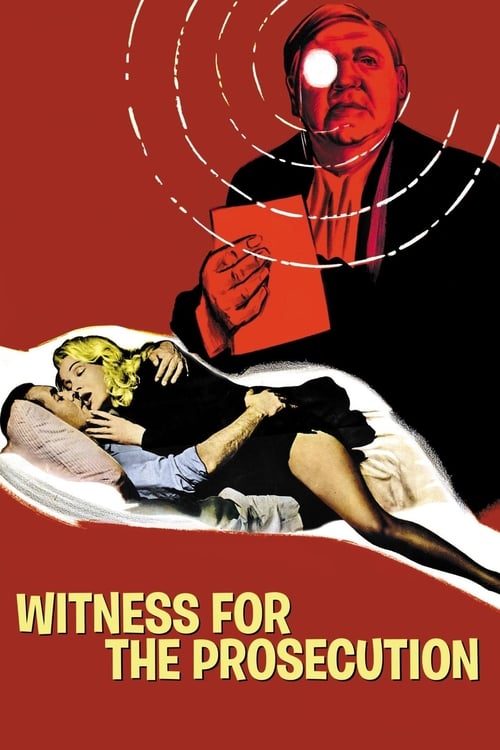
Witness for the Prosecution
A a labyrinthine courtroom drama, this film noir unwraps deception like a fine cigar, leaving a lingering ash of moral ambiguity.
Witness for the Prosecution

Witness for the Prosecution

"The most electrifying entertainment of our time!"

17 December 1957 United States of America 116 min ⭐ 8.2 (1,549)
Director: Billy Wilder
Cast: Tyrone Power, Marlene Dietrich, Charles Laughton, Elsa Lanchester, John Williams
Drama Crime Mystery
Deception and Manipulation The Fallibility of Justice Love and Betrayal Perception vs. Reality
Budget: $3,000,000
Box Office: $9,000,000

Overview

"Witness for the Prosecution" centers on the brilliant London barrister Sir Wilfrid Robarts (Charles Laughton), who, against doctor's orders after a heart attack, takes on the defense of Leonard Vole (Tyrone Power). Vole, a charming but unemployed inventor, is accused of murdering a wealthy widow, Emily French, who had made him the sole heir to her fortune. The circumstantial evidence against Vole is damning.

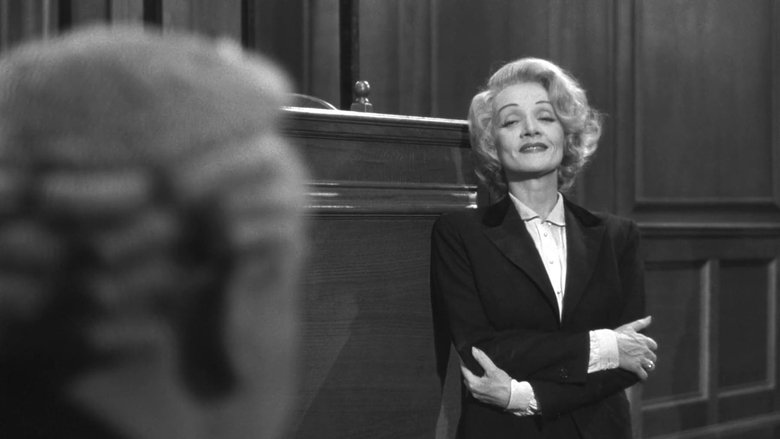
Sir Wilfrid's confidence in his client's innocence is shaken when he meets Vole's cold and enigmatic German wife, Christine (Marlene Dietrich). Her behavior is perplexing, and the case takes a stunning turn when she is called not for the defense, but as a witness for the prosecution. The ensuing trial becomes a masterclass in legal maneuvering and psychological gamesmanship, filled with shocking testimony and revelations that challenge the very notions of truth and justice, leading to one of cinema's most famous twist endings.

Core Meaning

At its heart, "Witness for the Prosecution" explores the fallibility and subjectivity of justice, demonstrating how the legal system can be brilliantly manipulated. The film posits that the truth is not always what is presented in a courtroom; rather, a verdict can be the result of masterful performance and deception. It delves into the dark complexities of human nature, questioning how well we can truly know another person and the extraordinary lengths people will go for love, revenge, and self-preservation. Ultimately, the director suggests that legal justice and moral truth are not always aligned, and the courtroom itself is a theater where the most convincing actor wins.

Thematic DNA

Deception and Manipulation 35%
The Fallibility of Justice 30%
Love and Betrayal 25%
Perception vs. Reality 10%

Deception and Manipulation

This is the central theme of the film. Nearly every character is engaged in some form of deception. Christine Vole masterfully manipulates the entire court, including the brilliant Sir Wilfrid, by playing the part of a cold, treacherous wife to discredit her own damning testimony. Leonard Vole, in turn, manipulates Christine with his seemingly earnest love. The film is a complex web of lies, disguises, and staged performances, highlighting how easily perceptions of truth can be molded and controlled.

The Fallibility of Justice

The film scrutinizes the integrity of the legal system. Sir Wilfrid, an embodiment of the law, uses every tool at his disposal, from theatrical cross-examinations to exploiting loopholes, to win his case. However, the shocking ending reveals that the 'not guilty' verdict is based on a foundation of perjury and elaborate staging, not on factual innocence. This suggests that the adversarial nature of the courtroom is a flawed mechanism for discovering absolute truth, vulnerable to human emotion and deceit.

Love and Betrayal

The film presents a cynical view of romantic relationships. Christine's initial actions are driven by an obsessive love for Leonard, a love so powerful she is willing to orchestrate a complex deception and risk perjury to save him. However, this devotion is met with the ultimate betrayal when Leonard reveals his infidelity and true, callous nature immediately after his acquittal. Her love then turns instantly to vengeful rage, culminating in a final, fatal act that serves as its own form of justice.

Perception vs. Reality

Throughout the film, what appears to be true is constantly challenged. Leonard Vole seems to be a charming, naïve victim. Christine appears to be a cold, untrustworthy foreigner. Sir Wilfrid appears to be in complete control. The film uses these assumptions against the audience, employing Sir Wilfrid's monocle as a literal and metaphorical lens through which truth is filtered and distorted. The final twists force a re-evaluation of everything that has transpired, proving that reality was far more complex than perceived.

Character Analysis

Sir Wilfrid Robarts

Charles Laughton

Archetype: The Mentor / Wounded Healer
Key Trait: Cynical Brilliance

Motivation

His primary motivation is the intellectual challenge of a seemingly impossible case. Restricted by his health, he craves the thrill and mental stimulation of the courtroom, which he sees as his true purpose. He is driven by a belief in his own superior ability to discern truth and manipulate the legal system to serve what he believes is justice.

Character Arc

Sir Wilfrid begins as a brilliant, cynical, and seemingly infallible barrister, albeit one weakened by a heart attack. His arc is one of intellectual pride leading to a fall. He takes Leonard's case out of a desire to prove his mind is still sharp. He masterfully conducts the defense, believing he has uncovered the truth and outsmarted the prosecution. The final revelation that he was merely a pawn in Christine's elaborate game shatters his self-assurance, leaving him humbled but also invigorated to take on a new, more just cause: defending Christine.

Christine Vole/Helm

Marlene Dietrich

Archetype: The Femme Fatale / The Trickster
Key Trait: Masterful Deceiver

Motivation

Her sole motivation is her all-consuming love for Leonard Vole. She is willing to commit perjury, create an elaborate deception, and sacrifice her own freedom to ensure his. When that motivation is destroyed by his betrayal, it is instantly replaced by a powerful desire for revenge.

Character Arc

Christine is introduced as a cold, enigmatic German wife. Her arc is a series of calculated transformations. She first appears as a potential alibi, then transforms into a vindictive, hateful witness for the prosecution, and later a disguised Cockney informant. The final twist reveals her true arc: a deeply devoted lover who masterminded the entire plot to save her husband. This image is shattered in the final moments when, upon discovering his betrayal, she transforms once more into an agent of immediate, violent justice. She is consistently underestimated and proves to be the most intelligent and ruthless character in the film.

Leonard Vole

Tyrone Power

Archetype: The Innocent / The Shadow
Key Trait: Duplicitous Charm

Motivation

Initially, his motivation appears to be survival and proving his innocence. However, his true motivations are greed (for Mrs. French's inheritance) and self-preservation at any cost. He is driven by a sociopathic ability to manipulate those around him, particularly women who love him, for his own gain.

Character Arc

Leonard Vole presents himself as a charming, likable, and slightly naive man wrongfully accused of a terrible crime. Throughout the trial, he maintains this persona of the innocent victim, gaining the trust of Sir Wilfrid and the sympathy of the audience. His arc is a complete inversion upon his acquittal. The mask of innocence drops to reveal a smug, cold-blooded murderer who not only killed Mrs. French but also callously used his wife's devotion. This shocking reveal recasts his entire performance as a masterful deception.

Miss Plimsoll

Elsa Lanchester

Archetype: The Guardian / The Comic Relief
Key Trait: Overzealous Care

Motivation

Her motivation is simple and unwavering: to keep Sir Wilfrid Robarts alive by enforcing his doctor's strict regimen. She is dedicated to her professional duty, even in the face of Sir Wilfrid's constant attempts to undermine her authority regarding his cigars, brandy, and workload.

Character Arc

Miss Plimsoll is Sir Wilfrid's fiercely protective and overbearing private nurse. Her character does not have a significant arc but serves as a constant and necessary foil to Sir Wilfrid. She is the guardian of his health, engaging in a continuous battle of wits with her cantankerous patient. Their comedic sparring, a highlight of the film, was enhanced by the fact that actors Charles Laughton and Elsa Lanchester were married in real life.

Symbols & Motifs

Sir Wilfrid's Monocle

Meaning:

The monocle symbolizes Sir Wilfrid's attempt to achieve clarity, insight, and judgment. He uses it to scrutinize witnesses, believing it helps him see through deception. However, it also represents a flawed, single-lensed perspective. In the end, despite his 'monocle test,' he is completely deceived by Christine and Leonard, showing that his trusted tool for perception can be fooled, symbolizing the limitations of his and the justice system's ability to see the whole truth.

Context:

Sir Wilfrid uses the monocle throughout the film, most notably during his initial assessment of Leonard Vole and during intense cross-examinations in the courtroom. He holds it up to catch the light, creating a glint that he believes reveals a person's honesty or dishonesty. Charles Laughton based this mannerism on his own lawyer, who used a monocle to intimidate witnesses.

Cigars and Brandy

Meaning:

The cigars and brandy, forbidden by his nurse, symbolize Sir Wilfrid's defiance, his intellect, and his indulgence in the vices that accompany his high-stakes profession. They are his small acts of rebellion against the restrictive, 'healthy' life Miss Plimsoll tries to enforce. Sneaking a cigar or a sip of brandy is akin to him taking on a dangerous case against medical advice; it is a necessary risk that fuels his brilliance and ultimately keeps him engaged with life.

Context:

Sir Wilfrid is constantly trying to outwit his nurse, Miss Plimsoll, to get his hands on his cigars. He hides them in his cane and has his staff help him procure them. His thermos, which is supposed to contain cocoa, is often secretly filled with brandy, a fact Miss Plimsoll is keenly aware of.

Christine's Disguise

Meaning:

Christine's physical transformation into a coarse, Cockney woman symbolizes the multifaceted nature of her identity and the theme of deception. The disguise is not just a costume; it's a complete performance that allows her to manipulate the justice system from the inside. It proves that identity and truth are fluid and can be fabricated to achieve a desired outcome, completely fooling the discerning Sir Wilfrid and the entire court.

Context:

Towards the end of the trial, Sir Wilfrid receives a mysterious phone call from a woman claiming to have letters written by Christine. He meets her at the train station, where he finds a heavily disguised woman with a Cockney accent who sells him the letters. It is revealed in the final twist that this woman was Christine herself, a performance so convincing that even the audience is unlikely to recognize her.

Memorable Quotes

I never faint because I am not sure that I will fall gracefully, and I never use smelling salts because they puff up the eyes. I am Christine Vole.

— Christine Vole

Context:

Sir Wilfrid has just instructed his colleague to be gentle with Mrs. Vole, expecting her to be fragile and prone to fainting upon hearing of her husband's arrest. Christine, having overheard him from the doorway, steps in and delivers this line coolly, shattering their preconceived notions.

Meaning:

This line, delivered upon her first entrance, immediately establishes Christine's character. It shows she is controlled, pragmatic, and completely unflappable, subverting the expectation of a hysterical, emotional wife. It's a declaration of her strength and self-possession, hinting at the calculated mind that will drive the film's plot.

The question is, were you lying then, are you lying now, or are you not in fact a chronic and habitual LIAR!

— Sir Wilfrid Robarts

Context:

During the trial, after Christine has given damning evidence against her husband, Sir Wilfrid relentlessly attacks her credibility on the stand. He builds his argument to this thundering accusation, which causes Christine to break down in apparent distress.

Meaning:

This is the climactic moment of Sir Wilfrid's cross-examination of Christine. It is deeply ironic, as he is accusing her of being a liar, which she is, but her entire deception is designed to make the jury believe this very accusation, thus discrediting her testimony against Leonard. He thinks he is exposing her, but he is actually playing directly into her hands.

If I had known how much you talk, I'd never have come out of my coma.

— Sir Wilfrid Robarts

Context:

This is one of many sharp remarks Sir Wilfrid directs at Miss Plimsoll as she fusses over his health and attempts to enforce his doctor's orders. It's said in a moment of frustration at her constant chatter and overbearing care.

Meaning:

This quote perfectly encapsulates the witty, acerbic relationship between Sir Wilfrid and his nurse, Miss Plimsoll. It's a prime example of the humor Billy Wilder injected into the script, providing levity amidst the tense courtroom drama and defining their affectionately combative dynamic.

We try not to make a habit of it.

— Sir Wilfrid Robarts

Context:

Leonard Vole, upon being accused, expresses his faith in the English justice system, saying, "But this is England, where I thought you never arrest, let alone convict, people for crimes they have not committed." Sir Wilfrid delivers this line as a wry, sobering response.

Meaning:

This is a dry, witty, and quintessentially British understatement that reflects Sir Wilfrid's cynical view of the justice system. While seemingly reassuring Leonard, it carries a world-weary undertone, suggesting that while the system strives for fairness, wrongful convictions are not an impossibility. It subtly hints at the fallibility of justice that the film goes on to explore.

Philosophical Questions

Is it morally justifiable to commit a crime (perjury) to achieve a perceived 'greater good' (saving a loved one)?

The film explores this through Christine's actions. She constructs an elaborate web of lies, committing serious crimes in the eyes of the law, all motivated by love and the belief that she is saving an innocent man. The film initially positions the audience to sympathize with her cleverness. However, the revelation that Leonard is guilty complicates this question immensely. Her actions did not save an innocent man but freed a guilty one. The film leaves the audience to grapple with whether her intentions absolve her actions, especially when they lead to a miscarriage of justice.

What is the true nature of justice: adherence to legal process or the achievement of a moral outcome?

"Witness for the Prosecution" presents a stark conflict between procedural justice and moral justice. The court acquits Leonard, following the letter of the law based on the (manipulated) evidence presented. This is a legal victory but a moral failure. Christine then delivers her own form of justice by killing Leonard in the courtroom. This act is illegal but, for many viewers, feels morally satisfying. The film forces the question of which outcome is truly 'just' and suggests that the legal system is merely a flawed tool, incapable of guaranteeing a truly moral result.

How reliable is human perception and testimony in the pursuit of truth?

The entire plot hinges on the unreliability of what characters see and say. Sir Wilfrid, a master at reading people, is completely wrong in his assessment of both Leonard and Christine. The jury is swayed by compelling performances rather than facts. Christine's testimony is a masterwork of truthful statements intended to create a false impression. The film powerfully argues that objective truth is incredibly difficult to ascertain in a system that relies on subjective human accounts, which can be clouded by emotion, bias, and deliberate deception.

Alternative Interpretations

While the film's ending is presented as a definitive series of twists, some interpretations focus on the psychological state of Christine Vole. One reading suggests that her actions are not solely born of rational, devoted love, but of a deeply obsessive and unstable attachment. Her immediate switch from selfless devotion to homicidal rage could be seen as evidence of a borderline personality, where love and hate are two sides of the same coin. From this perspective, her 'justice' is not a calculated act of revenge but an emotional, impulsive explosion.

Another interpretation centers on Sir Wilfrid. His decision to defend Christine at the end is presented as him taking on a new, righteous cause. However, it can also be read more cynically. Having been thoroughly fooled and his professional pride shattered, defending Christine is his only way to regain control of the narrative and prove his legal brilliance once more. It is less about justice for Christine and more about redemption for his own ego, demonstrating that even in his final act, his motivations are tied to the thrill of the legal game.

Cultural Impact

"Witness for the Prosecution" is widely regarded as one of the greatest courtroom dramas in cinema history. It set a benchmark for the genre with its intricate plotting, sharp dialogue, and a shocking double-twist ending that has become legendary. The film's success solidified Agatha Christie's reputation as a master storyteller whose work could be brilliantly translated to the screen.

Its influence can be seen in numerous legal thrillers that followed, which adopted its model of suspense, misdirection, and courtroom theatrics. The marketing campaign, which implored audiences to keep the ending a secret, was innovative for its time and pre-dated Alfred Hitchcock's similar strategy for "Psycho" (1960), helping to pioneer the concept of a "spoiler-free" viewing experience. The American Film Institute ranked it the #6 best courtroom drama of all time. The film received six Academy Award nominations, including Best Picture, Best Director, Best Actor (Laughton), and Best Supporting Actress (Lanchester), cementing its place as a classic of Hollywood's Golden Age.

Audience Reception

"Witness for the Prosecution" was a commercial and critical success upon its release and continues to be held in high regard by audiences. Viewers consistently praise the film for its clever, intricate plot, sharp and witty dialogue (a trademark of Billy Wilder), and the tour-de-force performances, especially from Charles Laughton and Marlene Dietrich. The film's double-twist ending is universally cited as one of the best in film history and is the most discussed aspect of the movie. Audiences enjoy the masterful build-up of suspense and the shocking, yet satisfying, payoff. The comedic subplot involving Sir Wilfrid and his nurse, Miss Plimsoll, is also frequently highlighted as a beloved element that provides perfect comic relief. There is very little criticism of the film; it is widely considered a near-perfect example of the courtroom drama genre.

Interesting Facts

  • The film's ending was a closely guarded secret. Director Billy Wilder did not give the actors the final ten pages of the script until it was time to shoot those scenes.
  • At the end of the film's theatrical run, a voice-over narrator asked audiences not to divulge the twist ending to friends.
  • Actors Charles Laughton (Sir Wilfrid) and Elsa Lanchester (Miss Plimsoll) were married in real life. This was their last film together.
  • Marlene Dietrich was so convinced she would receive an Academy Award nomination for her role that she pre-recorded an introduction for her Las Vegas show mentioning it. She was not nominated.
  • This was the last completed film for Tyrone Power, who died of a heart attack the following year during the filming of 'Solomon and Sheba'.
  • Agatha Christie herself considered this film the best adaptation of her work.
  • The character of Miss Plimsoll, the nurse, was created for the film and was not in Agatha Christie's original play, adding a significant comedic element.
  • Billy Wilder agreed to direct the film only if Marlene Dietrich was cast as Christine. Dietrich, in turn, had told the producers she would only take the part if Wilder directed.
  • The courtroom set was an exact replica of a courtroom in London's Old Bailey, costing $75,000 to build in 1957.

⚠️ Spoiler Analysis

Click to reveal detailed analysis with spoilers

Frequently Asked Questions

Explore More About This Movie

Dive deeper into specific aspects of the movie with our detailed analysis pages

Comments (0)

Leave a comment

No comments yet. Be the first to share your thoughts!